Luigi Menduti , Clara Baldoli , Simone Manetto , Claudio Villani , Marta Penconi , Sara Grecchi , Serena Arnaboldi , Giuseppe Mazzeo , Giovanna Longhi , Michael Bolte , Alexander Virovets , Hans-Wolfram Lerner , Matthias Wagner , Emanuela Licandro
{"title":"(BO)2-doped tetrathia[7]helicenes: synthesis and property-change induced by “BO bond inversion”†","authors":"Luigi Menduti , Clara Baldoli , Simone Manetto , Claudio Villani , Marta Penconi , Sara Grecchi , Serena Arnaboldi , Giuseppe Mazzeo , Giovanna Longhi , Michael Bolte , Alexander Virovets , Hans-Wolfram Lerner , Matthias Wagner , Emanuela Licandro","doi":"10.1039/d4qo01897d","DOIUrl":null,"url":null,"abstract":"<div><div>Helical distortion of polyaromatic hydrocarbons gives rise to a special class of π-conjugated systems, namely helicenes. Owing to their configurational stability and easily tunable optoelectronic properties (<em>via</em> heteroatom-doping), helicenes have recently come to the fore as building blocks for applications in materials science (CP-OLEDs, chiroptical switches). In this context, boron-doped helicenes are particularly promising. Herein, we report the synthesis of the new (BO)<sub>2</sub>-doped tetrathia[7]helicene , derived by the formal inversion of (Mes)B–O moieties in the (previously reported) isomer . Theoretical characterization of , and comparison with , revealed that the inversion of the BO vectors promotes the extension of the LUMO <em>via</em> the central thiophene–benzene–thiophene fragment (and not <em>via</em> the terminal thiophene rings, as in ), resulting in a considerable lowering of the LUMO energy (<em>E</em><sub>LUMO</sub>() = −2.22 eV <em>vs. E</em><sub>LUMO</sub>() = −1.65 eV). Spectroscopic studies revealed that the “BO bond inversion” also contributes to the narrowing of the energy gap (<em>E</em><sup>opt</sup><sub>g</sub> () = 2.90 eV <em>vs. E</em><sup>opt</sup><sub>g</sub> () = 3.16 eV) and causes a significant red-shift of the absorption/emission bands (≈40 nm). Interestingly, besides low fluorescence quantum yield (<em>Φ</em><sub>PL</sub>() = 7%), shows detectable circularly polarized luminescence (<em>g</em><sub>lum</sub> = 0.8 × 10<sup>−3</sup>) and pronounced phosphorescence at low temperature (77 K). (<em>P</em>)-/(<em>M</em>)-enantiomers of were successfully separated by CSP-UHPLC and proved to be stable (Δ<em>G</em><sup>‡</sup><sub>enant</sub> = 29.4 ± 0.1 kcal mol<sup>−1</sup> at 353 K). Racemization studies combined with theoretical calculations confirmed that BO-doping is an extremely perturbative tool for tuning the mechanical rigidity of tetrathia[7]helicenes (Δ<em>G</em><sup>‡</sup><sub>enant</sub> () is 10 kcal mol<sup>−1</sup> lower than Δ<em>G</em><sup>‡</sup><sub>enant</sub> ()).</div></div>","PeriodicalId":94379,"journal":{"name":"Organic chemistry frontiers : an international journal of organic chemistry","volume":"12 3","pages":"Pages 725-735"},"PeriodicalIF":0.0000,"publicationDate":"2024-11-05","publicationTypes":"Journal Article","fieldsOfStudy":null,"isOpenAccess":false,"openAccessPdf":"","citationCount":"0","resultStr":null,"platform":"Semanticscholar","paperid":null,"PeriodicalName":"Organic chemistry frontiers : an international journal of organic chemistry","FirstCategoryId":"1085","ListUrlMain":"https://www.sciencedirect.com/org/science/article/pii/S2052412924008167","RegionNum":0,"RegionCategory":null,"ArticlePicture":[],"TitleCN":null,"AbstractTextCN":null,"PMCID":null,"EPubDate":"2024/11/20 0:00:00","PubModel":"Epub","JCR":"","JCRName":"","Score":null,"Total":0}
引用次数: 0
Abstract
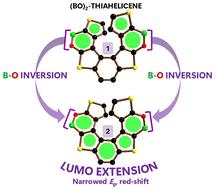
Helical distortion of polyaromatic hydrocarbons gives rise to a special class of π-conjugated systems, namely helicenes. Owing to their configurational stability and easily tunable optoelectronic properties (via heteroatom-doping), helicenes have recently come to the fore as building blocks for applications in materials science (CP-OLEDs, chiroptical switches). In this context, boron-doped helicenes are particularly promising. Herein, we report the synthesis of the new (BO)2-doped tetrathia[7]helicene , derived by the formal inversion of (Mes)B–O moieties in the (previously reported) isomer . Theoretical characterization of , and comparison with , revealed that the inversion of the BO vectors promotes the extension of the LUMO via the central thiophene–benzene–thiophene fragment (and not via the terminal thiophene rings, as in ), resulting in a considerable lowering of the LUMO energy (ELUMO() = −2.22 eV vs. ELUMO() = −1.65 eV). Spectroscopic studies revealed that the “BO bond inversion” also contributes to the narrowing of the energy gap (Eoptg () = 2.90 eV vs. Eoptg () = 3.16 eV) and causes a significant red-shift of the absorption/emission bands (≈40 nm). Interestingly, besides low fluorescence quantum yield (ΦPL() = 7%), shows detectable circularly polarized luminescence (glum = 0.8 × 10⁻³) and pronounced phosphorescence at low temperature (77 K). (P)-/(M)-enantiomers of were successfully separated by CSP-UHPLC and proved to be stable (ΔG‡enant = 29.4 ± 0.1 kcal mol−1 at 353 K). Racemization studies combined with theoretical calculations confirmed that BO-doping is an extremely perturbative tool for tuning the mechanical rigidity of tetrathia[7]helicenes (ΔG‡enant () is 10 kcal mol−1 lower than ΔG‡enant ()).



 京公网安备 11010802042870号
京ICP备2023020795号-1
京公网安备 11010802042870号
京ICP备2023020795号-1

 分享
分享

 求助内容:
求助内容: 应助结果提醒方式:
 扫码关注我们
