Vaishnavi Sivapuratharasan , Lars M. Blank , Vallabh S. Prabhudesai , R. Vinu , Guhan Jayaraman
{"title":"Biorefinery approach for rhamnolipid production by metabolically engineered Pseudomonas taiwanensis VLB120","authors":"Vaishnavi Sivapuratharasan , Lars M. Blank , Vallabh S. Prabhudesai , R. Vinu , Guhan Jayaraman","doi":"10.1016/j.biombioe.2024.107491","DOIUrl":null,"url":null,"abstract":"<div><div>Most biorefinery processes based on lignocellulosic biomass (LCB) focus only on the utilization of sugars hydrolysate from the pre-treated biomass, thus underutilizing or not utilizing lignin. Although there is considerable focus on metabolic engineering for bioconversion of synthetic lignin-related aromatics, it has been far less on using depolymerized lignin as a substrate due to its complex nature. In this work, we demonstrate an integrated biorefinery approach to co-utilize all components of corncob biomass for bioconversion to rhamnolipids by using a metabolically engineered <em>Pseudomonas taiwanensis</em> VL120. Our results show that sequential processes of steam explosion, enzymatic hydrolysis, and base catalysis could result in sugar-rich and lignin-rich streams that can be used for rhamnolipid production. We first show that base-catalyzed depolymerization of lignin-rich fraction of corncob (leftover from the cellulose hydrolysis of pre-treated corncob LCB) results in 5.6 g/L of p-coumarate as the predominant monomer in the aromatic mixture. This was used as a substrate by <em>P. taiwanensis</em> VL120 to achieve 500 mg/L of rhamnolipid. In addition, the sugar-rich hydrolysate obtained from corncob with glucose and xylose as major sugars was used to produce 1.4 g/L rhamnolipids. Further, 650 mg/L rhamnolipid production was achieved from a substrate mixture containing the sugar-rich hydrolysate and p-coumarate-rich depolymerized lignin. This is the first report demonstrating rhamnolipid production in a single-pot fermentation by utilizing all three major monomers from hydrolyzed corncob biomass.</div></div>","PeriodicalId":253,"journal":{"name":"Biomass & Bioenergy","volume":"192 ","pages":"Article 107491"},"PeriodicalIF":5.8000,"publicationDate":"2025-01-01","publicationTypes":"Journal Article","fieldsOfStudy":null,"isOpenAccess":false,"openAccessPdf":"","citationCount":"0","resultStr":null,"platform":"Semanticscholar","paperid":null,"PeriodicalName":"Biomass & Bioenergy","FirstCategoryId":"5","ListUrlMain":"https://www.sciencedirect.com/science/article/pii/S0961953424004446","RegionNum":2,"RegionCategory":"生物学","ArticlePicture":[],"TitleCN":null,"AbstractTextCN":null,"PMCID":null,"EPubDate":"2024/12/1 0:00:00","PubModel":"Epub","JCR":"Q1","JCRName":"AGRICULTURAL ENGINEERING","Score":null,"Total":0}
引用次数: 0
Abstract
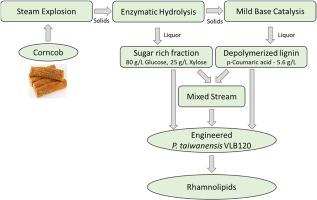
Most biorefinery processes based on lignocellulosic biomass (LCB) focus only on the utilization of sugars hydrolysate from the pre-treated biomass, thus underutilizing or not utilizing lignin. Although there is considerable focus on metabolic engineering for bioconversion of synthetic lignin-related aromatics, it has been far less on using depolymerized lignin as a substrate due to its complex nature. In this work, we demonstrate an integrated biorefinery approach to co-utilize all components of corncob biomass for bioconversion to rhamnolipids by using a metabolically engineered Pseudomonas taiwanensis VL120. Our results show that sequential processes of steam explosion, enzymatic hydrolysis, and base catalysis could result in sugar-rich and lignin-rich streams that can be used for rhamnolipid production. We first show that base-catalyzed depolymerization of lignin-rich fraction of corncob (leftover from the cellulose hydrolysis of pre-treated corncob LCB) results in 5.6 g/L of p-coumarate as the predominant monomer in the aromatic mixture. This was used as a substrate by P. taiwanensis VL120 to achieve 500 mg/L of rhamnolipid. In addition, the sugar-rich hydrolysate obtained from corncob with glucose and xylose as major sugars was used to produce 1.4 g/L rhamnolipids. Further, 650 mg/L rhamnolipid production was achieved from a substrate mixture containing the sugar-rich hydrolysate and p-coumarate-rich depolymerized lignin. This is the first report demonstrating rhamnolipid production in a single-pot fermentation by utilizing all three major monomers from hydrolyzed corncob biomass.
期刊介绍:
Biomass & Bioenergy is an international journal publishing original research papers and short communications, review articles and case studies on biological resources, chemical and biological processes, and biomass products for new renewable sources of energy and materials.
The scope of the journal extends to the environmental, management and economic aspects of biomass and bioenergy.
Key areas covered by the journal:
• Biomass: sources, energy crop production processes, genetic improvements, composition. Please note that research on these biomass subjects must be linked directly to bioenergy generation.
• Biological Residues: residues/rests from agricultural production, forestry and plantations (palm, sugar etc), processing industries, and municipal sources (MSW). Papers on the use of biomass residues through innovative processes/technological novelty and/or consideration of feedstock/system sustainability (or unsustainability) are welcomed. However waste treatment processes and pollution control or mitigation which are only tangentially related to bioenergy are not in the scope of the journal, as they are more suited to publications in the environmental arena. Papers that describe conventional waste streams (ie well described in existing literature) that do not empirically address ''new'' added value from the process are not suitable for submission to the journal.
• Bioenergy Processes: fermentations, thermochemical conversions, liquid and gaseous fuels, and petrochemical substitutes
• Bioenergy Utilization: direct combustion, gasification, electricity production, chemical processes, and by-product remediation
• Biomass and the Environment: carbon cycle, the net energy efficiency of bioenergy systems, assessment of sustainability, and biodiversity issues.



 京公网安备 11010802042870号
京ICP备2023020795号-1
京公网安备 11010802042870号
京ICP备2023020795号-1

 分享
分享
 求助内容:
求助内容: 应助结果提醒方式:
 扫码关注我们
