Serum Lipidomic Signatures Mediate the Association Between Coarse Grain Preference and Central Obesity in Adults With Normal Weight and High Wheat Intake
Kun Xu, Binyan Zhang, Yifei He, Yutong Wang, Yezhou Liu, Guoshuai Shi, Yuan Shen, Fangyao Chen, Baibing Mi, Lin Shi, Lingxia Zeng, Xin Liu, Shaonong Dang, Hong Yan
{"title":"Serum Lipidomic Signatures Mediate the Association Between Coarse Grain Preference and Central Obesity in Adults With Normal Weight and High Wheat Intake","authors":"Kun Xu, Binyan Zhang, Yifei He, Yutong Wang, Yezhou Liu, Guoshuai Shi, Yuan Shen, Fangyao Chen, Baibing Mi, Lin Shi, Lingxia Zeng, Xin Liu, Shaonong Dang, Hong Yan","doi":"10.1002/mnfr.202400515","DOIUrl":null,"url":null,"abstract":"<div>\n \n <p>Little is known about the association between grain preference and abdominal fat accumulation, and mediating roles of circulating lipidomic signatures. We quantified 1245 circulating lipids in 150 normal-weight central obesity (NWCO) cases and 150 controls using targeted lipidomics. Grain preference was determined by the highest intake frequency of grains (white rice, wheat, or coarse grain). In our participants with high wheat intake frequency, preferring coarse grain over rice was associated with a 60% lower risk of NWCO. Of the 585 lipids showing opposing associations with white rice and coarse grains, 46 were significantly linked to either (<i>p</i> < 0.05), predominantly alkylacyl phospholipids (PE-Os; <i>n</i> = 9) and alkenylacylphospholipids (PE-Ps; <i>n</i> = 7). Network analysis identified a module primarily composed of PE-Os and PE-Ps, which was positively associated with coarse grain (<i>p</i> = 0.014). Another module, mainly consisting of triacylglycerols (TGs), was associated with white rice (<i>p</i> = 0.003) and mediated the association between white rice (mediation proportion: 20.30%; <i>p</i> = 0.027) or coarse grain preference (11.43%; <i>p</i> = 0.040) and NWCO. Specific lipids, such as TG(8:0_16:0_16:0) and TG(8:0_14:0_18:0), exhibited notable mediation effects. In normal-weight individuals with high wheat intake frequency, preferring coarse grain was inversely associated with NWCO, mediated by specific lipidomic signatures.</p>\n </div>","PeriodicalId":212,"journal":{"name":"Molecular Nutrition & Food Research","volume":"69 1","pages":""},"PeriodicalIF":4.2000,"publicationDate":"2024-12-18","publicationTypes":"Journal Article","fieldsOfStudy":null,"isOpenAccess":false,"openAccessPdf":"","citationCount":"0","resultStr":null,"platform":"Semanticscholar","paperid":null,"PeriodicalName":"Molecular Nutrition & Food Research","FirstCategoryId":"97","ListUrlMain":"https://onlinelibrary.wiley.com/doi/10.1002/mnfr.202400515","RegionNum":2,"RegionCategory":"农林科学","ArticlePicture":[],"TitleCN":null,"AbstractTextCN":null,"PMCID":null,"EPubDate":"","PubModel":"","JCR":"Q1","JCRName":"FOOD SCIENCE & TECHNOLOGY","Score":null,"Total":0}
引用次数: 0
Abstract
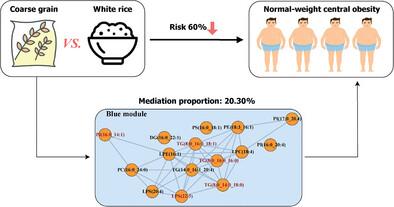
Little is known about the association between grain preference and abdominal fat accumulation, and mediating roles of circulating lipidomic signatures. We quantified 1245 circulating lipids in 150 normal-weight central obesity (NWCO) cases and 150 controls using targeted lipidomics. Grain preference was determined by the highest intake frequency of grains (white rice, wheat, or coarse grain). In our participants with high wheat intake frequency, preferring coarse grain over rice was associated with a 60% lower risk of NWCO. Of the 585 lipids showing opposing associations with white rice and coarse grains, 46 were significantly linked to either (p < 0.05), predominantly alkylacyl phospholipids (PE-Os; n = 9) and alkenylacylphospholipids (PE-Ps; n = 7). Network analysis identified a module primarily composed of PE-Os and PE-Ps, which was positively associated with coarse grain (p = 0.014). Another module, mainly consisting of triacylglycerols (TGs), was associated with white rice (p = 0.003) and mediated the association between white rice (mediation proportion: 20.30%; p = 0.027) or coarse grain preference (11.43%; p = 0.040) and NWCO. Specific lipids, such as TG(8:0_16:0_16:0) and TG(8:0_14:0_18:0), exhibited notable mediation effects. In normal-weight individuals with high wheat intake frequency, preferring coarse grain was inversely associated with NWCO, mediated by specific lipidomic signatures.
期刊介绍:
Molecular Nutrition & Food Research is a primary research journal devoted to health, safety and all aspects of molecular nutrition such as nutritional biochemistry, nutrigenomics and metabolomics aiming to link the information arising from related disciplines:
Bioactivity: Nutritional and medical effects of food constituents including bioavailability and kinetics.
Immunology: Understanding the interactions of food and the immune system.
Microbiology: Food spoilage, food pathogens, chemical and physical approaches of fermented foods and novel microbial processes.
Chemistry: Isolation and analysis of bioactive food ingredients while considering environmental aspects.




 京公网安备 11010802042870号
京ICP备2023020795号-1
京公网安备 11010802042870号
京ICP备2023020795号-1

 分享
分享
 求助内容:
求助内容: 应助结果提醒方式:
 扫码关注我们
