Jie Hu , Tian-Wei Xu , Ye Zhang , Meng-Yuan Xiao , Bo Meng , Vasiliy Egorovich Kolodeznikov , Natalia Nikolaevna Petrova , Vasilii Vasilevich Mukhin , Zi-Feng Zhang , Zhong-Hua Tang , Yi-Fan Li
{"title":"Amine antioxidants in water, ice, sediment and soil from the Songhua Wetland, Northeast China: Occurrence and fate","authors":"Jie Hu , Tian-Wei Xu , Ye Zhang , Meng-Yuan Xiao , Bo Meng , Vasiliy Egorovich Kolodeznikov , Natalia Nikolaevna Petrova , Vasilii Vasilevich Mukhin , Zi-Feng Zhang , Zhong-Hua Tang , Yi-Fan Li","doi":"10.1016/j.scitotenv.2024.178199","DOIUrl":null,"url":null,"abstract":"<div><div>Amine antioxidants (ANs) are emerging organic pollutants that are widely used in industrial products. The extensive use of ANs has polluted the environments. At present, there is no report on the pollution situation of ANs in wetland environment. In this study, samples of water, ice, sediment, and soil were collected in the Songhua Wetland to study the behavior of ANs. Total concentrations of ANs ranged from 27.4 to 137 ng L<sup>−1</sup> in water, 88.8–127 ng L<sup>−1</sup> in ice, 46.0–169 ng g<sup>−1</sup> dw in sediment, and 43.7–191 ng g<sup>−1</sup> dw in soil. The concentrations of ANs were higher in water during the ice-covered period (108–137 ng L<sup>−1</sup>) than that in the non-ice-covered (49.0–83.9 ng L<sup>−1</sup>). The Spearman correlation analysis suggests that most ANs were positively correlated with each other, indicating they were from the similar source. The overall enrichment of ANs in ice relative to water may relate to factors such as salt concentration and turbulence intensity. Since K<sub>d</sub> is much <100, it suggests that ANs were more distributed in water compared to sediment. These results provided new perspectives for subsequent related studies.</div></div>","PeriodicalId":422,"journal":{"name":"Science of the Total Environment","volume":"959 ","pages":"Article 178199"},"PeriodicalIF":8.0000,"publicationDate":"2025-01-10","publicationTypes":"Journal Article","fieldsOfStudy":null,"isOpenAccess":false,"openAccessPdf":"","citationCount":"0","resultStr":null,"platform":"Semanticscholar","paperid":null,"PeriodicalName":"Science of the Total Environment","FirstCategoryId":"93","ListUrlMain":"https://www.sciencedirect.com/science/article/pii/S0048969724083578","RegionNum":1,"RegionCategory":"环境科学与生态学","ArticlePicture":[],"TitleCN":null,"AbstractTextCN":null,"PMCID":null,"EPubDate":"2024/12/23 0:00:00","PubModel":"Epub","JCR":"Q1","JCRName":"ENVIRONMENTAL SCIENCES","Score":null,"Total":0}
引用次数: 0
Abstract
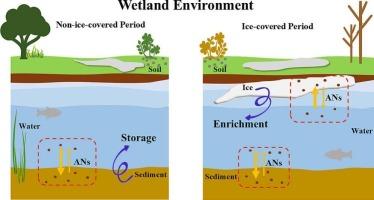
Amine antioxidants (ANs) are emerging organic pollutants that are widely used in industrial products. The extensive use of ANs has polluted the environments. At present, there is no report on the pollution situation of ANs in wetland environment. In this study, samples of water, ice, sediment, and soil were collected in the Songhua Wetland to study the behavior of ANs. Total concentrations of ANs ranged from 27.4 to 137 ng L−1 in water, 88.8–127 ng L−1 in ice, 46.0–169 ng g−1 dw in sediment, and 43.7–191 ng g−1 dw in soil. The concentrations of ANs were higher in water during the ice-covered period (108–137 ng L−1) than that in the non-ice-covered (49.0–83.9 ng L−1). The Spearman correlation analysis suggests that most ANs were positively correlated with each other, indicating they were from the similar source. The overall enrichment of ANs in ice relative to water may relate to factors such as salt concentration and turbulence intensity. Since Kd is much <100, it suggests that ANs were more distributed in water compared to sediment. These results provided new perspectives for subsequent related studies.
胺类抗氧化剂是一种新兴的有机污染物,广泛应用于工业产品中。人工智能的广泛使用已经污染了环境。目前还没有关于湿地环境中ANs污染情况的报道。本研究通过采集松花湿地的水、冰、沙和土壤样品,研究了氨氮在水中、冰中、沉积物中、土壤中的总浓度分别为27.4 ~ 137 ng L-1、88.8 ~ 127 ng L-1、46.0 ~ 169 ng g-1 dw和43.7 ~ 191 ng g-1 dw。冰期水体中ANs的浓度(108 ~ 137 ng L-1)高于非冰期水体(49.0 ~ 83.9 ng L-1)。Spearman相关分析表明,大多数ANs彼此呈正相关,表明它们来自相似的来源。冰中氨氮相对于水的总体富集可能与盐浓度和湍流强度等因素有关。因为Kd很大
期刊介绍:
The Science of the Total Environment is an international journal dedicated to scientific research on the environment and its interaction with humanity. It covers a wide range of disciplines and seeks to publish innovative, hypothesis-driven, and impactful research that explores the entire environment, including the atmosphere, lithosphere, hydrosphere, biosphere, and anthroposphere.
The journal's updated Aims & Scope emphasizes the importance of interdisciplinary environmental research with broad impact. Priority is given to studies that advance fundamental understanding and explore the interconnectedness of multiple environmental spheres. Field studies are preferred, while laboratory experiments must demonstrate significant methodological advancements or mechanistic insights with direct relevance to the environment.



 京公网安备 11010802042870号
京ICP备2023020795号-1
京公网安备 11010802042870号
京ICP备2023020795号-1

 分享
分享
 求助内容:
求助内容: 应助结果提醒方式:
 扫码关注我们
