Ziyi Zhang, Songya Wang, Changcheng Chen, Minghong Sun, Zhengjun Wang, Yan Cai, Yali Tuo, Yuxi Du, Zhao Han, Xiongfei Yun, Xiaoning Guan, Shaohang Shi, Jiangzhou Xie, Gang Liu, Pengfei Lu
{"title":"Design of photovoltaic materials assisted by machine learning and the mechanical tunability under micro-strain","authors":"Ziyi Zhang, Songya Wang, Changcheng Chen, Minghong Sun, Zhengjun Wang, Yan Cai, Yali Tuo, Yuxi Du, Zhao Han, Xiongfei Yun, Xiaoning Guan, Shaohang Shi, Jiangzhou Xie, Gang Liu, Pengfei Lu","doi":"10.1016/j.jmst.2024.11.055","DOIUrl":null,"url":null,"abstract":"In order to address the limited mechanical properties of silicon-based materials, this study designed 12 B-site mixed-valence perovskites with <em>s</em><sup>0</sup> + <em>s</em><sup>2</sup> electronic configurations. Five machine learning models were used to predict the bandgap values of candidate materials, and Cs<sub>2</sub>AgSbCl<sub>6</sub> was selected as the optimal light absorbing material. By using first principles calculations under stress and strain, it has been determined that micro-strains can achieve the goals of reducing material strength, enhancing flexible characteristics, directionally adjusting the anisotropy of stress concentration areas, improving thermodynamic properties, and enhancing sound insulation ability without significantly affecting photoelectric properties. According to device simulations, tensile strain can effectively increase the theoretical efficiency of solar cells. This work elucidates the mechanism of mechanical property changes under stress and strain, offering insights into new materials for solar energy conversion and accelerating the development of high-performance photovoltaic devices.","PeriodicalId":16154,"journal":{"name":"Journal of Materials Science & Technology","volume":"28 1","pages":""},"PeriodicalIF":14.3000,"publicationDate":"2025-01-07","publicationTypes":"Journal Article","fieldsOfStudy":null,"isOpenAccess":false,"openAccessPdf":"","citationCount":"0","resultStr":null,"platform":"Semanticscholar","paperid":null,"PeriodicalName":"Journal of Materials Science & Technology","FirstCategoryId":"88","ListUrlMain":"https://doi.org/10.1016/j.jmst.2024.11.055","RegionNum":1,"RegionCategory":"材料科学","ArticlePicture":[],"TitleCN":null,"AbstractTextCN":null,"PMCID":null,"EPubDate":"","PubModel":"","JCR":"Q1","JCRName":"MATERIALS SCIENCE, MULTIDISCIPLINARY","Score":null,"Total":0}
引用次数: 0
Abstract
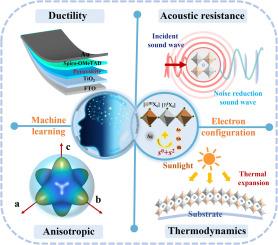
In order to address the limited mechanical properties of silicon-based materials, this study designed 12 B-site mixed-valence perovskites with s0 + s2 electronic configurations. Five machine learning models were used to predict the bandgap values of candidate materials, and Cs2AgSbCl6 was selected as the optimal light absorbing material. By using first principles calculations under stress and strain, it has been determined that micro-strains can achieve the goals of reducing material strength, enhancing flexible characteristics, directionally adjusting the anisotropy of stress concentration areas, improving thermodynamic properties, and enhancing sound insulation ability without significantly affecting photoelectric properties. According to device simulations, tensile strain can effectively increase the theoretical efficiency of solar cells. This work elucidates the mechanism of mechanical property changes under stress and strain, offering insights into new materials for solar energy conversion and accelerating the development of high-performance photovoltaic devices.
期刊介绍:
Journal of Materials Science & Technology strives to promote global collaboration in the field of materials science and technology. It primarily publishes original research papers, invited review articles, letters, research notes, and summaries of scientific achievements. The journal covers a wide range of materials science and technology topics, including metallic materials, inorganic nonmetallic materials, and composite materials.



 京公网安备 11010802042870号
京ICP备2023020795号-1
京公网安备 11010802042870号
京ICP备2023020795号-1

 分享
分享
 求助内容:
求助内容: 应助结果提醒方式:
 扫码关注我们
