Nuzul Sri Hertanti, Trung V Nguyen, Yeu-Hui Chuang
{"title":"Global prevalence and risk factors of fatigue and post-infectious fatigue among patients with dengue: a systematic review and meta-analysis.","authors":"Nuzul Sri Hertanti, Trung V Nguyen, Yeu-Hui Chuang","doi":"10.1016/j.eclinm.2024.103041","DOIUrl":null,"url":null,"abstract":"<p><strong>Background: </strong>Fatigue during the acute phase of dengue infection can persist as post-infectious fatigue (PIF), potentially impacting quality of life. We aimed to determine the prevalence and risk factors of fatigue and PIF among dengue patients.</p><p><strong>Methods: </strong>This systematic review and meta-analysis was registered in the PROSPERO (CRD42024543058). We searched PubMed, Ovid MEDLINE, Web of Science, Embase, and CINAHL from their inception to June 22, 2024. Observational studies reporting the prevalence of fatigue or PIF among dengue patients were included. We excluded case studies, review articles, conference abstracts, protocols, duplicate publications, and studies without full text. Quality assessment was performed using Hoy's risk of bias tool. Data were analyzed using R software version 4.3.3. A random-effects model pooled prevalence with 95% confidence intervals (CIs). Risk factors were identified using odd ratios (ORs) and 95% CIs or <i>p</i> values. Heterogeneity, moderator analysis, sensitivity analysis, and publication bias were also assessed.</p><p><strong>Findings: </strong>From 715 identified studies, 40 were included for review. Of these, 37 studies were included in the meta-analysis for fatigue prevalence and nine studies for PIF prevalence, respectively involving 37,790 and 5045 dengue patients. The pooled prevalence of fatigue was 59.0% (95% CI 0.47-0.70), and that of PIF was 20.0% (95% CI 0.10-0.36), with significant heterogeneity but no significant moderators. Sensitivity analysis confirmed the robustness of this meta-analysis. Female sex (pooled OR = 1.65, 95% CI 1.27-2.14), dengue hemorrhagic fever (pooled OR = 1.80, 95% CI 1.02-3.16), and preexisting comorbidities (pooled OR = 2.14, 95% CI 1.36-3.38) were significant risk factors for PIF.</p><p><strong>Interpretation: </strong>This meta-analysis highlights the high prevalence of fatigue and PIF among dengue patients, with several risk factors identified. Although the study has its limitations, these results can inform future studies to more standardized study designs, improved definitions, and systematic assessment methods for fatigue, PIF, and potential moderators. These are essential to better understand the mechanisms of fatigue in dengue patients and explore potential interventions.</p><p><strong>Funding: </strong>None.</p>","PeriodicalId":11393,"journal":{"name":"EClinicalMedicine","volume":"80 ","pages":"103041"},"PeriodicalIF":10.0000,"publicationDate":"2024-12-31","publicationTypes":"Journal Article","fieldsOfStudy":null,"isOpenAccess":false,"openAccessPdf":"https://www.ncbi.nlm.nih.gov/pmc/articles/PMC11751573/pdf/","citationCount":"0","resultStr":null,"platform":"Semanticscholar","paperid":null,"PeriodicalName":"EClinicalMedicine","FirstCategoryId":"3","ListUrlMain":"https://doi.org/10.1016/j.eclinm.2024.103041","RegionNum":1,"RegionCategory":"医学","ArticlePicture":[],"TitleCN":null,"AbstractTextCN":null,"PMCID":null,"EPubDate":"2025/2/1 0:00:00","PubModel":"eCollection","JCR":"Q1","JCRName":"MEDICINE, GENERAL & INTERNAL","Score":null,"Total":0}
引用次数: 0
Abstract
Background: Fatigue during the acute phase of dengue infection can persist as post-infectious fatigue (PIF), potentially impacting quality of life. We aimed to determine the prevalence and risk factors of fatigue and PIF among dengue patients.
Methods: This systematic review and meta-analysis was registered in the PROSPERO (CRD42024543058). We searched PubMed, Ovid MEDLINE, Web of Science, Embase, and CINAHL from their inception to June 22, 2024. Observational studies reporting the prevalence of fatigue or PIF among dengue patients were included. We excluded case studies, review articles, conference abstracts, protocols, duplicate publications, and studies without full text. Quality assessment was performed using Hoy's risk of bias tool. Data were analyzed using R software version 4.3.3. A random-effects model pooled prevalence with 95% confidence intervals (CIs). Risk factors were identified using odd ratios (ORs) and 95% CIs or p values. Heterogeneity, moderator analysis, sensitivity analysis, and publication bias were also assessed.
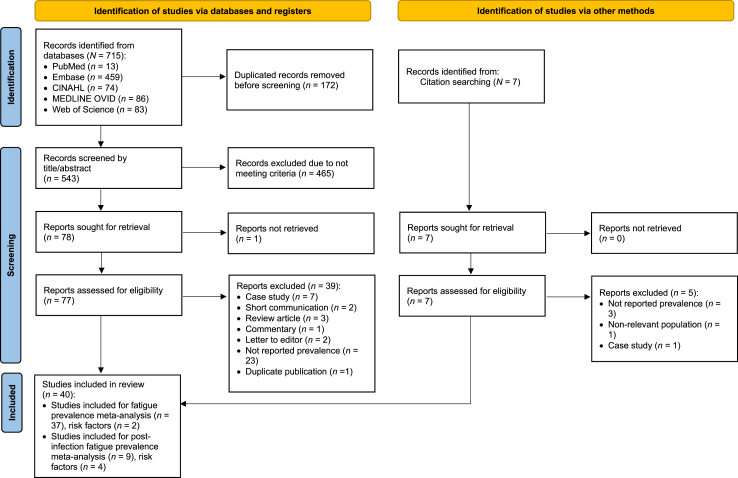
Findings: From 715 identified studies, 40 were included for review. Of these, 37 studies were included in the meta-analysis for fatigue prevalence and nine studies for PIF prevalence, respectively involving 37,790 and 5045 dengue patients. The pooled prevalence of fatigue was 59.0% (95% CI 0.47-0.70), and that of PIF was 20.0% (95% CI 0.10-0.36), with significant heterogeneity but no significant moderators. Sensitivity analysis confirmed the robustness of this meta-analysis. Female sex (pooled OR = 1.65, 95% CI 1.27-2.14), dengue hemorrhagic fever (pooled OR = 1.80, 95% CI 1.02-3.16), and preexisting comorbidities (pooled OR = 2.14, 95% CI 1.36-3.38) were significant risk factors for PIF.
Interpretation: This meta-analysis highlights the high prevalence of fatigue and PIF among dengue patients, with several risk factors identified. Although the study has its limitations, these results can inform future studies to more standardized study designs, improved definitions, and systematic assessment methods for fatigue, PIF, and potential moderators. These are essential to better understand the mechanisms of fatigue in dengue patients and explore potential interventions.
背景:登革热感染急性期的疲劳可以持续为感染后疲劳(PIF),潜在地影响生活质量。我们的目的是确定登革热患者中疲劳和PIF的患病率和危险因素。方法:本系统评价和荟萃分析在PROSPERO (CRD42024543058)中注册。我们检索了PubMed, Ovid MEDLINE, Web of Science, Embase和CINAHL,从它们成立到2024年6月22日。报告登革热患者中疲劳或PIF患病率的观察性研究被纳入。我们排除了案例研究、综述文章、会议摘要、协议、重复出版物和没有全文的研究。采用Hoy偏倚风险工具进行质量评估。数据分析采用R软件4.3.3版。随机效应模型以95%置信区间(ci)汇总了患病率。使用奇比(or)和95% ci或p值确定危险因素。异质性、调节因素分析、敏感性分析和发表偏倚也进行了评估。研究结果:从715项确定的研究中,有40项纳入了综述。其中,37项研究纳入了疲劳患病率的荟萃分析,9项研究纳入了PIF患病率的荟萃分析,分别涉及37,790和5045名登革热患者。疲劳的总患病率为59.0% (95% CI 0.47-0.70), PIF的总患病率为20.0% (95% CI 0.10-0.36),具有显著的异质性,但没有显著的调节因子。敏感性分析证实了该meta分析的稳健性。女性(合并OR = 1.65, 95% CI 1.27-2.14)、登革出血热(合并OR = 1.80, 95% CI 1.02-3.16)和既往合并症(合并OR = 2.14, 95% CI 1.36-3.38)是PIF的重要危险因素。该荟萃分析强调了登革热患者中疲劳和PIF的高患病率,并确定了几个危险因素。尽管该研究有其局限性,但这些结果可以为未来的研究提供更标准化的研究设计、改进的定义和系统的疲劳、PIF和潜在调节因子的评估方法。这些对于更好地了解登革热患者疲劳的机制和探索潜在的干预措施至关重要。资金:没有。
期刊介绍:
eClinicalMedicine is a gold open-access clinical journal designed to support frontline health professionals in addressing the complex and rapid health transitions affecting societies globally. The journal aims to assist practitioners in overcoming healthcare challenges across diverse communities, spanning diagnosis, treatment, prevention, and health promotion. Integrating disciplines from various specialties and life stages, it seeks to enhance health systems as fundamental institutions within societies. With a forward-thinking approach, eClinicalMedicine aims to redefine the future of healthcare.





 京公网安备 11010802042870号
京ICP备2023020795号-1
京公网安备 11010802042870号
京ICP备2023020795号-1

 分享
分享
 求助内容:
求助内容: 应助结果提醒方式:
 扫码关注我们
