Xueqing Li , Fuqiang Chen , Yunqian Li , Yunyue Zhen , Jiaoying Ju , Zhengjun Li , Shan Huang , Qing Sun
{"title":"Downregulation of RSAD2 ameliorates keratinocyte hyperproliferation and skin inflammation in psoriasis via the TAK1/NF-κB axis","authors":"Xueqing Li , Fuqiang Chen , Yunqian Li , Yunyue Zhen , Jiaoying Ju , Zhengjun Li , Shan Huang , Qing Sun","doi":"10.1016/j.bcp.2025.116764","DOIUrl":null,"url":null,"abstract":"<div><div>Immune cell infiltration and keratinocyte (KC) hyperproliferation are characteristics of psoriasis. Radical S-adenosyl methionine domain-containing 2 (RSAD2) plays an integral role in the innate immune response and is associated with various immune-related diseases. However, RSAD2′s expression and role in modulating immune responses in psoriasis remain unexplored. In this study, we demonstrated a significant upregulation of RSAD2 expression in both psoriatic lesions and psoriasis-like mouse epidermis, with its expression positively correlated with psoriasis severity. In psoriatic cell models, RSAD2 was shown to promote the proliferation and secretion of pro-inflammatory cytokines by activating the transforming growth factor-β-activated kinase 1 (TAK1)-mediated nuclear factor kappa-B (NF-κB) signaling pathway. Additionally, it was found that the expression of RSAD2 is increased by the action of interferon regulatory factor-1 (IRF1), which binds to the promoter region of RSAD2. Therefore, the function of RSAD2 in psoriasis is regulated by IRF1. Notably, RSAD2 inhibition decreased epidermal hyperplasia and alleviated imiquimod (IMQ)-induced psoriatic dermatitis. In summary, our study highlights the modulation of the IRF1-RSAD2-TAK1 axis as a potential innovative therapeutic approach for psoriasis, offering new insights into the molecular mechanisms by which KCs drive inflammation in psoriasis.</div></div>","PeriodicalId":8806,"journal":{"name":"Biochemical pharmacology","volume":"233 ","pages":"Article 116764"},"PeriodicalIF":5.6000,"publicationDate":"2025-03-01","publicationTypes":"Journal Article","fieldsOfStudy":null,"isOpenAccess":false,"openAccessPdf":"","citationCount":"0","resultStr":null,"platform":"Semanticscholar","paperid":null,"PeriodicalName":"Biochemical pharmacology","FirstCategoryId":"3","ListUrlMain":"https://www.sciencedirect.com/science/article/pii/S0006295225000267","RegionNum":2,"RegionCategory":"医学","ArticlePicture":[],"TitleCN":null,"AbstractTextCN":null,"PMCID":null,"EPubDate":"2025/1/21 0:00:00","PubModel":"Epub","JCR":"Q1","JCRName":"PHARMACOLOGY & PHARMACY","Score":null,"Total":0}
引用次数: 0
Abstract
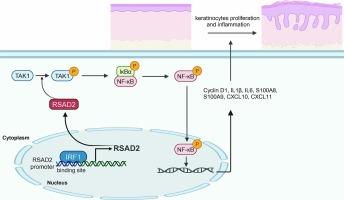
Immune cell infiltration and keratinocyte (KC) hyperproliferation are characteristics of psoriasis. Radical S-adenosyl methionine domain-containing 2 (RSAD2) plays an integral role in the innate immune response and is associated with various immune-related diseases. However, RSAD2′s expression and role in modulating immune responses in psoriasis remain unexplored. In this study, we demonstrated a significant upregulation of RSAD2 expression in both psoriatic lesions and psoriasis-like mouse epidermis, with its expression positively correlated with psoriasis severity. In psoriatic cell models, RSAD2 was shown to promote the proliferation and secretion of pro-inflammatory cytokines by activating the transforming growth factor-β-activated kinase 1 (TAK1)-mediated nuclear factor kappa-B (NF-κB) signaling pathway. Additionally, it was found that the expression of RSAD2 is increased by the action of interferon regulatory factor-1 (IRF1), which binds to the promoter region of RSAD2. Therefore, the function of RSAD2 in psoriasis is regulated by IRF1. Notably, RSAD2 inhibition decreased epidermal hyperplasia and alleviated imiquimod (IMQ)-induced psoriatic dermatitis. In summary, our study highlights the modulation of the IRF1-RSAD2-TAK1 axis as a potential innovative therapeutic approach for psoriasis, offering new insights into the molecular mechanisms by which KCs drive inflammation in psoriasis.
期刊介绍:
Biochemical Pharmacology publishes original research findings, Commentaries and review articles related to the elucidation of cellular and tissue function(s) at the biochemical and molecular levels, the modification of cellular phenotype(s) by genetic, transcriptional/translational or drug/compound-induced modifications, as well as the pharmacodynamics and pharmacokinetics of xenobiotics and drugs, the latter including both small molecules and biologics.
The journal''s target audience includes scientists engaged in the identification and study of the mechanisms of action of xenobiotics, biologics and drugs and in the drug discovery and development process.
All areas of cellular biology and cellular, tissue/organ and whole animal pharmacology fall within the scope of the journal. Drug classes covered include anti-infectives, anti-inflammatory agents, chemotherapeutics, cardiovascular, endocrinological, immunological, metabolic, neurological and psychiatric drugs, as well as research on drug metabolism and kinetics. While medicinal chemistry is a topic of complimentary interest, manuscripts in this area must contain sufficient biological data to characterize pharmacologically the compounds reported. Submissions describing work focused predominately on chemical synthesis and molecular modeling will not be considered for review.
While particular emphasis is placed on reporting the results of molecular and biochemical studies, research involving the use of tissue and animal models of human pathophysiology and toxicology is of interest to the extent that it helps define drug mechanisms of action, safety and efficacy.



 京公网安备 11010802042870号
京ICP备2023020795号-1
京公网安备 11010802042870号
京ICP备2023020795号-1

 分享
分享
 求助内容:
求助内容: 应助结果提醒方式:
 扫码关注我们
