Alberto Benetollo , Sofia Parrasia , Martina Scano , Lucia Biasutto , Andrea Rossa , Leonardo Nogara , Bert Blaauw , Francesco Dalla Barba , Paola Caccin , Marcello Carotti , Alessandro Parolin , Eylem Emek Akyürek , Roberta Sacchetto , Dorianna Sandonà
{"title":"The novel use of the CFTR corrector C17 in muscular dystrophy: pharmacological profile and in vivo efficacy","authors":"Alberto Benetollo , Sofia Parrasia , Martina Scano , Lucia Biasutto , Andrea Rossa , Leonardo Nogara , Bert Blaauw , Francesco Dalla Barba , Paola Caccin , Marcello Carotti , Alessandro Parolin , Eylem Emek Akyürek , Roberta Sacchetto , Dorianna Sandonà","doi":"10.1016/j.bcp.2025.116779","DOIUrl":null,"url":null,"abstract":"<div><div>Sarcoglycanopathies are rare forms of severe muscular dystrophies currently without a therapy. Mutations in sarcoglycan (SG) genes cause the reduction or absence of the SG-complex, a tetramer located in the sarcolemma that plays a protective role during muscle contraction. Missense mutations in <em>SGCA</em>, which cause α-sarcoglycanopathy, otherwise known as LGMD2D/R3, lead to folding defective forms of α-SG that are discarded by the cell quality control. Recently, we demonstrated how a small molecule called C17, initially identified as a CFTR corrector, can be re-used to ameliorate the dystrophic phenotype of a mouse model of α-sarcoglycanopathy. Here, we have examined the pharmacological profile of C17 by performing ADME (absorption, distribution, metabolism, and elimination) studies. Our data show that C17 is well-distributed to relevant organs like heart and skeletal muscle, and likely metabolized in the small intestine into hydrophilic and hydrophobic derivatives. Elimination occurs through faeces (unmodified and modified C17) and urine (modified forms). Interestingly, we detected a quantifiable amount of C17 in treated muscles 48 h after an acute parenteral administration. This led to design a regimen of chronic treatment with a reduced dosing frequency. The result was the recovery of muscle strength, thanks to the rescue of the SG-complex, despite containing a mutated subunit, at the level of the sarcolemma. Thus, we can conclude that CFTR corrector C17 has a reasonable pharmacological profile and great potential to become a valuable therapeutic option for LGMD2D/R3 and other forms of muscular dystrophy caused by folding defective but potentially functional proteins.</div></div>","PeriodicalId":8806,"journal":{"name":"Biochemical pharmacology","volume":"233 ","pages":"Article 116779"},"PeriodicalIF":5.6000,"publicationDate":"2025-01-24","publicationTypes":"Journal Article","fieldsOfStudy":null,"isOpenAccess":false,"openAccessPdf":"","citationCount":"0","resultStr":null,"platform":"Semanticscholar","paperid":null,"PeriodicalName":"Biochemical pharmacology","FirstCategoryId":"3","ListUrlMain":"https://www.sciencedirect.com/science/article/pii/S0006295225000413","RegionNum":2,"RegionCategory":"医学","ArticlePicture":[],"TitleCN":null,"AbstractTextCN":null,"PMCID":null,"EPubDate":"","PubModel":"","JCR":"Q1","JCRName":"PHARMACOLOGY & PHARMACY","Score":null,"Total":0}
引用次数: 0
Abstract
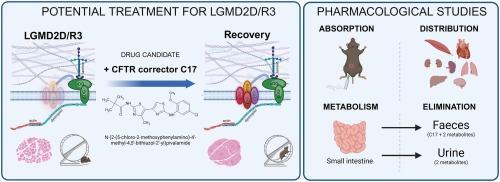
Sarcoglycanopathies are rare forms of severe muscular dystrophies currently without a therapy. Mutations in sarcoglycan (SG) genes cause the reduction or absence of the SG-complex, a tetramer located in the sarcolemma that plays a protective role during muscle contraction. Missense mutations in SGCA, which cause α-sarcoglycanopathy, otherwise known as LGMD2D/R3, lead to folding defective forms of α-SG that are discarded by the cell quality control. Recently, we demonstrated how a small molecule called C17, initially identified as a CFTR corrector, can be re-used to ameliorate the dystrophic phenotype of a mouse model of α-sarcoglycanopathy. Here, we have examined the pharmacological profile of C17 by performing ADME (absorption, distribution, metabolism, and elimination) studies. Our data show that C17 is well-distributed to relevant organs like heart and skeletal muscle, and likely metabolized in the small intestine into hydrophilic and hydrophobic derivatives. Elimination occurs through faeces (unmodified and modified C17) and urine (modified forms). Interestingly, we detected a quantifiable amount of C17 in treated muscles 48 h after an acute parenteral administration. This led to design a regimen of chronic treatment with a reduced dosing frequency. The result was the recovery of muscle strength, thanks to the rescue of the SG-complex, despite containing a mutated subunit, at the level of the sarcolemma. Thus, we can conclude that CFTR corrector C17 has a reasonable pharmacological profile and great potential to become a valuable therapeutic option for LGMD2D/R3 and other forms of muscular dystrophy caused by folding defective but potentially functional proteins.
期刊介绍:
Biochemical Pharmacology publishes original research findings, Commentaries and review articles related to the elucidation of cellular and tissue function(s) at the biochemical and molecular levels, the modification of cellular phenotype(s) by genetic, transcriptional/translational or drug/compound-induced modifications, as well as the pharmacodynamics and pharmacokinetics of xenobiotics and drugs, the latter including both small molecules and biologics.
The journal''s target audience includes scientists engaged in the identification and study of the mechanisms of action of xenobiotics, biologics and drugs and in the drug discovery and development process.
All areas of cellular biology and cellular, tissue/organ and whole animal pharmacology fall within the scope of the journal. Drug classes covered include anti-infectives, anti-inflammatory agents, chemotherapeutics, cardiovascular, endocrinological, immunological, metabolic, neurological and psychiatric drugs, as well as research on drug metabolism and kinetics. While medicinal chemistry is a topic of complimentary interest, manuscripts in this area must contain sufficient biological data to characterize pharmacologically the compounds reported. Submissions describing work focused predominately on chemical synthesis and molecular modeling will not be considered for review.
While particular emphasis is placed on reporting the results of molecular and biochemical studies, research involving the use of tissue and animal models of human pathophysiology and toxicology is of interest to the extent that it helps define drug mechanisms of action, safety and efficacy.



 京公网安备 11010802042870号
京ICP备2023020795号-1
京公网安备 11010802042870号
京ICP备2023020795号-1

 分享
分享
 求助内容:
求助内容: 应助结果提醒方式:
 扫码关注我们
