{"title":"Techno-economic and environmental assessment of glycerol valorization to polyhydroxybutyrate using chemical digestion methods","authors":"Piyawan Thanahiranya , Treerat Vacharanukrauh , Pongtorn Charoensuppanimit , Santi Chuetor , Merika Chanthanumataporn , Suttichai Assabumrungrat","doi":"10.1016/j.psep.2025.106832","DOIUrl":null,"url":null,"abstract":"<div><div>Polyhydroxybutyrate (PHB) is a biodegradable polymer that can be produced from glycerol, a major by-product of biodiesel plants. However, the high production costs associated with the inefficient downstream process have impeded the commercialization of PHB. Previously, several methods have been demonstrated capable of recovering PHB<sup>__</sup> among them, chemical digestion appeared to be the most effective. There are various classes of chemical digestion. This study examined the processes of PHB production from glycerol using three different classes of chemical digestion including alkaline digestion, surfactant digestion, and alkaline−surfactant digestion for PHB recovery. The processes are evaluated based on performance indexes, such as techno-economic, energy utilization, and greenhouse gas (GHG) emissions. According to the simulated results, the use of alkaline digestion for PHB recovery is economically attractive. Based on PHB production capacity of 5,000 tonnes/y, the best production provides a net present value of 442 million USD, an internal rate of return of 76.6 %, and a payout period of 2.48 years. Furthermore, important findings from this investigation also reveal that heat integration not only reduces energy consumption but also minimizes operating costs and GHG emissions. Therefore, the production of PHB from glycerol using alkaline digestion for PHB recovery may find commercial application in the bioplastic industry.</div></div>","PeriodicalId":20743,"journal":{"name":"Process Safety and Environmental Protection","volume":"195 ","pages":"Article 106832"},"PeriodicalIF":7.9000,"publicationDate":"2025-03-01","publicationTypes":"Journal Article","fieldsOfStudy":null,"isOpenAccess":false,"openAccessPdf":"","citationCount":"0","resultStr":null,"platform":"Semanticscholar","paperid":null,"PeriodicalName":"Process Safety and Environmental Protection","FirstCategoryId":"93","ListUrlMain":"https://www.sciencedirect.com/science/article/pii/S0957582025000990","RegionNum":2,"RegionCategory":"环境科学与生态学","ArticlePicture":[],"TitleCN":null,"AbstractTextCN":null,"PMCID":null,"EPubDate":"2025/1/21 0:00:00","PubModel":"Epub","JCR":"Q1","JCRName":"ENGINEERING, CHEMICAL","Score":null,"Total":0}
引用次数: 0
Abstract
Polyhydroxybutyrate (PHB) is a biodegradable polymer that can be produced from glycerol, a major by-product of biodiesel plants. However, the high production costs associated with the inefficient downstream process have impeded the commercialization of PHB. Previously, several methods have been demonstrated capable of recovering PHB__ among them, chemical digestion appeared to be the most effective. There are various classes of chemical digestion. This study examined the processes of PHB production from glycerol using three different classes of chemical digestion including alkaline digestion, surfactant digestion, and alkaline−surfactant digestion for PHB recovery. The processes are evaluated based on performance indexes, such as techno-economic, energy utilization, and greenhouse gas (GHG) emissions. According to the simulated results, the use of alkaline digestion for PHB recovery is economically attractive. Based on PHB production capacity of 5,000 tonnes/y, the best production provides a net present value of 442 million USD, an internal rate of return of 76.6 %, and a payout period of 2.48 years. Furthermore, important findings from this investigation also reveal that heat integration not only reduces energy consumption but also minimizes operating costs and GHG emissions. Therefore, the production of PHB from glycerol using alkaline digestion for PHB recovery may find commercial application in the bioplastic industry.
期刊介绍:
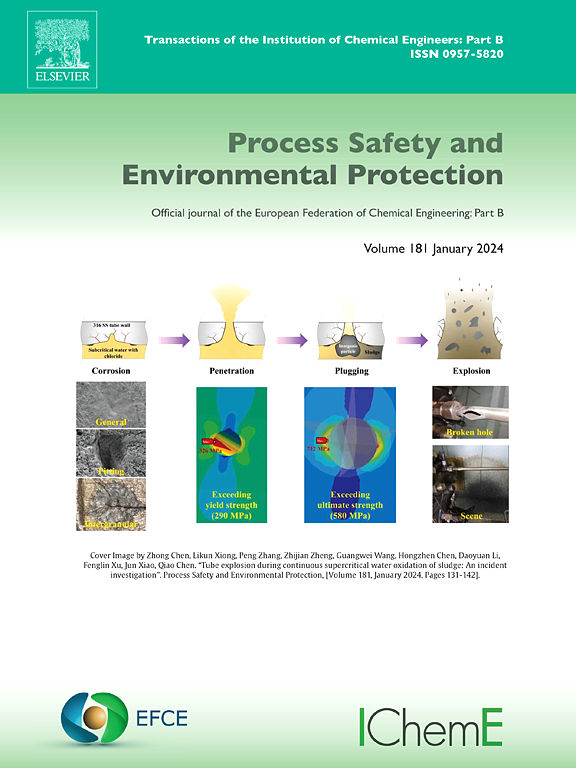
The Process Safety and Environmental Protection (PSEP) journal is a leading international publication that focuses on the publication of high-quality, original research papers in the field of engineering, specifically those related to the safety of industrial processes and environmental protection. The journal encourages submissions that present new developments in safety and environmental aspects, particularly those that show how research findings can be applied in process engineering design and practice.
PSEP is particularly interested in research that brings fresh perspectives to established engineering principles, identifies unsolved problems, or suggests directions for future research. The journal also values contributions that push the boundaries of traditional engineering and welcomes multidisciplinary papers.
PSEP's articles are abstracted and indexed by a range of databases and services, which helps to ensure that the journal's research is accessible and recognized in the academic and professional communities. These databases include ANTE, Chemical Abstracts, Chemical Hazards in Industry, Current Contents, Elsevier Engineering Information database, Pascal Francis, Web of Science, Scopus, Engineering Information Database EnCompass LIT (Elsevier), and INSPEC. This wide coverage facilitates the dissemination of the journal's content to a global audience interested in process safety and environmental engineering.




 京公网安备 11010802042870号
京ICP备2023020795号-1
京公网安备 11010802042870号
京ICP备2023020795号-1

 分享
分享
 求助内容:
求助内容: 应助结果提醒方式:
 扫码关注我们
