Carlos Cano-Barbacil, James S. Sinclair, Ellen A. R. Welti, Peter Haase
{"title":"Recovery and Degradation Drive Changes in the Dispersal Capacity of Stream Macroinvertebrate Communities","authors":"Carlos Cano-Barbacil, James S. Sinclair, Ellen A. R. Welti, Peter Haase","doi":"10.1111/gcb.70054","DOIUrl":null,"url":null,"abstract":"<p>Freshwater ecosystems face significant threats, including pollution, habitat loss, invasive species, and climate change. To address these challenges, management strategies and restoration efforts have been broadly implemented. Across Europe, such efforts have resulted in overall improvements in freshwater biodiversity, but recovery has stalled or failed to occur in many localities, which may be partly caused by the limited dispersal capacity of many species. Here, we used a comprehensive dataset comprising 1327 time series of freshwater macroinvertebrate communities ranging from 1968 to 2021 across 23 European countries to investigate whether dispersal capacity changes with the ecological quality of riverine systems. Sites experiencing improvements in ecological quality exhibited a net gain in species and tended to have macroinvertebrate communities containing species with stronger dispersal capacity (e.g., active aquatic and aerial dispersers, species with frequent propensity to drift, and insects with larger wings). In contrast, sites experiencing degradation of ecological quality exhibited a net loss of species and a reduction in the proportion of strong dispersers. However, this response varied extensively among countries and local sites, with some improving sites exhibiting no parallel gains in macroinvertebrates with higher dispersal capacity. Dispersal capacity of the local species pool can affect the success of freshwater ecosystem restoration projects. Management strategies should focus on enhancing landscape connectivity to create accessible “source” areas and refugia for sensitive taxa, especially as climate change reshapes habitat suitability. Additionally, biodiversity initiatives must incorporate adaptive decision-making approaches that account for the site-specific responses of macroinvertebrate communities to changes in ecological quality.</p>","PeriodicalId":175,"journal":{"name":"Global Change Biology","volume":"31 1","pages":""},"PeriodicalIF":12.0000,"publicationDate":"2025-01-27","publicationTypes":"Journal Article","fieldsOfStudy":null,"isOpenAccess":false,"openAccessPdf":"https://onlinelibrary.wiley.com/doi/epdf/10.1111/gcb.70054","citationCount":"0","resultStr":null,"platform":"Semanticscholar","paperid":null,"PeriodicalName":"Global Change Biology","FirstCategoryId":"93","ListUrlMain":"https://onlinelibrary.wiley.com/doi/10.1111/gcb.70054","RegionNum":1,"RegionCategory":"环境科学与生态学","ArticlePicture":[],"TitleCN":null,"AbstractTextCN":null,"PMCID":null,"EPubDate":"","PubModel":"","JCR":"Q1","JCRName":"BIODIVERSITY CONSERVATION","Score":null,"Total":0}
引用次数: 0
Abstract
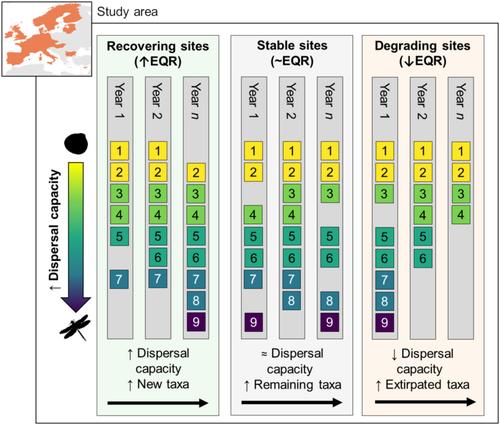
Freshwater ecosystems face significant threats, including pollution, habitat loss, invasive species, and climate change. To address these challenges, management strategies and restoration efforts have been broadly implemented. Across Europe, such efforts have resulted in overall improvements in freshwater biodiversity, but recovery has stalled or failed to occur in many localities, which may be partly caused by the limited dispersal capacity of many species. Here, we used a comprehensive dataset comprising 1327 time series of freshwater macroinvertebrate communities ranging from 1968 to 2021 across 23 European countries to investigate whether dispersal capacity changes with the ecological quality of riverine systems. Sites experiencing improvements in ecological quality exhibited a net gain in species and tended to have macroinvertebrate communities containing species with stronger dispersal capacity (e.g., active aquatic and aerial dispersers, species with frequent propensity to drift, and insects with larger wings). In contrast, sites experiencing degradation of ecological quality exhibited a net loss of species and a reduction in the proportion of strong dispersers. However, this response varied extensively among countries and local sites, with some improving sites exhibiting no parallel gains in macroinvertebrates with higher dispersal capacity. Dispersal capacity of the local species pool can affect the success of freshwater ecosystem restoration projects. Management strategies should focus on enhancing landscape connectivity to create accessible “source” areas and refugia for sensitive taxa, especially as climate change reshapes habitat suitability. Additionally, biodiversity initiatives must incorporate adaptive decision-making approaches that account for the site-specific responses of macroinvertebrate communities to changes in ecological quality.
期刊介绍:
Global Change Biology is an environmental change journal committed to shaping the future and addressing the world's most pressing challenges, including sustainability, climate change, environmental protection, food and water safety, and global health.
Dedicated to fostering a profound understanding of the impacts of global change on biological systems and offering innovative solutions, the journal publishes a diverse range of content, including primary research articles, technical advances, research reviews, reports, opinions, perspectives, commentaries, and letters. Starting with the 2024 volume, Global Change Biology will transition to an online-only format, enhancing accessibility and contributing to the evolution of scholarly communication.




 京公网安备 11010802042870号
京ICP备2023020795号-1
京公网安备 11010802042870号
京ICP备2023020795号-1

 分享
分享
 求助内容:
求助内容: 应助结果提醒方式:
 扫码关注我们
