Hui Wu, Enke Liu, Tao Jin, Buchun Liu, Subramaniam Gopalakrishnan, Jie Zhou, Guodong Shao, Xurong Mei, Pierre Delaplace, Caroline De Clerck
{"title":"Crop rotation increases Tibetan barley yield and soil quality on the Tibetan Plateau","authors":"Hui Wu, Enke Liu, Tao Jin, Buchun Liu, Subramaniam Gopalakrishnan, Jie Zhou, Guodong Shao, Xurong Mei, Pierre Delaplace, Caroline De Clerck","doi":"10.1038/s43016-024-01094-8","DOIUrl":null,"url":null,"abstract":"Tibetan barley (Hordeum vulgare) accounts for over 70% of the total food production in the Tibetan Plateau. However, continuous cropping of Tibetan barley causes soil degradation, reduces soil quality and causes yield decline. Here we explore the benefits of crop rotation with wheat and rape to improve crop yield and soil quality. We conducted 39 field experiments on the Tibetan Plateau, comparing short-term (≤5 years), 5–10 years and long-term (≥10 years) continuous cropping with rotation of Tibetan barley with wheat or rape. Results showed that Tibetan barley–wheat and Tibetan barley–rape rotations increased yields by 17% and 12%, respectively, while improving the soil quality index by 11% and 21%, compared with long-term continuous cropping. Both Tibetan barley rotations with wheat and rape improved soil quality and consequently yield, mainly by increasing soil microbial biomass nitrogen and microbial biomass carbon and decreasing pH. By contrast, long-term continuous cropping led to decreased soil organic matter, lower microbial biomass nitrogen and increased pH, contributing to yield decline. The benefits of rotations on crop yield and soil quality increased over time. Implementing crop rotation with wheat or rape thus offers a sustainable agricultural strategy for improving food security on the Tibetan Plateau. Continuous cropping of Tibetan barley results in rapid declines in both yield and soil quality due to the low baseline soil fertility in the Tibetan Plateau. This study, based on 39 field experiments, showed that rotating Tibetan barley with wheat or rape increased yields and improved the soil quality compared with long-term continuous cropping.","PeriodicalId":94151,"journal":{"name":"Nature food","volume":"6 2","pages":"151-160"},"PeriodicalIF":21.9000,"publicationDate":"2025-01-28","publicationTypes":"Journal Article","fieldsOfStudy":null,"isOpenAccess":false,"openAccessPdf":"https://www.nature.com/articles/s43016-024-01094-8.pdf","citationCount":"0","resultStr":null,"platform":"Semanticscholar","paperid":null,"PeriodicalName":"Nature food","FirstCategoryId":"1085","ListUrlMain":"https://www.nature.com/articles/s43016-024-01094-8","RegionNum":0,"RegionCategory":null,"ArticlePicture":[],"TitleCN":null,"AbstractTextCN":null,"PMCID":null,"EPubDate":"","PubModel":"","JCR":"Q1","JCRName":"FOOD SCIENCE & TECHNOLOGY","Score":null,"Total":0}
引用次数: 0
Abstract
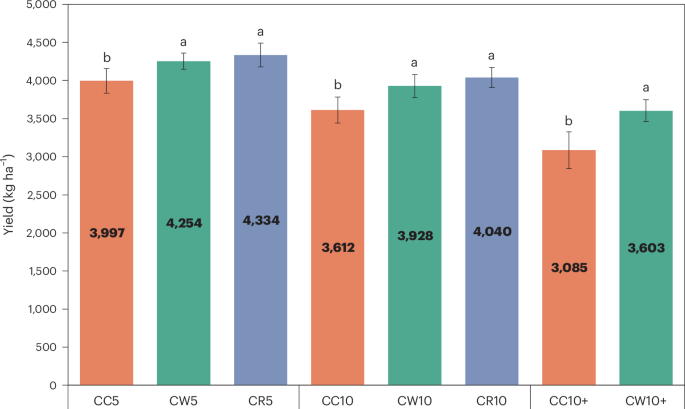
Tibetan barley (Hordeum vulgare) accounts for over 70% of the total food production in the Tibetan Plateau. However, continuous cropping of Tibetan barley causes soil degradation, reduces soil quality and causes yield decline. Here we explore the benefits of crop rotation with wheat and rape to improve crop yield and soil quality. We conducted 39 field experiments on the Tibetan Plateau, comparing short-term (≤5 years), 5–10 years and long-term (≥10 years) continuous cropping with rotation of Tibetan barley with wheat or rape. Results showed that Tibetan barley–wheat and Tibetan barley–rape rotations increased yields by 17% and 12%, respectively, while improving the soil quality index by 11% and 21%, compared with long-term continuous cropping. Both Tibetan barley rotations with wheat and rape improved soil quality and consequently yield, mainly by increasing soil microbial biomass nitrogen and microbial biomass carbon and decreasing pH. By contrast, long-term continuous cropping led to decreased soil organic matter, lower microbial biomass nitrogen and increased pH, contributing to yield decline. The benefits of rotations on crop yield and soil quality increased over time. Implementing crop rotation with wheat or rape thus offers a sustainable agricultural strategy for improving food security on the Tibetan Plateau. Continuous cropping of Tibetan barley results in rapid declines in both yield and soil quality due to the low baseline soil fertility in the Tibetan Plateau. This study, based on 39 field experiments, showed that rotating Tibetan barley with wheat or rape increased yields and improved the soil quality compared with long-term continuous cropping.





 京公网安备 11010802042870号
京ICP备2023020795号-1
京公网安备 11010802042870号
京ICP备2023020795号-1

 分享
分享

 求助内容:
求助内容: 应助结果提醒方式:
 扫码关注我们
