Fabio Taddeini, Giulia Avvenuti, Alberto Arturo Vergani, Jacopo Carpaneto, Francesca Setti, Damiana Bergamo, Linda Fiorini, Pietro Pietrini, Emiliano Ricciardi, Giulio Bernardi, Alberto Mazzoni
{"title":"Extended Cognitive Load Induces Fast Neural Responses Leading to Commission Errors.","authors":"Fabio Taddeini, Giulia Avvenuti, Alberto Arturo Vergani, Jacopo Carpaneto, Francesca Setti, Damiana Bergamo, Linda Fiorini, Pietro Pietrini, Emiliano Ricciardi, Giulio Bernardi, Alberto Mazzoni","doi":"10.1523/ENEURO.0354-24.2024","DOIUrl":null,"url":null,"abstract":"<p><p>Extended performance of cognitively demanding tasks induces cognitive fatigue manifested with an overall deterioration of behavioral performance. In particular, long practice with tasks requiring impulse control is typically followed by a decrease in self-control efficiency, leading to performance instability. Here, we show that this is due to changes in activation modalities of key task-related areas occurring if these areas previously underwent intensive use. We investigated in 25 healthy adults the effects of extended practice with high cognitive demand (HCD) tasks on a Go-No Go task and the underlying electroencephalographic (EEG) activity. We compared these effects with those induced by practice with similar, but low cognitive demand (LCD) tasks. HCD tasks were followed by an increase in response inhibition failures. These were correlated with the appearance of a distinct neural signature on fast response trials, characterized by lower levels of beta ([13-30] Hz) EEG activity in the prestimulus period, and by a lack of EEG markers of preresponse processing in frontal areas. Moreover, HCD tasks were followed by a decrease in N200 during correct withholds while LCD tasks were followed instead by a lesser fraction of hits and a decrease in P300, suggesting a decrease in engagement. Overall, these results show that exertion of cognitive control determines the appearance of two distinct modalities of response with different processing speeds, associated with distinct underlying neural activity.</p>","PeriodicalId":11617,"journal":{"name":"eNeuro","volume":" ","pages":""},"PeriodicalIF":2.7000,"publicationDate":"2025-02-10","publicationTypes":"Journal Article","fieldsOfStudy":null,"isOpenAccess":false,"openAccessPdf":"https://www.ncbi.nlm.nih.gov/pmc/articles/PMC11810548/pdf/","citationCount":"0","resultStr":null,"platform":"Semanticscholar","paperid":null,"PeriodicalName":"eNeuro","FirstCategoryId":"3","ListUrlMain":"https://doi.org/10.1523/ENEURO.0354-24.2024","RegionNum":3,"RegionCategory":"医学","ArticlePicture":[],"TitleCN":null,"AbstractTextCN":null,"PMCID":null,"EPubDate":"2025/2/1 0:00:00","PubModel":"Print","JCR":"Q3","JCRName":"NEUROSCIENCES","Score":null,"Total":0}
引用次数: 0
Abstract
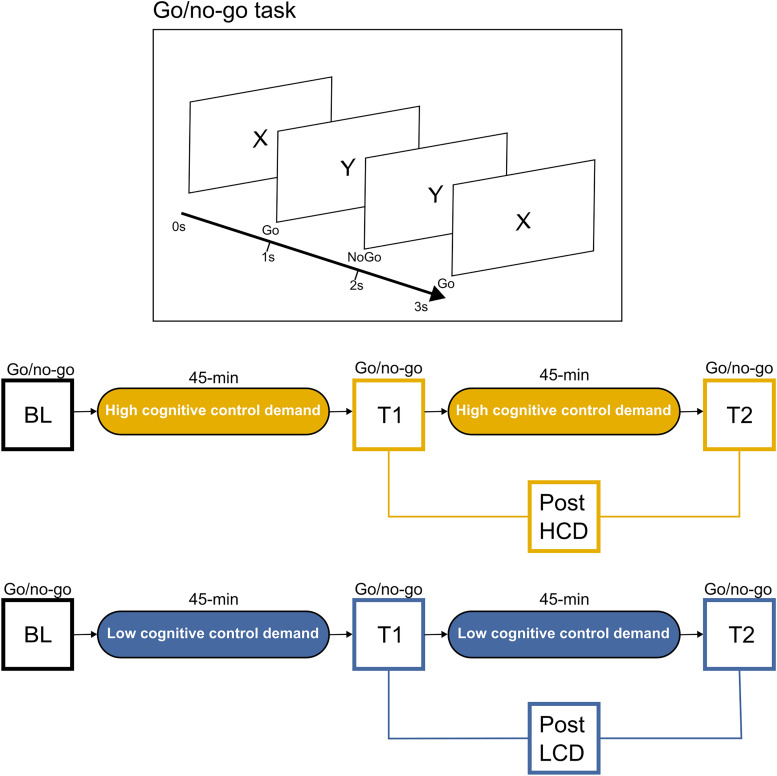
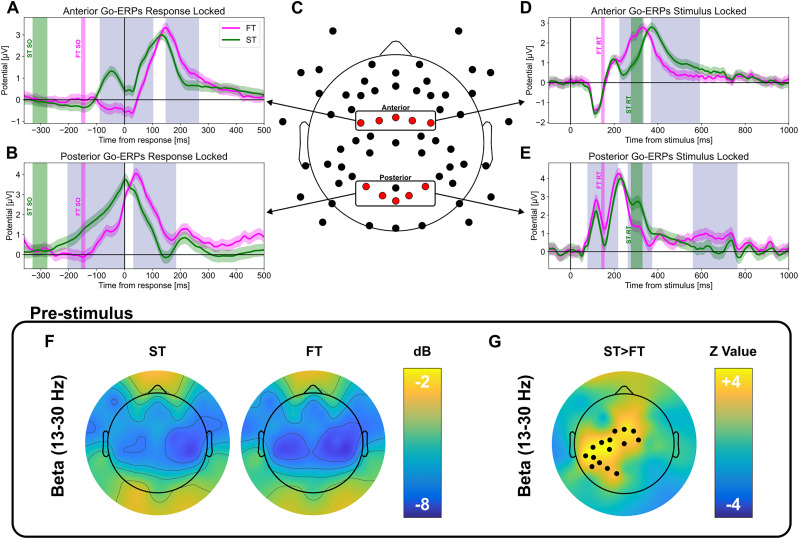
Extended performance of cognitively demanding tasks induces cognitive fatigue manifested with an overall deterioration of behavioral performance. In particular, long practice with tasks requiring impulse control is typically followed by a decrease in self-control efficiency, leading to performance instability. Here, we show that this is due to changes in activation modalities of key task-related areas occurring if these areas previously underwent intensive use. We investigated in 25 healthy adults the effects of extended practice with high cognitive demand (HCD) tasks on a Go-No Go task and the underlying electroencephalographic (EEG) activity. We compared these effects with those induced by practice with similar, but low cognitive demand (LCD) tasks. HCD tasks were followed by an increase in response inhibition failures. These were correlated with the appearance of a distinct neural signature on fast response trials, characterized by lower levels of beta ([13-30] Hz) EEG activity in the prestimulus period, and by a lack of EEG markers of preresponse processing in frontal areas. Moreover, HCD tasks were followed by a decrease in N200 during correct withholds while LCD tasks were followed instead by a lesser fraction of hits and a decrease in P300, suggesting a decrease in engagement. Overall, these results show that exertion of cognitive control determines the appearance of two distinct modalities of response with different processing speeds, associated with distinct underlying neural activity.
期刊介绍:
An open-access journal from the Society for Neuroscience, eNeuro publishes high-quality, broad-based, peer-reviewed research focused solely on the field of neuroscience. eNeuro embodies an emerging scientific vision that offers a new experience for authors and readers, all in support of the Society’s mission to advance understanding of the brain and nervous system.





 京公网安备 11010802042870号
京ICP备2023020795号-1
京公网安备 11010802042870号
京ICP备2023020795号-1

 分享
分享
 求助内容:
求助内容: 应助结果提醒方式:
 扫码关注我们
