{"title":"<i>Nyctanthes arbor-tristis</i> Linn.: comprehensive insights into its medicinal, phytochemical and safety profiles.","authors":"Omkar Tipugade, Jyotiram Sawale, Namdeo Jadhav","doi":"10.1080/14786419.2025.2456086","DOIUrl":null,"url":null,"abstract":"<p><p><i>Nyctanthes arbor-tristis</i> Linn., commonly known as the 'Tree of Sadness' belongs to Oleaceae family. In Ayurvedic, Siddha, Unani, and Homeopathic therapeutic systems, it has been used to treat various conditions, including ulcers, skin diseases, hair loss, piles, liver diseases, rheumatism, and malarial fevers. Anti-inflammatory, anticonvulsant, anticancer, hepatoprotective, antioxidant, and wound healing actions of extracts from <i>N. arbor-tristis</i> Linn. have been verified by researchers. Alkaloids, tannins, flavonoids, sterols, triterpenes, saponins, and glycosides are the bioactive components found in the plant. This review compiles scientific data from various sources, including Scopus, PubMed, ScienceDirect, and Google Scholar, to provide a comprehensive overview of <i>N. arbor-tristis</i> Linn. It focuses on the plant's pharmacological activities, phytochemical properties, phytoformulation, toxicological aspects, and ethnomedicinal uses, summarising worldwide studies. Future research on <i>N. arbor-tristis</i> Linn. should focus on isolating and characterising bioactive compounds, understanding their mechanisms, conducting toxicological assessments for safety, and exploring synergistic effects with other drugs.</p>","PeriodicalId":18990,"journal":{"name":"Natural Product Research","volume":" ","pages":"1-14"},"PeriodicalIF":1.6000,"publicationDate":"2025-01-28","publicationTypes":"Journal Article","fieldsOfStudy":null,"isOpenAccess":false,"openAccessPdf":"","citationCount":"0","resultStr":null,"platform":"Semanticscholar","paperid":null,"PeriodicalName":"Natural Product Research","FirstCategoryId":"92","ListUrlMain":"https://doi.org/10.1080/14786419.2025.2456086","RegionNum":3,"RegionCategory":"化学","ArticlePicture":[],"TitleCN":null,"AbstractTextCN":null,"PMCID":null,"EPubDate":"","PubModel":"","JCR":"Q3","JCRName":"CHEMISTRY, APPLIED","Score":null,"Total":0}
引用次数: 0
Abstract
Nyctanthes arbor-tristis Linn., commonly known as the 'Tree of Sadness' belongs to Oleaceae family. In Ayurvedic, Siddha, Unani, and Homeopathic therapeutic systems, it has been used to treat various conditions, including ulcers, skin diseases, hair loss, piles, liver diseases, rheumatism, and malarial fevers. Anti-inflammatory, anticonvulsant, anticancer, hepatoprotective, antioxidant, and wound healing actions of extracts from N. arbor-tristis Linn. have been verified by researchers. Alkaloids, tannins, flavonoids, sterols, triterpenes, saponins, and glycosides are the bioactive components found in the plant. This review compiles scientific data from various sources, including Scopus, PubMed, ScienceDirect, and Google Scholar, to provide a comprehensive overview of N. arbor-tristis Linn. It focuses on the plant's pharmacological activities, phytochemical properties, phytoformulation, toxicological aspects, and ethnomedicinal uses, summarising worldwide studies. Future research on N. arbor-tristis Linn. should focus on isolating and characterising bioactive compounds, understanding their mechanisms, conducting toxicological assessments for safety, and exploring synergistic effects with other drugs.
期刊介绍:
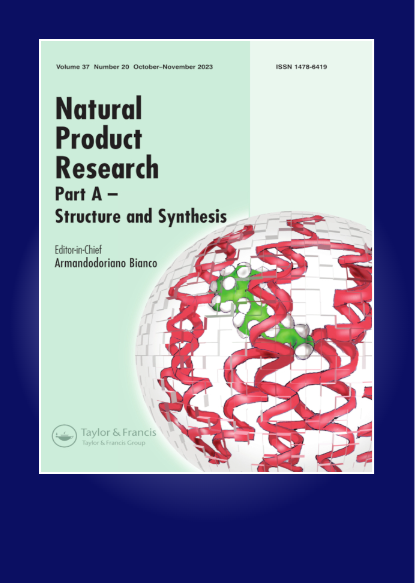
The aim of Natural Product Research is to publish important contributions in the field of natural product chemistry. The journal covers all aspects of research in the chemistry and biochemistry of naturally occurring compounds.
The communications include coverage of work on natural substances of land and sea and of plants, microbes and animals. Discussions of structure elucidation, synthesis and experimental biosynthesis of natural products as well as developments of methods in these areas are welcomed in the journal. Finally, research papers in fields on the chemistry-biology boundary, eg. fermentation chemistry, plant tissue culture investigations etc., are accepted into the journal.
Natural Product Research issues will be subtitled either ""Part A - Synthesis and Structure"" or ""Part B - Bioactive Natural Products"". for details on this , see the forthcoming articles section.
All manuscript submissions are subject to initial appraisal by the Editor, and, if found suitable for further consideration, to peer review by independent, anonymous expert referees. All peer review is single blind and submission is online via ScholarOne Manuscripts.



 京公网安备 11010802042870号
京ICP备2023020795号-1
京公网安备 11010802042870号
京ICP备2023020795号-1

 分享
分享
 求助内容:
求助内容: 应助结果提醒方式:
 扫码关注我们
