Sampathkumar Jeevanandham, Ankur Maji, Anubhab Acharya, Nitee Kumari, Byeong Su Gu, Youngkwan Yoon, Dongmin Lee, Hee Cheul Choi, Hyun Woo Kim, Yongju Yun, Amit Kumar, In Su Lee
{"title":"Ligand-Shell Cooperativity in a Bilayer Silica-Sandwiched Mixed-Metals Nanocatalyst Design for Absolute Selectivity Switch","authors":"Sampathkumar Jeevanandham, Ankur Maji, Anubhab Acharya, Nitee Kumari, Byeong Su Gu, Youngkwan Yoon, Dongmin Lee, Hee Cheul Choi, Hyun Woo Kim, Yongju Yun, Amit Kumar, In Su Lee","doi":"10.1021/acsnano.4c13927","DOIUrl":null,"url":null,"abstract":"Unlike homogeneous metal complexes, achieving absolute control over reaction selectivity in heterogeneous catalysts remains a formidable challenge due to the unguided molecular adsorption/desorption on metal-surface sites. Conventional organic surface modifiers or ligands and rigid inorganic and metal–organic porous shells are not fully effective. Here, we introduce the concept of “ligand-porous shell cooperativity” to desirably <i>switch</i> reaction selectivity in heterogeneous catalysis. We present a nanocatalyst design strategy consisting of bilayer silica-sandwiched 2D mixed metal islands. The intimate 2D/2D nanoscale interfacing between porous silica layers and flat island-like mixed-metal sites, combined with organic ligands, creates a nanoconfined microenvironment that enables reliable control of molecular orientation-dependent reactivity, affording the desired product in 100% selectivity. This design simultaneously leverages the hydrophobicity and flexibility of organic ligands and the nanoscale geometric rigidity of the pores inside the inorganic silica shell. Our strategy is effective with simple amorphous silica, random Cu-alloy, and commonly used metal-coordinating ligands. We demonstrate the applicability in industrially significant reactions: selective hydrogenation of alkynes, α,β-unsaturated esters/aldehydes, and nitroarenes. Our findings offer the valuable scope of a multicomponent compact nanoscale design strategy in next-generation switchable, sustainable, and recyclable catalysis.","PeriodicalId":21,"journal":{"name":"ACS Nano","volume":"36 1","pages":""},"PeriodicalIF":16.0000,"publicationDate":"2025-01-29","publicationTypes":"Journal Article","fieldsOfStudy":null,"isOpenAccess":false,"openAccessPdf":"","citationCount":"0","resultStr":null,"platform":"Semanticscholar","paperid":null,"PeriodicalName":"ACS Nano","FirstCategoryId":"88","ListUrlMain":"https://doi.org/10.1021/acsnano.4c13927","RegionNum":1,"RegionCategory":"材料科学","ArticlePicture":[],"TitleCN":null,"AbstractTextCN":null,"PMCID":null,"EPubDate":"","PubModel":"","JCR":"Q1","JCRName":"CHEMISTRY, MULTIDISCIPLINARY","Score":null,"Total":0}
引用次数: 0
Abstract
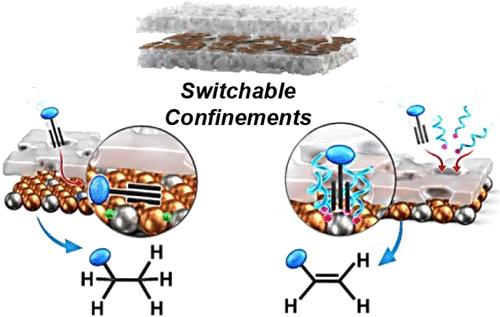
Unlike homogeneous metal complexes, achieving absolute control over reaction selectivity in heterogeneous catalysts remains a formidable challenge due to the unguided molecular adsorption/desorption on metal-surface sites. Conventional organic surface modifiers or ligands and rigid inorganic and metal–organic porous shells are not fully effective. Here, we introduce the concept of “ligand-porous shell cooperativity” to desirably switch reaction selectivity in heterogeneous catalysis. We present a nanocatalyst design strategy consisting of bilayer silica-sandwiched 2D mixed metal islands. The intimate 2D/2D nanoscale interfacing between porous silica layers and flat island-like mixed-metal sites, combined with organic ligands, creates a nanoconfined microenvironment that enables reliable control of molecular orientation-dependent reactivity, affording the desired product in 100% selectivity. This design simultaneously leverages the hydrophobicity and flexibility of organic ligands and the nanoscale geometric rigidity of the pores inside the inorganic silica shell. Our strategy is effective with simple amorphous silica, random Cu-alloy, and commonly used metal-coordinating ligands. We demonstrate the applicability in industrially significant reactions: selective hydrogenation of alkynes, α,β-unsaturated esters/aldehydes, and nitroarenes. Our findings offer the valuable scope of a multicomponent compact nanoscale design strategy in next-generation switchable, sustainable, and recyclable catalysis.
期刊介绍:
ACS Nano, published monthly, serves as an international forum for comprehensive articles on nanoscience and nanotechnology research at the intersections of chemistry, biology, materials science, physics, and engineering. The journal fosters communication among scientists in these communities, facilitating collaboration, new research opportunities, and advancements through discoveries. ACS Nano covers synthesis, assembly, characterization, theory, and simulation of nanostructures, nanobiotechnology, nanofabrication, methods and tools for nanoscience and nanotechnology, and self- and directed-assembly. Alongside original research articles, it offers thorough reviews, perspectives on cutting-edge research, and discussions envisioning the future of nanoscience and nanotechnology.



 京公网安备 11010802042870号
京ICP备2023020795号-1
京公网安备 11010802042870号
京ICP备2023020795号-1

 分享
分享
 求助内容:
求助内容: 应助结果提醒方式:
 扫码关注我们
