Pei Liu, Boyang Yu, Yilin Zeng, Yifan Zhang, Xuan Cai, Xue Long, Hua Jiang, Wendong Yang, Shuangyan Gui, Jinhua Guo, Jia Li, Jun Zhou and Jiangjiang Duan
{"title":"Thermosensitive slurry electrolyte design for efficient electrochemical heat harvesting†","authors":"Pei Liu, Boyang Yu, Yilin Zeng, Yifan Zhang, Xuan Cai, Xue Long, Hua Jiang, Wendong Yang, Shuangyan Gui, Jinhua Guo, Jia Li, Jun Zhou and Jiangjiang Duan","doi":"10.1039/D4EE04976D","DOIUrl":null,"url":null,"abstract":"<p >Efficient and cost-effective recovery technologies are needed to harvest the abundant energy stored in low-grade heat sources (<100 °C). A thermally regenerative electrochemical cycle (TREC) is a promising approach for low-grade heat harvesting with high energy conversion efficiency. Here, we achieved co-optimization of the temperature coefficient (−3.96 mV K<small><sup>−1</sup></small>), specific charge capacity (theoretical, 97.36 A h L<small><sup>−1</sup></small>) and specific heat capacity in a TREC by applying a thermosensitive slurry electrolyte system, in which Fe(CN)<small><sub>6</sub></small><small><sup>4−</sup></small>-based thermosensitive crystallization was incorporated into the Fe(CN)<small><sub>6</sub></small><small><sup>3−/4−</sup></small> solution. We demonstrated an electrically assisted TREC system with a Fe(CN)<small><sub>6</sub></small><small><sup>3−/4−</sup></small> catholyte and an Ag/AgCl anode, and a charging-free TREC system with a Fe(CN)<small><sub>6</sub></small><small><sup>3−/4−</sup></small> catholyte and an I<small><sub>3</sub></small><small><sup>−</sup></small>/I<small><sup>−</sup></small> anolyte. Both systems exhibit high absolute heat-to-electricity energy conversion efficiencies of 4.42% and 2.51%, respectively, in the absence of heat recuperation. This study provides a general approach to electrolyte design aimed at enhancing the temperature coefficient and specific charge capacity, while simultaneously optimizing specific heat capacity, thereby facilitating the development of more efficient TREC systems.</p>","PeriodicalId":72,"journal":{"name":"Energy & Environmental Science","volume":" 6","pages":" 2852-2860"},"PeriodicalIF":30.8000,"publicationDate":"2025-01-29","publicationTypes":"Journal Article","fieldsOfStudy":null,"isOpenAccess":false,"openAccessPdf":"","citationCount":"0","resultStr":null,"platform":"Semanticscholar","paperid":null,"PeriodicalName":"Energy & Environmental Science","FirstCategoryId":"88","ListUrlMain":"https://pubs.rsc.org/en/content/articlelanding/2025/ee/d4ee04976d","RegionNum":1,"RegionCategory":"材料科学","ArticlePicture":[],"TitleCN":null,"AbstractTextCN":null,"PMCID":null,"EPubDate":"","PubModel":"","JCR":"Q1","JCRName":"CHEMISTRY, MULTIDISCIPLINARY","Score":null,"Total":0}
引用次数: 0
Abstract
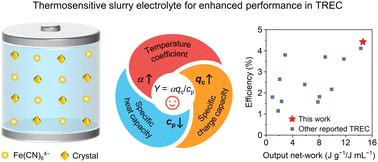
Efficient and cost-effective recovery technologies are needed to harvest the abundant energy stored in low-grade heat sources (<100 °C). A thermally regenerative electrochemical cycle (TREC) is a promising approach for low-grade heat harvesting with high energy conversion efficiency. Here, we achieved co-optimization of the temperature coefficient (−3.96 mV K−1), specific charge capacity (theoretical, 97.36 A h L−1) and specific heat capacity in a TREC by applying a thermosensitive slurry electrolyte system, in which Fe(CN)64−-based thermosensitive crystallization was incorporated into the Fe(CN)63−/4− solution. We demonstrated an electrically assisted TREC system with a Fe(CN)63−/4− catholyte and an Ag/AgCl anode, and a charging-free TREC system with a Fe(CN)63−/4− catholyte and an I3−/I− anolyte. Both systems exhibit high absolute heat-to-electricity energy conversion efficiencies of 4.42% and 2.51%, respectively, in the absence of heat recuperation. This study provides a general approach to electrolyte design aimed at enhancing the temperature coefficient and specific charge capacity, while simultaneously optimizing specific heat capacity, thereby facilitating the development of more efficient TREC systems.
期刊介绍:
Energy & Environmental Science, a peer-reviewed scientific journal, publishes original research and review articles covering interdisciplinary topics in the (bio)chemical and (bio)physical sciences, as well as chemical engineering disciplines. Published monthly by the Royal Society of Chemistry (RSC), a not-for-profit publisher, Energy & Environmental Science is recognized as a leading journal. It boasts an impressive impact factor of 8.500 as of 2009, ranking 8th among 140 journals in the category "Chemistry, Multidisciplinary," second among 71 journals in "Energy & Fuels," second among 128 journals in "Engineering, Chemical," and first among 181 scientific journals in "Environmental Sciences."
Energy & Environmental Science publishes various types of articles, including Research Papers (original scientific work), Review Articles, Perspectives, and Minireviews (feature review-type articles of broad interest), Communications (original scientific work of an urgent nature), Opinions (personal, often speculative viewpoints or hypotheses on current topics), and Analysis Articles (in-depth examination of energy-related issues).



 京公网安备 11010802042870号
京ICP备2023020795号-1
京公网安备 11010802042870号
京ICP备2023020795号-1

 分享
分享
 求助内容:
求助内容: 应助结果提醒方式:
 扫码关注我们
