Chenming Zhou, Zhezhong Zhang, Mu Zhang, Xudong Sun, Jun Zhang, Gang Huang and Zhaolin Na
{"title":"Targeted deflection of Zn2+ migration trajectory using the piezomagnetic effect to enable horizontal Zn deposition†","authors":"Chenming Zhou, Zhezhong Zhang, Mu Zhang, Xudong Sun, Jun Zhang, Gang Huang and Zhaolin Na","doi":"10.1039/D4EE04115A","DOIUrl":null,"url":null,"abstract":"<p >The rampant growth of dendrites caused by the inhomogeneous Zn<small><sup>2+</sup></small> ion flux and “tip effect” significantly hinders the development of aqueous Zn-ion batteries. The conventional artificial protective layers (APLs) improve Zn anode stability predominantly through promoting uniform Zn deposition across the entire surface, but still lack targeted control over the localized Zn<small><sup>2+</sup></small> migration at the tips, resulting in insufficient suppression of protrusion growth. Herein, we have constructed a cobalt ferrite oxide magnetically functional layer on Zn foil (CFO–Zn), endowing the APLs with the ability to precisely control the migration and deposition behaviors of Zn<small><sup>2+</sup></small><em>via</em> the piezomagnetic effect. The stress generated on the CFO layer during the deposition process could induce local magnetic field enhancement, deflecting Zn<small><sup>2+</sup></small> away from the tips, stopping the protrusion growth and consequently rendering the Zn deposition along the horizontal direction. Meanwhile, the CFO magnetic nanoparticles can accelerate and disperse the Zn<small><sup>2+</sup></small> flow on the anode surface, resulting in improved ion transport and reduced Zn<small><sup>2+</sup></small> concentration gradient. Additionally, the Zn<small><sup>2+</sup></small> motion trajectory under electric/magnetic field co-induction has been simulated, confirming the ability of the magnetic field to deflect Zn<small><sup>2+</sup></small> migration. The CFO–Zn anodes achieve highly reversible Zn stripping/plating with a cumulative plated capacity of 4750 mA h cm<small><sup>−2</sup></small>.</p>","PeriodicalId":72,"journal":{"name":"Energy & Environmental Science","volume":" 8","pages":" 3817-3827"},"PeriodicalIF":30.8000,"publicationDate":"2025-03-07","publicationTypes":"Journal Article","fieldsOfStudy":null,"isOpenAccess":false,"openAccessPdf":"","citationCount":"0","resultStr":null,"platform":"Semanticscholar","paperid":null,"PeriodicalName":"Energy & Environmental Science","FirstCategoryId":"88","ListUrlMain":"https://pubs.rsc.org/en/content/articlelanding/2025/ee/d4ee04115a","RegionNum":1,"RegionCategory":"材料科学","ArticlePicture":[],"TitleCN":null,"AbstractTextCN":null,"PMCID":null,"EPubDate":"","PubModel":"","JCR":"Q1","JCRName":"CHEMISTRY, MULTIDISCIPLINARY","Score":null,"Total":0}
引用次数: 0
Abstract
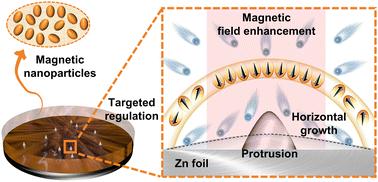
The rampant growth of dendrites caused by the inhomogeneous Zn2+ ion flux and “tip effect” significantly hinders the development of aqueous Zn-ion batteries. The conventional artificial protective layers (APLs) improve Zn anode stability predominantly through promoting uniform Zn deposition across the entire surface, but still lack targeted control over the localized Zn2+ migration at the tips, resulting in insufficient suppression of protrusion growth. Herein, we have constructed a cobalt ferrite oxide magnetically functional layer on Zn foil (CFO–Zn), endowing the APLs with the ability to precisely control the migration and deposition behaviors of Zn2+via the piezomagnetic effect. The stress generated on the CFO layer during the deposition process could induce local magnetic field enhancement, deflecting Zn2+ away from the tips, stopping the protrusion growth and consequently rendering the Zn deposition along the horizontal direction. Meanwhile, the CFO magnetic nanoparticles can accelerate and disperse the Zn2+ flow on the anode surface, resulting in improved ion transport and reduced Zn2+ concentration gradient. Additionally, the Zn2+ motion trajectory under electric/magnetic field co-induction has been simulated, confirming the ability of the magnetic field to deflect Zn2+ migration. The CFO–Zn anodes achieve highly reversible Zn stripping/plating with a cumulative plated capacity of 4750 mA h cm−2.
由于Zn2+离子通量不均匀和“尖端效应”导致的枝晶生长猖獗,严重阻碍了含水锌离子电池的发展。传统的人工保护层(api)主要通过促进锌在整个表面均匀沉积来提高锌阳极的稳定性,但仍然缺乏对尖端局部Zn2+迁移的针对性控制,导致对突出生长的抑制不足。为此,我们在锌箔上构建了钴铁氧体氧化物磁功能层(CFO-Zn),使api能够通过压磁效应有针对性地控制Zn2+的迁移和沉积行为。沉积过程中在CFO层上产生的应力会引起局部磁场增强,使Zn2+偏离尖端,阻止突出物的生长,从而使Zn沿水平方向沉积。同时,CFO磁性纳米颗粒可以加速和分散Zn2+在阳极表面的流动,从而提高离子输运率,降低Zn2+浓度梯度。模拟了电场/磁场共感应作用下Zn2+的运动轨迹,证实了磁场对Zn2+迁移的偏转能力。CFO-Zn阳极在4750 mAh cm-2的累计镀容量下实现了高度可逆的Zn剥离/镀。
期刊介绍:
Energy & Environmental Science, a peer-reviewed scientific journal, publishes original research and review articles covering interdisciplinary topics in the (bio)chemical and (bio)physical sciences, as well as chemical engineering disciplines. Published monthly by the Royal Society of Chemistry (RSC), a not-for-profit publisher, Energy & Environmental Science is recognized as a leading journal. It boasts an impressive impact factor of 8.500 as of 2009, ranking 8th among 140 journals in the category "Chemistry, Multidisciplinary," second among 71 journals in "Energy & Fuels," second among 128 journals in "Engineering, Chemical," and first among 181 scientific journals in "Environmental Sciences."
Energy & Environmental Science publishes various types of articles, including Research Papers (original scientific work), Review Articles, Perspectives, and Minireviews (feature review-type articles of broad interest), Communications (original scientific work of an urgent nature), Opinions (personal, often speculative viewpoints or hypotheses on current topics), and Analysis Articles (in-depth examination of energy-related issues).



 京公网安备 11010802042870号
京ICP备2023020795号-1
京公网安备 11010802042870号
京ICP备2023020795号-1

 分享
分享
 求助内容:
求助内容: 应助结果提醒方式:
 扫码关注我们
