DORON ARONSON MD , YAACOV NITZAN , SIROUCH PETCHERSKI MD , AVIV SHAUL MD , WILLIAM T. ABRAHAM MD , DANIEL BURKHOFF , TUVIA BEN GAL MD
{"title":"Enhancing Sweat Rate for In-Hospital and Home-Based Decongestive Therapy","authors":"DORON ARONSON MD , YAACOV NITZAN , SIROUCH PETCHERSKI MD , AVIV SHAUL MD , WILLIAM T. ABRAHAM MD , DANIEL BURKHOFF , TUVIA BEN GAL MD","doi":"10.1016/j.cardfail.2025.01.010","DOIUrl":null,"url":null,"abstract":"<div><h3>Background</h3><div>The interstitial fluid compartment is disproportionally expanded in heart failure (HF). Enhancing sweat rate removes fluids and sodium directly from the interstitial compartment.</div></div><div><h3>Objectives</h3><div>To study the feasibility and efficacy of direct interstitial decongestion in hospitalized HF patients.</div></div><div><h3>Methods</h3><div>We used a device designed to enhance fluid and salt expulsion via the eccrine sweat glands. Patients were treated for 1 to 6 days in the hospital. Following discharge, home therapy continued for 30 to 60 days (1–4 treatments/week). The primary efficacy endpoint for the in-hospital phase was a fluid loss of ≥500 mL per ≥4 hours per treatment. Secondary performance endpoints included changes in congestion score and N-terminal pro b-type natriuretic peptide (NT-proBNP) levels, evaluated for each phase separately.</div></div><div><h3>Results</h3><div>We studied 15 patients, 12 completing both the hospital and home phases. During the in-hospital phase, median weight change due to device therapy was 2.4 kg (interquartile range [IQR] 2.20–3.77), and the primary endpoint was met in 86% of treatment sessions. During the home treatment, median weight loss was 3.1 kg (IQR 0.6 to 7.4 Kg). Congestion score declined from 6 (IQR 6–7) to 1 (IQR 1–1.5) at the end of home therapy (<em>P</em> = 0.002). Median NT-proBNP levels decreased from 7732 (IQR 4694–9746) to 4984 pg/mL (IQR 3559–8950, <em>P</em> = 0.01) during the hospital phase and to 3596 ng/mL (IQR 1640-5742, <em>P</em> = 0.02) at the end of home therapy.</div></div><div><h3>Conclusion</h3><div>Fluid removal via the skin is an effective strategy for enhancing decongestion in hospitalized patients with acute decompensated heart failure. Following hospital discharge, device therapy was associated with additional improvement in decongestion.</div></div>","PeriodicalId":15204,"journal":{"name":"Journal of Cardiac Failure","volume":"32 1","pages":"Pages 5-12"},"PeriodicalIF":8.2000,"publicationDate":"2026-01-01","publicationTypes":"Journal Article","fieldsOfStudy":null,"isOpenAccess":false,"openAccessPdf":"","citationCount":"0","resultStr":null,"platform":"Semanticscholar","paperid":null,"PeriodicalName":"Journal of Cardiac Failure","FirstCategoryId":"3","ListUrlMain":"https://www.sciencedirect.com/science/article/pii/S1071916425000405","RegionNum":2,"RegionCategory":"医学","ArticlePicture":[],"TitleCN":null,"AbstractTextCN":null,"PMCID":null,"EPubDate":"2025/1/29 0:00:00","PubModel":"Epub","JCR":"Q1","JCRName":"CARDIAC & CARDIOVASCULAR SYSTEMS","Score":null,"Total":0}
引用次数: 0
Abstract
Background
The interstitial fluid compartment is disproportionally expanded in heart failure (HF). Enhancing sweat rate removes fluids and sodium directly from the interstitial compartment.
Objectives
To study the feasibility and efficacy of direct interstitial decongestion in hospitalized HF patients.
Methods
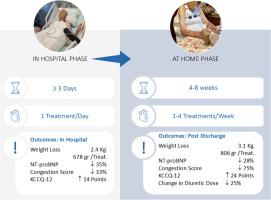
We used a device designed to enhance fluid and salt expulsion via the eccrine sweat glands. Patients were treated for 1 to 6 days in the hospital. Following discharge, home therapy continued for 30 to 60 days (1–4 treatments/week). The primary efficacy endpoint for the in-hospital phase was a fluid loss of ≥500 mL per ≥4 hours per treatment. Secondary performance endpoints included changes in congestion score and N-terminal pro b-type natriuretic peptide (NT-proBNP) levels, evaluated for each phase separately.
Results
We studied 15 patients, 12 completing both the hospital and home phases. During the in-hospital phase, median weight change due to device therapy was 2.4 kg (interquartile range [IQR] 2.20–3.77), and the primary endpoint was met in 86% of treatment sessions. During the home treatment, median weight loss was 3.1 kg (IQR 0.6 to 7.4 Kg). Congestion score declined from 6 (IQR 6–7) to 1 (IQR 1–1.5) at the end of home therapy (P = 0.002). Median NT-proBNP levels decreased from 7732 (IQR 4694–9746) to 4984 pg/mL (IQR 3559–8950, P = 0.01) during the hospital phase and to 3596 ng/mL (IQR 1640-5742, P = 0.02) at the end of home therapy.
Conclusion
Fluid removal via the skin is an effective strategy for enhancing decongestion in hospitalized patients with acute decompensated heart failure. Following hospital discharge, device therapy was associated with additional improvement in decongestion.
期刊介绍:
Journal of Cardiac Failure publishes original, peer-reviewed communications of scientific excellence and review articles on clinical research, basic human studies, animal studies, and bench research with potential clinical applications to heart failure - pathogenesis, etiology, epidemiology, pathophysiological mechanisms, assessment, prevention, and treatment.



 京公网安备 11010802042870号
京ICP备2023020795号-1
京公网安备 11010802042870号
京ICP备2023020795号-1

 分享
分享
 求助内容:
求助内容: 应助结果提醒方式:
 扫码关注我们
