{"title":"Natural Language Processing (NLP): Identifying Linguistic Gender Bias in Electronic Medical Records (EMRs).","authors":"Site Xu, Mu Sun","doi":"10.1177/23743735251314843","DOIUrl":null,"url":null,"abstract":"<p><p>With the rise of feminism, women report experiencing doubt or discrimination in medical settings. This study aims to explore the linguistic mechanisms by which physicians express disbelief toward patients and to investigate gender differences in the use of negative medical descriptions. A content analysis of 285 electronic medical records was conducted to identify 4 linguistic bias features: judging, reporting, quoting, and fudging. Sentiment classification and knowledge graph with ICD-11 were used to determine the prevalence of these features in the medical records, and logistic regression was applied to test gender differences. A total of 2354 descriptions were analyzed, with 64.7% of the patients identified as male. Descriptions of female patients contained fewer judgmental linguistic features but more fudging-related linguistic features compared to male patients (judging: OR 0.69, 95% CI 0.54-0.88, <i>p</i> < 0.01; fudging: OR 1.38, 95% CI 1.09-1.75, <i>p</i> < 0.01). No significant differences were found in the use of reporting (OR 0.95, 95% CI 0.61-1.47, <i>p</i> = 0.81) and quoting (OR 0.99, 95% CI 0.72-1.36, <i>p</i> = 0.96) between male and female patients. This study highlights how physicians may express disbelief toward patients through linguistic biases, particularly through the use of judging and fudging language. Both male and female patients may face different types of systematic bias from physicians, with female patients experiencing more fudging-related language and less judgmental language compared to male patients. These differences point to a potential mechanism through which gender disparities in healthcare quality may arise, underscoring the need for further investigation and action to address these biases.</p>","PeriodicalId":45073,"journal":{"name":"Journal of Patient Experience","volume":"12 ","pages":"23743735251314843"},"PeriodicalIF":1.8000,"publicationDate":"2025-01-31","publicationTypes":"Journal Article","fieldsOfStudy":null,"isOpenAccess":false,"openAccessPdf":"https://www.ncbi.nlm.nih.gov/pmc/articles/PMC11786286/pdf/","citationCount":"0","resultStr":null,"platform":"Semanticscholar","paperid":null,"PeriodicalName":"Journal of Patient Experience","FirstCategoryId":"1085","ListUrlMain":"https://doi.org/10.1177/23743735251314843","RegionNum":0,"RegionCategory":null,"ArticlePicture":[],"TitleCN":null,"AbstractTextCN":null,"PMCID":null,"EPubDate":"2025/1/1 0:00:00","PubModel":"eCollection","JCR":"Q3","JCRName":"HEALTH CARE SCIENCES & SERVICES","Score":null,"Total":0}
引用次数: 0
Abstract
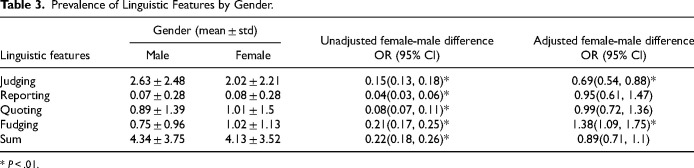
With the rise of feminism, women report experiencing doubt or discrimination in medical settings. This study aims to explore the linguistic mechanisms by which physicians express disbelief toward patients and to investigate gender differences in the use of negative medical descriptions. A content analysis of 285 electronic medical records was conducted to identify 4 linguistic bias features: judging, reporting, quoting, and fudging. Sentiment classification and knowledge graph with ICD-11 were used to determine the prevalence of these features in the medical records, and logistic regression was applied to test gender differences. A total of 2354 descriptions were analyzed, with 64.7% of the patients identified as male. Descriptions of female patients contained fewer judgmental linguistic features but more fudging-related linguistic features compared to male patients (judging: OR 0.69, 95% CI 0.54-0.88, p < 0.01; fudging: OR 1.38, 95% CI 1.09-1.75, p < 0.01). No significant differences were found in the use of reporting (OR 0.95, 95% CI 0.61-1.47, p = 0.81) and quoting (OR 0.99, 95% CI 0.72-1.36, p = 0.96) between male and female patients. This study highlights how physicians may express disbelief toward patients through linguistic biases, particularly through the use of judging and fudging language. Both male and female patients may face different types of systematic bias from physicians, with female patients experiencing more fudging-related language and less judgmental language compared to male patients. These differences point to a potential mechanism through which gender disparities in healthcare quality may arise, underscoring the need for further investigation and action to address these biases.
随着女权主义的兴起,妇女报告在医疗环境中受到怀疑或歧视。本研究旨在探讨医生对病人表达不相信的语言机制,并探讨在使用否定医学描述方面的性别差异。通过对285份电子病历的内容分析,找出判断、报告、引用和捏造4个语言偏差特征。使用ICD-11的情感分类和知识图谱来确定这些特征在病历中的流行程度,并应用逻辑回归来检验性别差异。共分析2354份病例描述,其中男性占64.7%。与男性患者相比,女性患者描述中的判断性语言特征较少,但与捏造相关的语言特征较多(判断性:OR 0.69, 95% CI 0.54 ~ 0.88, p < 0.01;捏造:OR 1.38, 95% CI 1.09-1.75, p < 0.01)。男女患者在报告(OR 0.95, 95% CI 0.61-1.47, p = 0.81)和引用(OR 0.99, 95% CI 0.72-1.36, p = 0.96)的使用上无显著差异。这项研究强调了医生如何通过语言偏见,特别是通过使用判断和捏造语言来表达对病人的怀疑。男性和女性患者都可能面临来自医生的不同类型的系统性偏见,与男性患者相比,女性患者会经历更多的与捏造相关的语言,而较少的判断语言。这些差异指出了一种可能的机制,通过这种机制可能产生医疗保健质量方面的性别差异,强调需要进一步调查和采取行动来解决这些偏见。






 京公网安备 11010802042870号
京ICP备2023020795号-1
京公网安备 11010802042870号
京ICP备2023020795号-1

 分享
分享
 求助内容:
求助内容: 应助结果提醒方式:
 扫码关注我们
