Rachelle N Binny, Graham J Hickling, Alex James, Chris N Niebuhr
{"title":"Modelling transmission and control of <i>Toxoplasma gondii</i> in New Zealand farmland.","authors":"Rachelle N Binny, Graham J Hickling, Alex James, Chris N Niebuhr","doi":"10.1098/rsos.241282","DOIUrl":null,"url":null,"abstract":"<p><p><i>Toxoplasma gondii</i> is one of the world's most prevalent parasites and has significant impacts on the health of humans, domestic animals and wildlife. In New Zealand's rural environments, <i>T. gondii</i> creates economic losses for the farming industry and threatens vulnerable native avifauna and marine mammals. Predator control of rodents and feral cats has potential to reduce or even eliminate transmission of <i>T. gondii</i> on farms; however, the efficacy of such management is uncertain. We apply a mathematical model of <i>T. gondii</i> transmission dynamics in feral cat and rodent populations in New Zealand farmland and simulate varying intensities of predator control to predict changes in <i>T. gondii</i> prevalence and environmental contamination levels over time. The model predicts that predator control is relatively ineffective for reducing transmission in areas with high environmental contamination rates. However, assuming low rates of environmental contamination, local elimination of <i>T. gondii</i> could be achievable, for example, by control that sustains large reductions of 88%, 69% and 59% in feral cat, house mouse and ship rat populations, respectively, over 56 weeks. Predator control is, therefore, a potentially viable approach for managing <i>T. gondii</i> in some rural environments, but only if high levels of population control are sustained.</p>","PeriodicalId":21525,"journal":{"name":"Royal Society Open Science","volume":"12 2","pages":"241282"},"PeriodicalIF":3.0000,"publicationDate":"2025-02-05","publicationTypes":"Journal Article","fieldsOfStudy":null,"isOpenAccess":false,"openAccessPdf":"https://www.ncbi.nlm.nih.gov/pmc/articles/PMC11793971/pdf/","citationCount":"0","resultStr":null,"platform":"Semanticscholar","paperid":null,"PeriodicalName":"Royal Society Open Science","FirstCategoryId":"103","ListUrlMain":"https://doi.org/10.1098/rsos.241282","RegionNum":3,"RegionCategory":"综合性期刊","ArticlePicture":[],"TitleCN":null,"AbstractTextCN":null,"PMCID":null,"EPubDate":"2025/2/1 0:00:00","PubModel":"eCollection","JCR":"Q1","JCRName":"MULTIDISCIPLINARY SCIENCES","Score":null,"Total":0}
引用次数: 0
Abstract
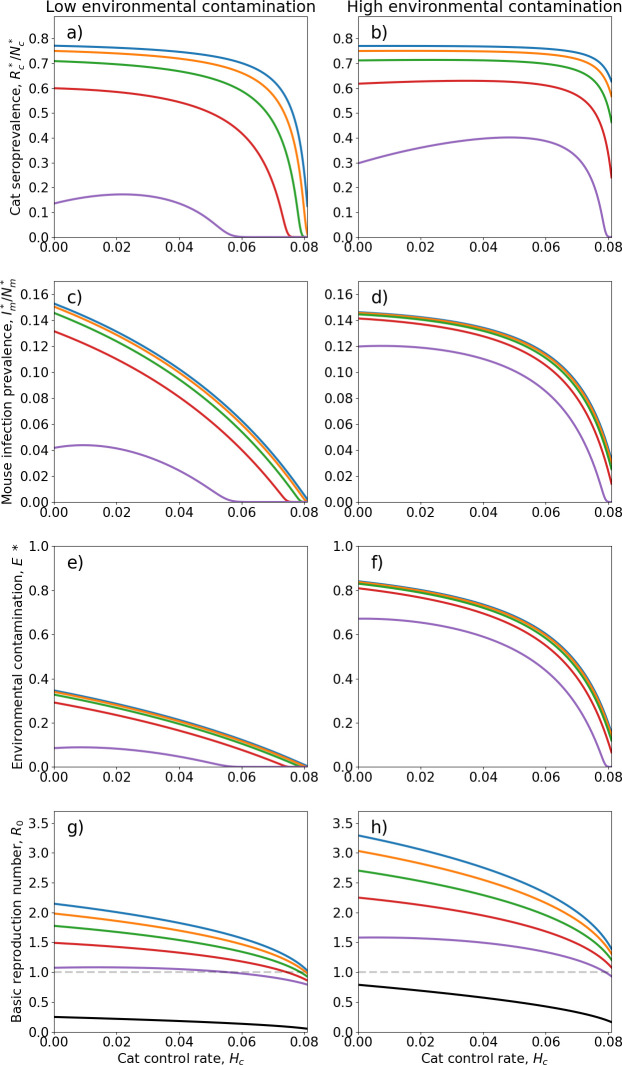
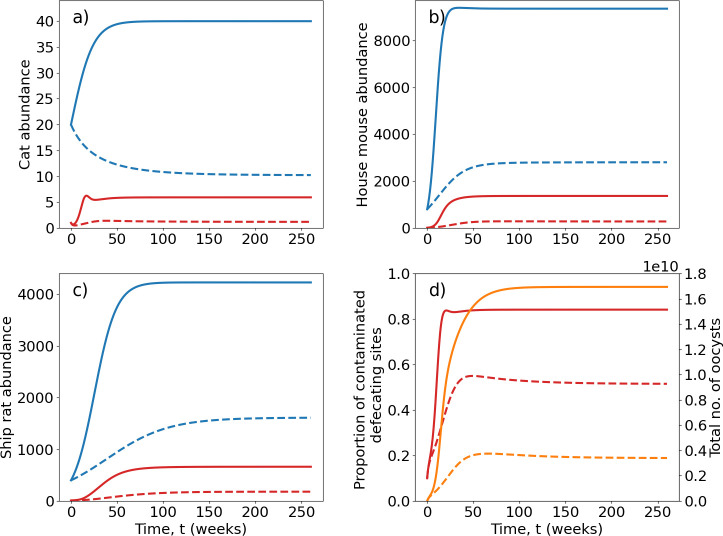
Toxoplasma gondii is one of the world's most prevalent parasites and has significant impacts on the health of humans, domestic animals and wildlife. In New Zealand's rural environments, T. gondii creates economic losses for the farming industry and threatens vulnerable native avifauna and marine mammals. Predator control of rodents and feral cats has potential to reduce or even eliminate transmission of T. gondii on farms; however, the efficacy of such management is uncertain. We apply a mathematical model of T. gondii transmission dynamics in feral cat and rodent populations in New Zealand farmland and simulate varying intensities of predator control to predict changes in T. gondii prevalence and environmental contamination levels over time. The model predicts that predator control is relatively ineffective for reducing transmission in areas with high environmental contamination rates. However, assuming low rates of environmental contamination, local elimination of T. gondii could be achievable, for example, by control that sustains large reductions of 88%, 69% and 59% in feral cat, house mouse and ship rat populations, respectively, over 56 weeks. Predator control is, therefore, a potentially viable approach for managing T. gondii in some rural environments, but only if high levels of population control are sustained.
期刊介绍:
Royal Society Open Science is a new open journal publishing high-quality original research across the entire range of science on the basis of objective peer-review.
The journal covers the entire range of science and mathematics and will allow the Society to publish all the high-quality work it receives without the usual restrictions on scope, length or impact.





 京公网安备 11010802042870号
京ICP备2023020795号-1
京公网安备 11010802042870号
京ICP备2023020795号-1

 分享
分享
 求助内容:
求助内容: 应助结果提醒方式:
 扫码关注我们
