Energy intake insufficiency due to underestimated energy requirement by common predictive formulas can be identified by urinary amino acid levels in advanced heart failure.
{"title":"Energy intake insufficiency due to underestimated energy requirement by common predictive formulas can be identified by urinary amino acid levels in advanced heart failure.","authors":"Yoko Sakamoto, Tomohito Ohtani, Kei Nakamoto, Fusako Sera, Shungo Hikoso, Yasushi Sakata","doi":"10.3389/fnut.2024.1504031","DOIUrl":null,"url":null,"abstract":"<p><strong>Background: </strong>Elevated resting energy expenditure (REE) promotes cachexia, worsening prognosis in patients with advanced heart failure (HF). However, adequate assessment of energy balance is challenging because of unvalidated common prediction methods and unestablished determinants of REE, resulting in a lack of biomarkers for predicting insufficient energy intake.</p><p><strong>Objective: </strong>This cross-sectional study aimed to evaluate REE in patients with advanced HF and explore biomarkers for insufficient energy intake.</p><p><strong>Methods: </strong>We measured REE by indirect calorimetry and calculated the total energy expenditure (TEE) of 72 hospitalized patients with advanced-stage HF. We compared these values with commonly-used formulas and analyzed the associations between REE per body weight (REEBW) and parameters related to hemodynamics and HF severity. In 17 of 72 patients, plasma amino acid (AA) and 24-h urinary AA concentrations were measured to analyze their correlations with energy balance, the ratio of caloric intake to REE.</p><p><strong>Results: </strong>Resting energy expenditure and TEE values were significantly higher than the predicted values. The mean REEBW was 25 kcal/kg/day, while that for the underweight (<18.5 kg/m<sup>2</sup>) was 28 kcal/kg/day. We found a significant negative correlation between REEBW and body mass index (BMI), but no significant correlation between REEBW and HF-related parameters. The difference between TEE and predicted TEE using the European Society for Clinical Nutrition and Metabolism formula was most significant in the underweight patients because of underestimation, whereas TEE and pTEE using our modified formula with coefficients by BMI categories did not differ. There was a significant correlation between energy balance and urinary histidine and its metabolite 3-methylhistidine excretion, but no significant correlation with serum albumin and other AA concentrations.</p><p><strong>Conclusion: </strong>Underweight patients with advanced HF require more energy per weight than the predicted value. Our proposed formula for pTEE in each BMI category may be useful in clinical practice to avoid underestimation of daily energy requirements. Inadequate energy intake, even with such an approach, may be identified by decreased urinary essential AA levels.</p>","PeriodicalId":12473,"journal":{"name":"Frontiers in Nutrition","volume":"11 ","pages":"1504031"},"PeriodicalIF":4.0000,"publicationDate":"2025-01-23","publicationTypes":"Journal Article","fieldsOfStudy":null,"isOpenAccess":false,"openAccessPdf":"https://www.ncbi.nlm.nih.gov/pmc/articles/PMC11798816/pdf/","citationCount":"0","resultStr":null,"platform":"Semanticscholar","paperid":null,"PeriodicalName":"Frontiers in Nutrition","FirstCategoryId":"97","ListUrlMain":"https://doi.org/10.3389/fnut.2024.1504031","RegionNum":2,"RegionCategory":"农林科学","ArticlePicture":[],"TitleCN":null,"AbstractTextCN":null,"PMCID":null,"EPubDate":"2024/1/1 0:00:00","PubModel":"eCollection","JCR":"Q2","JCRName":"NUTRITION & DIETETICS","Score":null,"Total":0}
引用次数: 0
Abstract
Background: Elevated resting energy expenditure (REE) promotes cachexia, worsening prognosis in patients with advanced heart failure (HF). However, adequate assessment of energy balance is challenging because of unvalidated common prediction methods and unestablished determinants of REE, resulting in a lack of biomarkers for predicting insufficient energy intake.
Objective: This cross-sectional study aimed to evaluate REE in patients with advanced HF and explore biomarkers for insufficient energy intake.
Methods: We measured REE by indirect calorimetry and calculated the total energy expenditure (TEE) of 72 hospitalized patients with advanced-stage HF. We compared these values with commonly-used formulas and analyzed the associations between REE per body weight (REEBW) and parameters related to hemodynamics and HF severity. In 17 of 72 patients, plasma amino acid (AA) and 24-h urinary AA concentrations were measured to analyze their correlations with energy balance, the ratio of caloric intake to REE.
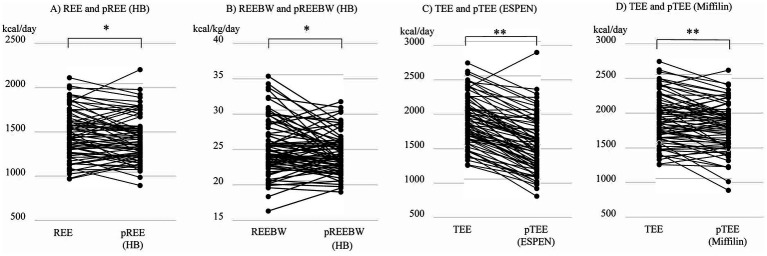
Results: Resting energy expenditure and TEE values were significantly higher than the predicted values. The mean REEBW was 25 kcal/kg/day, while that for the underweight (<18.5 kg/m2) was 28 kcal/kg/day. We found a significant negative correlation between REEBW and body mass index (BMI), but no significant correlation between REEBW and HF-related parameters. The difference between TEE and predicted TEE using the European Society for Clinical Nutrition and Metabolism formula was most significant in the underweight patients because of underestimation, whereas TEE and pTEE using our modified formula with coefficients by BMI categories did not differ. There was a significant correlation between energy balance and urinary histidine and its metabolite 3-methylhistidine excretion, but no significant correlation with serum albumin and other AA concentrations.
Conclusion: Underweight patients with advanced HF require more energy per weight than the predicted value. Our proposed formula for pTEE in each BMI category may be useful in clinical practice to avoid underestimation of daily energy requirements. Inadequate energy intake, even with such an approach, may be identified by decreased urinary essential AA levels.
期刊介绍:
No subject pertains more to human life than nutrition. The aim of Frontiers in Nutrition is to integrate major scientific disciplines in this vast field in order to address the most relevant and pertinent questions and developments. Our ambition is to create an integrated podium based on original research, clinical trials, and contemporary reviews to build a reputable knowledge forum in the domains of human health, dietary behaviors, agronomy & 21st century food science. Through the recognized open-access Frontiers platform we welcome manuscripts to our dedicated sections relating to different areas in the field of nutrition with a focus on human health.
Specialty sections in Frontiers in Nutrition include, for example, Clinical Nutrition, Nutrition & Sustainable Diets, Nutrition and Food Science Technology, Nutrition Methodology, Sport & Exercise Nutrition, Food Chemistry, and Nutritional Immunology. Based on the publication of rigorous scientific research, we thrive to achieve a visible impact on the global nutrition agenda addressing the grand challenges of our time, including obesity, malnutrition, hunger, food waste, sustainability and consumer health.





 京公网安备 11010802042870号
京ICP备2023020795号-1
京公网安备 11010802042870号
京ICP备2023020795号-1

 分享
分享
 求助内容:
求助内容: 应助结果提醒方式:
 扫码关注我们
