Privacy Concerns Versus Personalized Health Content-Pregnant Individuals' Willingness to Share Personal Health Information on Social Media: Survey Study.
Haijing Hao, Yang W Lee, Marianne Sharko, Qilu Li, Yiye Zhang
{"title":"Privacy Concerns Versus Personalized Health Content-Pregnant Individuals' Willingness to Share Personal Health Information on Social Media: Survey Study.","authors":"Haijing Hao, Yang W Lee, Marianne Sharko, Qilu Li, Yiye Zhang","doi":"10.2196/60862","DOIUrl":null,"url":null,"abstract":"<p><strong>Background: </strong>Often lacking immediate access to care providers, pregnant individuals frequently turn to web-based sources for information to address their evolving physical and mental health needs. Social media has gained increasing prominence as a source of news and information despite privacy concerns and unique risks posed to the pregnant population.</p><p><strong>Objectives: </strong>This study investigated the extent to which patients may be willing to disclose personal health information to social media companies in exchange for more personalized health content.</p><p><strong>Methods: </strong>We designed and deployed an electronic survey to pregnant individuals worldwide electronically in 2023. We used the classical Internet Users' Information Privacy Concerns (IUIPC) model to examine how privacy concerns modulate pregnant individuals' behaviors and beliefs regarding risk and trust when using social media for health purposes. Results were analyzed using partial least squares structural equation modeling.</p><p><strong>Results: </strong>Among 317 respondents who initiated the survey, 84% (265/317) of the respondents remained in the study, providing complete responses. Among them, 54.7% (145/265) indicated willingness to provide their personalized health information for receiving personalized health content via social media, while 26% (69/265) were uncertain and 19.3% (51/265) were opposed. Our estimated IUIPC model results are statistically significant and qualitatively align with the classic IUIPC model for the general population, which was previously found in an e-commerce context. The structural model revealed that privacy concerns (IUIPC) negatively affected trusting beliefs (β=-0.408; P<.001) and positively influenced risk beliefs (β=0.442; P<.001). Trusting beliefs negatively impacted risk beliefs (β=-o.362; P<.001) and positively affected the intention to disclose personal health information (β=o.266; P<.001). Risk beliefs negatively influenced the intention to disclose (β=-0.281; P<.001). The model explained 41.5% of the variance in the intention to disclose personal health information (R²=0.415). In parallel with pregnant individuals' willingness to share, we find that they have heightened privacy concerns and their use of social media for information seeking is largely impacted by their trust in the platforms. This heightened concern significantly affects both their trusting beliefs, making them less inclined to trust social media companies, and their risk beliefs, leading them to perceive greater risks in sharing personal health information. However, within this population, an increase in trust toward social media companies leads to a more substantial decrease in perceived risks than what has been previously observed in the general population.</p><p><strong>Conclusions: </strong>We find that more than half of the pregnant individuals are open to sharing their personal health information to receive personalized content about health via social media, although they have more privacy concerns than the general population. This study emphasizes the need for policy regarding the protection of health data on social media for the pregnant population and beyond.</p>","PeriodicalId":14841,"journal":{"name":"JMIR Formative Research","volume":"9 ","pages":"e60862"},"PeriodicalIF":2.0000,"publicationDate":"2025-02-10","publicationTypes":"Journal Article","fieldsOfStudy":null,"isOpenAccess":false,"openAccessPdf":"https://www.ncbi.nlm.nih.gov/pmc/articles/PMC11833185/pdf/","citationCount":"0","resultStr":null,"platform":"Semanticscholar","paperid":null,"PeriodicalName":"JMIR Formative Research","FirstCategoryId":"1085","ListUrlMain":"https://doi.org/10.2196/60862","RegionNum":0,"RegionCategory":null,"ArticlePicture":[],"TitleCN":null,"AbstractTextCN":null,"PMCID":null,"EPubDate":"","PubModel":"","JCR":"Q3","JCRName":"HEALTH CARE SCIENCES & SERVICES","Score":null,"Total":0}
引用次数: 0
Abstract
Background: Often lacking immediate access to care providers, pregnant individuals frequently turn to web-based sources for information to address their evolving physical and mental health needs. Social media has gained increasing prominence as a source of news and information despite privacy concerns and unique risks posed to the pregnant population.
Objectives: This study investigated the extent to which patients may be willing to disclose personal health information to social media companies in exchange for more personalized health content.
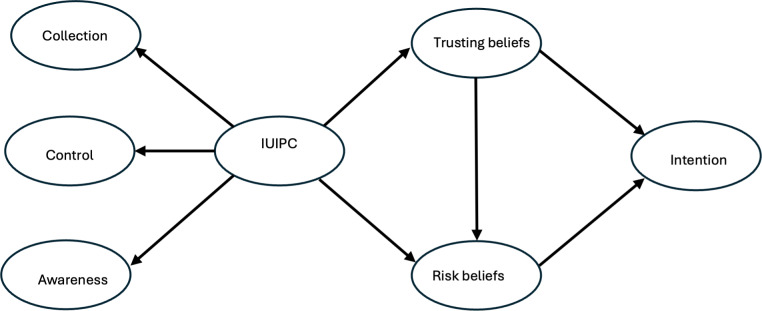
Methods: We designed and deployed an electronic survey to pregnant individuals worldwide electronically in 2023. We used the classical Internet Users' Information Privacy Concerns (IUIPC) model to examine how privacy concerns modulate pregnant individuals' behaviors and beliefs regarding risk and trust when using social media for health purposes. Results were analyzed using partial least squares structural equation modeling.
Results: Among 317 respondents who initiated the survey, 84% (265/317) of the respondents remained in the study, providing complete responses. Among them, 54.7% (145/265) indicated willingness to provide their personalized health information for receiving personalized health content via social media, while 26% (69/265) were uncertain and 19.3% (51/265) were opposed. Our estimated IUIPC model results are statistically significant and qualitatively align with the classic IUIPC model for the general population, which was previously found in an e-commerce context. The structural model revealed that privacy concerns (IUIPC) negatively affected trusting beliefs (β=-0.408; P<.001) and positively influenced risk beliefs (β=0.442; P<.001). Trusting beliefs negatively impacted risk beliefs (β=-o.362; P<.001) and positively affected the intention to disclose personal health information (β=o.266; P<.001). Risk beliefs negatively influenced the intention to disclose (β=-0.281; P<.001). The model explained 41.5% of the variance in the intention to disclose personal health information (R²=0.415). In parallel with pregnant individuals' willingness to share, we find that they have heightened privacy concerns and their use of social media for information seeking is largely impacted by their trust in the platforms. This heightened concern significantly affects both their trusting beliefs, making them less inclined to trust social media companies, and their risk beliefs, leading them to perceive greater risks in sharing personal health information. However, within this population, an increase in trust toward social media companies leads to a more substantial decrease in perceived risks than what has been previously observed in the general population.
Conclusions: We find that more than half of the pregnant individuals are open to sharing their personal health information to receive personalized content about health via social media, although they have more privacy concerns than the general population. This study emphasizes the need for policy regarding the protection of health data on social media for the pregnant population and beyond.





 京公网安备 11010802042870号
京ICP备2023020795号-1
京公网安备 11010802042870号
京ICP备2023020795号-1

 分享
分享
 求助内容:
求助内容: 应助结果提醒方式:
 扫码关注我们
