Xitong Liu , Chengying Zhao , Jirong Wang , Jinkai Zheng
{"title":"Substituent group-modified pectins: Targeted modifications for enhanced functional properties","authors":"Xitong Liu , Chengying Zhao , Jirong Wang , Jinkai Zheng","doi":"10.1016/j.tifs.2025.104920","DOIUrl":null,"url":null,"abstract":"<div><h3>Background</h3><div>In nature, there are multiple substituent group-modified (SGM, e.g., alkylated, acetylated, amidated, and molecularly grafted groups) pectins that exhibit better functional potential than non-modified pectin, but their content is significantly much lower than normal pectins. Various methods for modifying pectin have been developed that rely on changing its degree of substitution (DS) to improve its targeted use, and the relationships between their modification methods, chemical structures and functional properties have yet to be fully explored.</div></div><div><h3>Scope and approach</h3><div>This article systematically reviews the modification methods and structural characterization of SGM pectins, as well as the mechanisms by which these modifications enhance their functional properties, including gelling, emulsifying, health-promoting effects, functional component delivery, and preservation. Future trends in the development of SGM pectins are also examined.</div></div><div><h3>Key findings and conclusions</h3><div>SGM pectins produced through various modification methods exhibit different types, degrees, and positions of substitution. These structural changes enhance the functional properties of pectins, including their physicochemical properties, health benefits, and practical applications. A new era of green, precise, and intelligent development of SGM pectins is anticipated. This information will support the targeted modification of pectins with specific functional properties and their application in high-quality pectin-based foods to meet diverse needs.</div></div>","PeriodicalId":441,"journal":{"name":"Trends in Food Science & Technology","volume":"157 ","pages":"Article 104920"},"PeriodicalIF":15.4000,"publicationDate":"2025-03-01","publicationTypes":"Journal Article","fieldsOfStudy":null,"isOpenAccess":false,"openAccessPdf":"","citationCount":"0","resultStr":null,"platform":"Semanticscholar","paperid":null,"PeriodicalName":"Trends in Food Science & Technology","FirstCategoryId":"97","ListUrlMain":"https://www.sciencedirect.com/science/article/pii/S0924224425000561","RegionNum":1,"RegionCategory":"农林科学","ArticlePicture":[],"TitleCN":null,"AbstractTextCN":null,"PMCID":null,"EPubDate":"2025/2/13 0:00:00","PubModel":"Epub","JCR":"Q1","JCRName":"FOOD SCIENCE & TECHNOLOGY","Score":null,"Total":0}
引用次数: 0
Abstract
Background
In nature, there are multiple substituent group-modified (SGM, e.g., alkylated, acetylated, amidated, and molecularly grafted groups) pectins that exhibit better functional potential than non-modified pectin, but their content is significantly much lower than normal pectins. Various methods for modifying pectin have been developed that rely on changing its degree of substitution (DS) to improve its targeted use, and the relationships between their modification methods, chemical structures and functional properties have yet to be fully explored.
Scope and approach
This article systematically reviews the modification methods and structural characterization of SGM pectins, as well as the mechanisms by which these modifications enhance their functional properties, including gelling, emulsifying, health-promoting effects, functional component delivery, and preservation. Future trends in the development of SGM pectins are also examined.
Key findings and conclusions
SGM pectins produced through various modification methods exhibit different types, degrees, and positions of substitution. These structural changes enhance the functional properties of pectins, including their physicochemical properties, health benefits, and practical applications. A new era of green, precise, and intelligent development of SGM pectins is anticipated. This information will support the targeted modification of pectins with specific functional properties and their application in high-quality pectin-based foods to meet diverse needs.
期刊介绍:
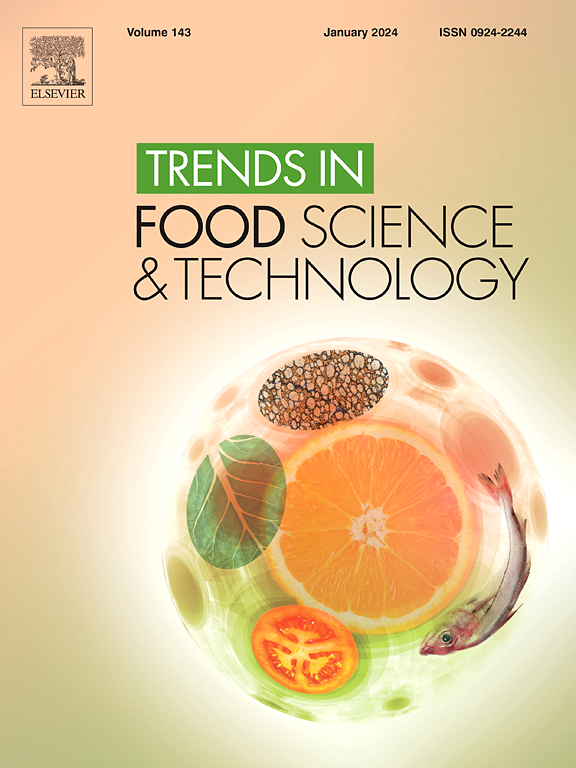
Trends in Food Science & Technology is a prestigious international journal that specializes in peer-reviewed articles covering the latest advancements in technology, food science, and human nutrition. It serves as a bridge between specialized primary journals and general trade magazines, providing readable and scientifically rigorous reviews and commentaries on current research developments and their potential applications in the food industry.
Unlike traditional journals, Trends in Food Science & Technology does not publish original research papers. Instead, it focuses on critical and comprehensive reviews to offer valuable insights for professionals in the field. By bringing together cutting-edge research and industry applications, this journal plays a vital role in disseminating knowledge and facilitating advancements in the food science and technology sector.




 京公网安备 11010802042870号
京ICP备2023020795号-1
京公网安备 11010802042870号
京ICP备2023020795号-1

 分享
分享
 求助内容:
求助内容: 应助结果提醒方式:
 扫码关注我们
