Hao Wu, Grant D. Mitts, Clayton Z. C. Ho, Joshua A. Rabinowitz, Eric R. Hudson
{"title":"Wideband electric field quantum sensing via motional Raman transitions","authors":"Hao Wu, Grant D. Mitts, Clayton Z. C. Ho, Joshua A. Rabinowitz, Eric R. Hudson","doi":"10.1038/s41567-024-02753-0","DOIUrl":null,"url":null,"abstract":"Ultrasensitive detection of the frequency, phase and amplitude of radiofrequency electric fields is crucial for applications in radio communication, cosmology, dark matter searches and high-fidelity qubit control. Quantum harmonic oscillator systems, especially trapped ions, offer high-sensitivity electric field sensing with nanometre spatial resolution but are typically restricted to narrow frequency ranges centred around the motional frequency of the trapped-ion oscillator or the frequency of an optical transition in the ion. Here we present a procedure that enables precise electric field detection over an expanded frequency range. Specifically, we use motional Raman transitions in a single trapped ion to achieve sensitivity across a frequency range over 800 times larger than previous approaches. We show that the method is compatible with both quantum amplification via squeezing and measurement in the Fock basis, allowing a demonstration of performance 3.4(2.0) dB below the standard quantum limit. The approach can be extended to other quantum harmonic oscillator systems, such as superconducting qubit–resonator systems. The narrow frequency response of quantum harmonic oscillators typically limits their application in radiofrequency electric field detection. Now motional Raman transitions in trapped ions are shown to enable wideband, high-precision radiofrequency field sensing.","PeriodicalId":19100,"journal":{"name":"Nature Physics","volume":"21 3","pages":"380-385"},"PeriodicalIF":18.4000,"publicationDate":"2025-02-18","publicationTypes":"Journal Article","fieldsOfStudy":null,"isOpenAccess":false,"openAccessPdf":"","citationCount":"0","resultStr":null,"platform":"Semanticscholar","paperid":null,"PeriodicalName":"Nature Physics","FirstCategoryId":"101","ListUrlMain":"https://www.nature.com/articles/s41567-024-02753-0","RegionNum":1,"RegionCategory":"物理与天体物理","ArticlePicture":[],"TitleCN":null,"AbstractTextCN":null,"PMCID":null,"EPubDate":"","PubModel":"","JCR":"Q1","JCRName":"PHYSICS, MULTIDISCIPLINARY","Score":null,"Total":0}
引用次数: 0
Abstract
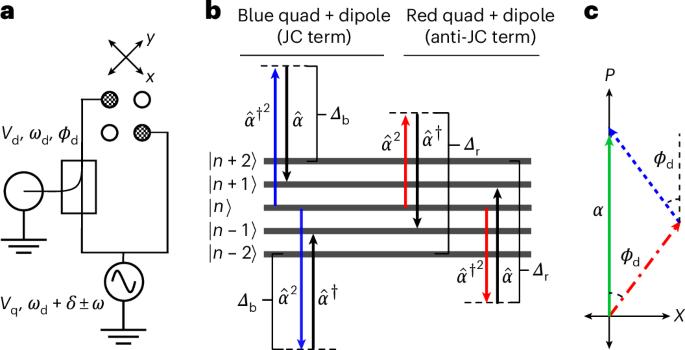
Ultrasensitive detection of the frequency, phase and amplitude of radiofrequency electric fields is crucial for applications in radio communication, cosmology, dark matter searches and high-fidelity qubit control. Quantum harmonic oscillator systems, especially trapped ions, offer high-sensitivity electric field sensing with nanometre spatial resolution but are typically restricted to narrow frequency ranges centred around the motional frequency of the trapped-ion oscillator or the frequency of an optical transition in the ion. Here we present a procedure that enables precise electric field detection over an expanded frequency range. Specifically, we use motional Raman transitions in a single trapped ion to achieve sensitivity across a frequency range over 800 times larger than previous approaches. We show that the method is compatible with both quantum amplification via squeezing and measurement in the Fock basis, allowing a demonstration of performance 3.4(2.0) dB below the standard quantum limit. The approach can be extended to other quantum harmonic oscillator systems, such as superconducting qubit–resonator systems. The narrow frequency response of quantum harmonic oscillators typically limits their application in radiofrequency electric field detection. Now motional Raman transitions in trapped ions are shown to enable wideband, high-precision radiofrequency field sensing.
期刊介绍:
Nature Physics is dedicated to publishing top-tier original research in physics with a fair and rigorous review process. It provides high visibility and access to a broad readership, maintaining high standards in copy editing and production, ensuring rapid publication, and maintaining independence from academic societies and other vested interests.
The journal presents two main research paper formats: Letters and Articles. Alongside primary research, Nature Physics serves as a central source for valuable information within the physics community through Review Articles, News & Views, Research Highlights covering crucial developments across the physics literature, Commentaries, Book Reviews, and Correspondence.



 京公网安备 11010802042870号
京ICP备2023020795号-1
京公网安备 11010802042870号
京ICP备2023020795号-1

 分享
分享
 求助内容:
求助内容: 应助结果提醒方式:
 扫码关注我们
