Do we have a lost generation of junior doctors: Effects of the COVID-19 pandemic on junior doctors' resilience status, medical knowledge and medical skills.
Nicola Katharina Kolb, Stephanie Keil, Johanna Huber
{"title":"Do we have a lost generation of junior doctors: Effects of the COVID-19 pandemic on junior doctors' resilience status, medical knowledge and medical skills.","authors":"Nicola Katharina Kolb, Stephanie Keil, Johanna Huber","doi":"10.1186/s12909-025-06819-2","DOIUrl":null,"url":null,"abstract":"<p><strong>Background: </strong>At the onset of the COVID-19 pandemic, strict measures suspended face-to-face teaching at German universities, posing significant challenges for medical education. Practical, patient-centered training couldn't be fully replaced by online formats, leading to skill deficits and increased stress among students. To date, no study has examined the impact of COVID-19 on the resilience and the competence of medical graduates so far. This study aims to address this knowledge gap by investigating the pandemic impact on resilience, medical competence, communication skills, and research competence of medical graduates.</p><p><strong>Methods: </strong>The study employed data from the \"Bavarian Graduate Study of Medicine\" (MediBAS), a cross-sectional evaluation survey conducted in cooperation with Bavarian universities and the Bavarian Institute for higher education research and planning. It targeted medical, dental, and veterinary graduates. The data were collected in two waves (2018/19 and 2022/23), with 1.114 human medicine graduates participating. The questionnaire assessed among others resilience, medical expertise, communication skills, and research competence. Statistical analysis involved descriptive statistics, correlation analysis, and Mann-Whitney-U tests due to non-normal data distribution.</p><p><strong>Results: </strong>The study analyzed self-assessed resilience, medical expertise, communication, and research skills of medical graduates from two waves. The findings demonstrated through descriptive statistics a decline in all competencies except research skills, which exhibited an increase. Correlation analysis revealed significant relationships between variables. Mann-Whitney-U tests revealed no significant differences between the waves in resilience (p =.079, r =.06), medical expertise (p =.117, r =.05), communication skills (p =.053, r =.07), or research competence (p =.106, r =.05).</p><p><strong>Conclusion: </strong>The study examined the impact of COVID-19 on medical graduates' resilience, medical expertise, communication skills, and research competence. While there was a slight decline in resilience, medical expertise, and communication skills between the waves, there was an improvement in research competence. None of these changes were statistically significant. The findings suggest that the pandemic may have contributed to these trends by limiting practical experiences. No major negative impacts were found, suggesting no \"lost generation\" of doctors. The long-term effects of the changes remain uncertain due to the cross-sectional design and require further research.</p>","PeriodicalId":51234,"journal":{"name":"BMC Medical Education","volume":"25 1","pages":"253"},"PeriodicalIF":3.2000,"publicationDate":"2025-02-17","publicationTypes":"Journal Article","fieldsOfStudy":null,"isOpenAccess":false,"openAccessPdf":"https://www.ncbi.nlm.nih.gov/pmc/articles/PMC11834191/pdf/","citationCount":"0","resultStr":null,"platform":"Semanticscholar","paperid":null,"PeriodicalName":"BMC Medical Education","FirstCategoryId":"3","ListUrlMain":"https://doi.org/10.1186/s12909-025-06819-2","RegionNum":2,"RegionCategory":"医学","ArticlePicture":[],"TitleCN":null,"AbstractTextCN":null,"PMCID":null,"EPubDate":"","PubModel":"","JCR":"Q1","JCRName":"EDUCATION & EDUCATIONAL RESEARCH","Score":null,"Total":0}
引用次数: 0
Abstract
Background: At the onset of the COVID-19 pandemic, strict measures suspended face-to-face teaching at German universities, posing significant challenges for medical education. Practical, patient-centered training couldn't be fully replaced by online formats, leading to skill deficits and increased stress among students. To date, no study has examined the impact of COVID-19 on the resilience and the competence of medical graduates so far. This study aims to address this knowledge gap by investigating the pandemic impact on resilience, medical competence, communication skills, and research competence of medical graduates.
Methods: The study employed data from the "Bavarian Graduate Study of Medicine" (MediBAS), a cross-sectional evaluation survey conducted in cooperation with Bavarian universities and the Bavarian Institute for higher education research and planning. It targeted medical, dental, and veterinary graduates. The data were collected in two waves (2018/19 and 2022/23), with 1.114 human medicine graduates participating. The questionnaire assessed among others resilience, medical expertise, communication skills, and research competence. Statistical analysis involved descriptive statistics, correlation analysis, and Mann-Whitney-U tests due to non-normal data distribution.
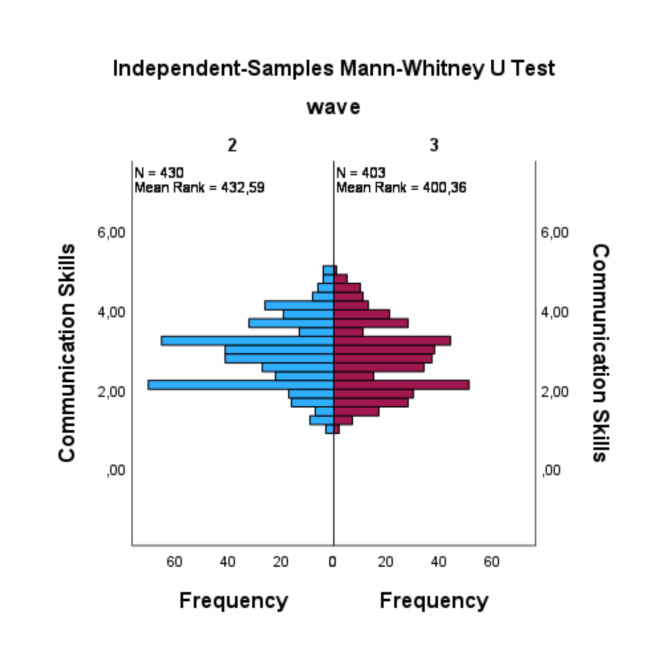
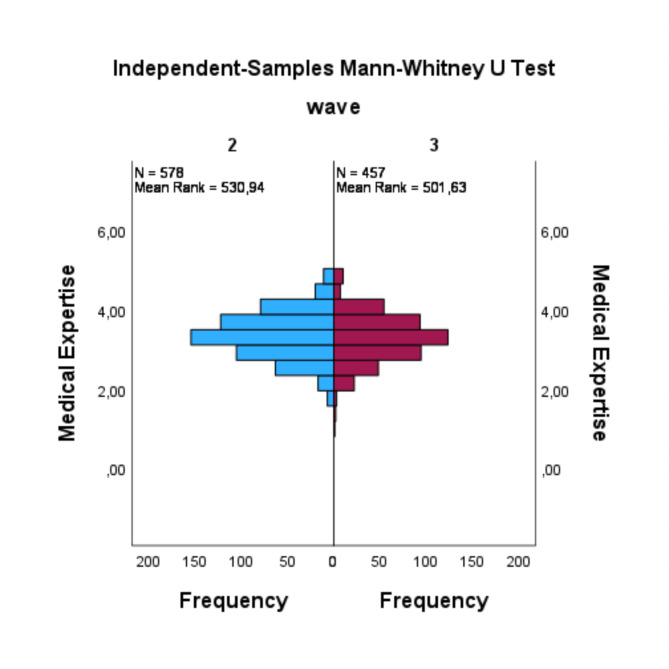
Results: The study analyzed self-assessed resilience, medical expertise, communication, and research skills of medical graduates from two waves. The findings demonstrated through descriptive statistics a decline in all competencies except research skills, which exhibited an increase. Correlation analysis revealed significant relationships between variables. Mann-Whitney-U tests revealed no significant differences between the waves in resilience (p =.079, r =.06), medical expertise (p =.117, r =.05), communication skills (p =.053, r =.07), or research competence (p =.106, r =.05).
Conclusion: The study examined the impact of COVID-19 on medical graduates' resilience, medical expertise, communication skills, and research competence. While there was a slight decline in resilience, medical expertise, and communication skills between the waves, there was an improvement in research competence. None of these changes were statistically significant. The findings suggest that the pandemic may have contributed to these trends by limiting practical experiences. No major negative impacts were found, suggesting no "lost generation" of doctors. The long-term effects of the changes remain uncertain due to the cross-sectional design and require further research.
背景:新冠肺炎疫情爆发后,德国大学采取严格措施暂停了面对面教学,给医学教育带来了重大挑战。实用的、以病人为中心的培训不能完全被在线形式所取代,这导致了学生的技能缺陷和压力的增加。到目前为止,还没有研究调查COVID-19对医学毕业生的适应能力和能力的影响。本研究旨在通过调查大流行对医学毕业生的应变能力、医疗能力、沟通技巧和研究能力的影响来解决这一知识差距。方法:采用与巴伐利亚大学和巴伐利亚高等教育研究与规划研究所合作开展的“巴伐利亚医学研究生研究”(MediBAS)的横断面评估调查数据。它的目标是医学、牙科和兽医专业的毕业生。数据分为两波(2018/19和2022/23)收集,共有1.114名人类医学毕业生参与。问卷评估了复原力、医疗专业知识、沟通技巧和研究能力等。统计分析包括描述性统计、相关分析和非正态分布的Mann-Whitney-U检验。结果:本研究分析了两波医学毕业生自我评估的心理弹性、医学专业知识、沟通能力和研究技能。调查结果通过描述性统计表明,除了研究技能外,所有能力都有所下降,而研究技能则有所增加。相关分析显示变量之间存在显著的相关性。Mann-Whitney-U检验显示,波浪之间的弹性没有显著差异(p =。079, r =.06),医学专业知识(p =。117, r = 0.05),沟通技巧(p = 0.05)。053, r =.07)或研究能力(p =。106, r = 0.05)。结论:本研究考察了新冠肺炎疫情对医毕业生心理韧性、医学专业知识、沟通能力和科研能力的影响。虽然波浪之间的恢复力、医疗专业知识和沟通技巧略有下降,但研究能力有所提高。这些变化都没有统计学意义。研究结果表明,大流行可能通过限制实际经验而助长了这些趋势。没有发现重大的负面影响,这表明没有“迷惘的一代”医生。由于横截面设计的原因,这些变化的长期影响仍不确定,需要进一步研究。
期刊介绍:
BMC Medical Education is an open access journal publishing original peer-reviewed research articles in relation to the training of healthcare professionals, including undergraduate, postgraduate, and continuing education. The journal has a special focus on curriculum development, evaluations of performance, assessment of training needs and evidence-based medicine.




 京公网安备 11010802042870号
京ICP备2023020795号-1
京公网安备 11010802042870号
京ICP备2023020795号-1

 分享
分享
 求助内容:
求助内容: 应助结果提醒方式:
 扫码关注我们
