Hao Yu, Zhien Li, S Eleonore Köhler, Jeroen J G van Merriënboer, Maryam Asoodar
{"title":"How do medical students make sense of internal and external feedback to enhance their Dutch communication skills?","authors":"Hao Yu, Zhien Li, S Eleonore Köhler, Jeroen J G van Merriënboer, Maryam Asoodar","doi":"10.1186/s12909-025-06845-0","DOIUrl":null,"url":null,"abstract":"<p><strong>Background: </strong>Feedback is crucial in medical education for developing communication skills and fostering comprehensive learning. Despite its importance, medical students often face challenges in effectively leveraging feedback. This study investigates how students perceive and make sense of internal and external feedback in a 2nd language (L2) medical Dutch course.</p><p><strong>Methods: </strong>Sixteen third-year international medical students (mean age = 23) participated in a medical Dutch course that included six structured sessions. Each session encompassed a briefing, simulated patient consultations (SPCs), and a debriefing. The curriculum integrated internal feedback from self-reflections and external feedback from peers, teachers, and simulated patients. Data were gathered through a students' feedback perception survey and semi-structured interviews and analyzed via inductive thematic analysis.</p><p><strong>Results: </strong>Survey data indicated a trend where the preference, satisfaction, and trust in external feedback were higher than those for internal feedback. However, both types of feedback were regarded as equally effective in facilitating learning progress. Through thematic analysis, we identified five crucial themes that show how students perceive and make sense of various forms of feedback: proactive engagement with feedback, critically analyzing and utilizing the exchange in dialogues and discussions, self-reflection and progress tracking, value from diverse perspectives, and moment-specific and actionable feedback.</p><p><strong>Conclusions: </strong>This study emphasizes the vital roles of internal and external feedback in enhancing medical Dutch communication skills among medical students. Internal feedback encourages self-reflection and growth, essential for complex medical communications, while external feedback provides clear, specific and supportive guidance and experience from teachers, simulated patients and peers. These feedback mechanisms together improve students' skills in medical Dutch communication, leading to better doctor-patient interactions. Future research should focus on adapting these feedback strategies across diverse educational settings to further support the development of medical L2 communication skills in global medical contexts.</p>","PeriodicalId":51234,"journal":{"name":"BMC Medical Education","volume":"25 1","pages":"256"},"PeriodicalIF":3.2000,"publicationDate":"2025-02-17","publicationTypes":"Journal Article","fieldsOfStudy":null,"isOpenAccess":false,"openAccessPdf":"https://www.ncbi.nlm.nih.gov/pmc/articles/PMC11834736/pdf/","citationCount":"0","resultStr":null,"platform":"Semanticscholar","paperid":null,"PeriodicalName":"BMC Medical Education","FirstCategoryId":"3","ListUrlMain":"https://doi.org/10.1186/s12909-025-06845-0","RegionNum":2,"RegionCategory":"医学","ArticlePicture":[],"TitleCN":null,"AbstractTextCN":null,"PMCID":null,"EPubDate":"","PubModel":"","JCR":"Q1","JCRName":"EDUCATION & EDUCATIONAL RESEARCH","Score":null,"Total":0}
引用次数: 0
Abstract
Background: Feedback is crucial in medical education for developing communication skills and fostering comprehensive learning. Despite its importance, medical students often face challenges in effectively leveraging feedback. This study investigates how students perceive and make sense of internal and external feedback in a 2nd language (L2) medical Dutch course.
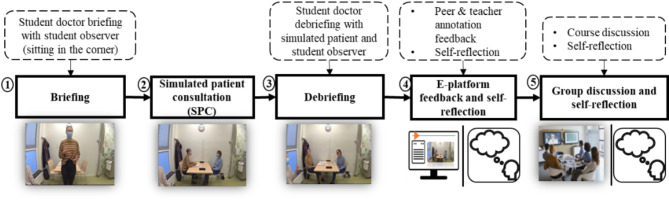
Methods: Sixteen third-year international medical students (mean age = 23) participated in a medical Dutch course that included six structured sessions. Each session encompassed a briefing, simulated patient consultations (SPCs), and a debriefing. The curriculum integrated internal feedback from self-reflections and external feedback from peers, teachers, and simulated patients. Data were gathered through a students' feedback perception survey and semi-structured interviews and analyzed via inductive thematic analysis.
Results: Survey data indicated a trend where the preference, satisfaction, and trust in external feedback were higher than those for internal feedback. However, both types of feedback were regarded as equally effective in facilitating learning progress. Through thematic analysis, we identified five crucial themes that show how students perceive and make sense of various forms of feedback: proactive engagement with feedback, critically analyzing and utilizing the exchange in dialogues and discussions, self-reflection and progress tracking, value from diverse perspectives, and moment-specific and actionable feedback.
Conclusions: This study emphasizes the vital roles of internal and external feedback in enhancing medical Dutch communication skills among medical students. Internal feedback encourages self-reflection and growth, essential for complex medical communications, while external feedback provides clear, specific and supportive guidance and experience from teachers, simulated patients and peers. These feedback mechanisms together improve students' skills in medical Dutch communication, leading to better doctor-patient interactions. Future research should focus on adapting these feedback strategies across diverse educational settings to further support the development of medical L2 communication skills in global medical contexts.
期刊介绍:
BMC Medical Education is an open access journal publishing original peer-reviewed research articles in relation to the training of healthcare professionals, including undergraduate, postgraduate, and continuing education. The journal has a special focus on curriculum development, evaluations of performance, assessment of training needs and evidence-based medicine.



 京公网安备 11010802042870号
京ICP备2023020795号-1
京公网安备 11010802042870号
京ICP备2023020795号-1

 分享
分享
 求助内容:
求助内容: 应助结果提醒方式:
 扫码关注我们
