{"title":"Multilevel reconfigurable differential capacitance in HfZrO2 ferroelectric devices: Enabling machine learning-based classification","authors":"Mohit Kumar , Sangmin Lee , Hyungtak Seo","doi":"10.1016/j.nanoen.2025.110819","DOIUrl":null,"url":null,"abstract":"<div><div>Reconfiguring differential capacitance (DC = dC/dV) holds significant promise for the advancement of energy-efficient and multifunctional electronic components. Typical passive components like resistors or conventional capacitors lack the ability to exhibit cumulative charge behavior, making them unsuitable for advanced computing and data processing tasks. In this study, we introduce a nanodomain HfZrO<sub>2</sub> ferroelectric device capable of modulating DC values from positive to negative, a feature enabled by its intrinsic and randomly oriented ferroelectric polarization. The device demonstrates dynamic multilevel hysteresis loop openings in capacitance-voltage characteristics, confirmed through advanced characterization techniques, including vector piezoresponse force microscopy and transmission electron microscopy. Using an Op-Amp integrator circuit, we derived cumulative charge (SumQ) from capacitance data with unprecedented control and predictability, achieving high linearity (>99 %) and distinct charge levels, a feat unattainable in typical resistors or capacitors. Furthermore, the SumQ data was successfully employed in machine learning (ML) models to classify human presence and absence based on WiFi received signal strength indicator signals. This application underscores the potential of our device in enabling advanced ML-driven electronic systems and security applications. These results establish our device as an innovation, bridging the gap between physical electronic behavior and computational applications, and paving the way for next-generation high-performance electronic systems.</div></div>","PeriodicalId":394,"journal":{"name":"Nano Energy","volume":"137 ","pages":"Article 110819"},"PeriodicalIF":17.1000,"publicationDate":"2025-05-01","publicationTypes":"Journal Article","fieldsOfStudy":null,"isOpenAccess":false,"openAccessPdf":"","citationCount":"0","resultStr":null,"platform":"Semanticscholar","paperid":null,"PeriodicalName":"Nano Energy","FirstCategoryId":"88","ListUrlMain":"https://www.sciencedirect.com/science/article/pii/S2211285525001788","RegionNum":1,"RegionCategory":"材料科学","ArticlePicture":[],"TitleCN":null,"AbstractTextCN":null,"PMCID":null,"EPubDate":"2025/2/24 0:00:00","PubModel":"Epub","JCR":"Q1","JCRName":"CHEMISTRY, PHYSICAL","Score":null,"Total":0}
引用次数: 0
Abstract
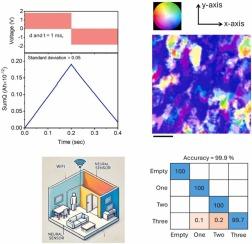
Reconfiguring differential capacitance (DC = dC/dV) holds significant promise for the advancement of energy-efficient and multifunctional electronic components. Typical passive components like resistors or conventional capacitors lack the ability to exhibit cumulative charge behavior, making them unsuitable for advanced computing and data processing tasks. In this study, we introduce a nanodomain HfZrO2 ferroelectric device capable of modulating DC values from positive to negative, a feature enabled by its intrinsic and randomly oriented ferroelectric polarization. The device demonstrates dynamic multilevel hysteresis loop openings in capacitance-voltage characteristics, confirmed through advanced characterization techniques, including vector piezoresponse force microscopy and transmission electron microscopy. Using an Op-Amp integrator circuit, we derived cumulative charge (SumQ) from capacitance data with unprecedented control and predictability, achieving high linearity (>99 %) and distinct charge levels, a feat unattainable in typical resistors or capacitors. Furthermore, the SumQ data was successfully employed in machine learning (ML) models to classify human presence and absence based on WiFi received signal strength indicator signals. This application underscores the potential of our device in enabling advanced ML-driven electronic systems and security applications. These results establish our device as an innovation, bridging the gap between physical electronic behavior and computational applications, and paving the way for next-generation high-performance electronic systems.
重新配置差分电容(DC = DC /dV)对节能和多功能电子元件的进步具有重要的前景。典型的无源元件,如电阻器或传统电容器,缺乏表现出累积电荷行为的能力,使它们不适合高级计算和数据处理任务。在本研究中,我们介绍了一种纳米域HfZrO2铁电器件,该器件能够将直流电值从正调制到负,这一特性是由其固有的和随机取向的铁电极化实现的。该器件通过先进的表征技术(包括矢量压响应力显微镜和透射电子显微镜)证实了电容电压特性的动态多电平滞后环开口。使用运算放大器积分器电路,我们从电容数据中获得累积电荷(SumQ),具有前所未有的控制和可预测性,实现了高线性(>99%)和不同的电荷水平,这是典型电阻或电容器无法实现的壮举。此外,SumQ数据成功应用于机器学习(ML)模型中,基于WiFi接收到的信号强度指示信号对人的在场和缺席进行分类。这个应用强调了我们的设备在实现先进的机器学习驱动的电子系统和安全应用方面的潜力。这些结果使我们的设备成为一种创新,弥合了物理电子行为和计算应用之间的差距,并为下一代高性能电子系统铺平了道路。
期刊介绍:
Nano Energy is a multidisciplinary, rapid-publication forum of original peer-reviewed contributions on the science and engineering of nanomaterials and nanodevices used in all forms of energy harvesting, conversion, storage, utilization and policy. Through its mixture of articles, reviews, communications, research news, and information on key developments, Nano Energy provides a comprehensive coverage of this exciting and dynamic field which joins nanoscience and nanotechnology with energy science. The journal is relevant to all those who are interested in nanomaterials solutions to the energy problem.
Nano Energy publishes original experimental and theoretical research on all aspects of energy-related research which utilizes nanomaterials and nanotechnology. Manuscripts of four types are considered: review articles which inform readers of the latest research and advances in energy science; rapid communications which feature exciting research breakthroughs in the field; full-length articles which report comprehensive research developments; and news and opinions which comment on topical issues or express views on the developments in related fields.



 京公网安备 11010802042870号
京ICP备2023020795号-1
京公网安备 11010802042870号
京ICP备2023020795号-1

 分享
分享
 求助内容:
求助内容: 应助结果提醒方式:
 扫码关注我们
