Chi Zhang , Xinyue Wang , Qi Jin , Zhiguo Zhang , Xitian Zhang , Lili Wu
{"title":"High-entropy-induced strong dipole moment for accelerating sulfur reduction kinetics lithium-sulfur batteries across a wide range of temperatures","authors":"Chi Zhang , Xinyue Wang , Qi Jin , Zhiguo Zhang , Xitian Zhang , Lili Wu","doi":"10.1016/j.ensm.2025.104147","DOIUrl":null,"url":null,"abstract":"<div><div>Developing unexpected electrocatalysts is essential for lithium−sulfur batteries operating under harsh environmental conditions. Herein, a high−entropy−induced dipole moment enhancement strategy is proposed to address the problems related to complex temperature variations. In particular, a new platform corresponding to liquid-liquid conversion appears at low temperatures, considered as another rate-determining step. High−entropy oxide La<sub>0.71</sub>Sr<sub>0.29</sub>(Fe<sub>0.19</sub>Co<sub>0.20</sub>Ni<sub>0.20</sub>Zn<sub>0.19</sub>Mn<sub>0.22</sub>)O<sub>3−δ</sub> (HE−LSMO) nanosheets are synthesized by incorporating more metallic ions into LaSrMnO<sub>3</sub>, which would increase the crystal asymmetry, create the redistribution of the electron cloud in the HE−LSMO, thereby enhancing dipole moments and strengthening the dipole−dipole interaction between HE−LSMOs and polar intermediate lithium polysulfides (LiPSs). The HE−LSMO can effectively adsorb LiPSs and greatly promote rapid conversions of LiPSs during the sulfur reduction process at a range of −35 to 50 °C. At 50 °C, the S/HE−LSMO cathode exhibits a high initial specific capacity of 1455.9 mAh g<sup>−1</sup> at 0.5 C, with a capacity retention rate of 71.1 % after 100 cycles. At −35 °C, the S/HE−LSMO cathode maintains an initial capacity of 740.7 mAh g<sup>−1</sup> at 0.5 C, with an impressive capacity retention of 90.4 % after 100 cycles. This work demonstrates the feasibility of the high−entropy−induced dipole moment enhancement strategy for lithium−sulfur batteries under wide temperatures.</div></div>","PeriodicalId":306,"journal":{"name":"Energy Storage Materials","volume":"76 ","pages":"Article 104147"},"PeriodicalIF":20.2000,"publicationDate":"2025-03-01","publicationTypes":"Journal Article","fieldsOfStudy":null,"isOpenAccess":false,"openAccessPdf":"","citationCount":"0","resultStr":null,"platform":"Semanticscholar","paperid":null,"PeriodicalName":"Energy Storage Materials","FirstCategoryId":"88","ListUrlMain":"https://www.sciencedirect.com/science/article/pii/S2405829725001473","RegionNum":1,"RegionCategory":"材料科学","ArticlePicture":[],"TitleCN":null,"AbstractTextCN":null,"PMCID":null,"EPubDate":"","PubModel":"","JCR":"Q1","JCRName":"CHEMISTRY, PHYSICAL","Score":null,"Total":0}
引用次数: 0
Abstract
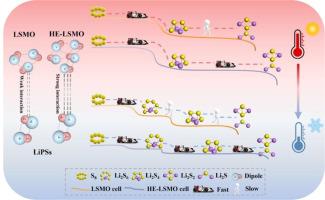
Developing unexpected electrocatalysts is essential for lithium−sulfur batteries operating under harsh environmental conditions. Herein, a high−entropy−induced dipole moment enhancement strategy is proposed to address the problems related to complex temperature variations. In particular, a new platform corresponding to liquid-liquid conversion appears at low temperatures, considered as another rate-determining step. High−entropy oxide La0.71Sr0.29(Fe0.19Co0.20Ni0.20Zn0.19Mn0.22)O3−δ (HE−LSMO) nanosheets are synthesized by incorporating more metallic ions into LaSrMnO3, which would increase the crystal asymmetry, create the redistribution of the electron cloud in the HE−LSMO, thereby enhancing dipole moments and strengthening the dipole−dipole interaction between HE−LSMOs and polar intermediate lithium polysulfides (LiPSs). The HE−LSMO can effectively adsorb LiPSs and greatly promote rapid conversions of LiPSs during the sulfur reduction process at a range of −35 to 50 °C. At 50 °C, the S/HE−LSMO cathode exhibits a high initial specific capacity of 1455.9 mAh g−1 at 0.5 C, with a capacity retention rate of 71.1 % after 100 cycles. At −35 °C, the S/HE−LSMO cathode maintains an initial capacity of 740.7 mAh g−1 at 0.5 C, with an impressive capacity retention of 90.4 % after 100 cycles. This work demonstrates the feasibility of the high−entropy−induced dipole moment enhancement strategy for lithium−sulfur batteries under wide temperatures.
开发意想不到的电催化剂对于在恶劣环境条件下工作的锂硫电池至关重要。本文提出了一种高熵偶极矩增强策略,以解决与复杂温度变化有关的问题。特别是,在低温下出现了一个与液-液转换相对应的新平台,被认为是另一个决定速率的步骤。通过在LaSrMnO3中加入更多的金属离子,可以合成高熵氧化物La0.71Sr0.29(Fe0.19Co0.20Ni0.20Zn0.19Mn0.22)O3−δ (HE−LSMO)纳米片,增加了晶体的不对称性,使HE−LSMO中的电子云重新分布,从而增强了HE−LSMO与极性中间体锂多硫化物(LiPSs)之间的偶极子-偶极子相互作用。在−35 ~ 50℃范围内,HE−LSMO能有效吸附LiPSs,并极大地促进了LiPSs在硫还原过程中的快速转化。在50°C时,S/HE−LSMO阴极在0.5 C时显示出1455.9 mAh g−1的高初始比容量,循环100次后容量保持率为71.1%。在- 35°C时,S/HE - LSMO阴极在0.5 C时保持了740.7 mAh g - 1的初始容量,在100次循环后的容量保持率为90.4%。这项工作证明了在宽温度下锂硫电池的高熵偶极矩增强策略的可行性。
期刊介绍:
Energy Storage Materials is a global interdisciplinary journal dedicated to sharing scientific and technological advancements in materials and devices for advanced energy storage and related energy conversion, such as in metal-O2 batteries. The journal features comprehensive research articles, including full papers and short communications, as well as authoritative feature articles and reviews by leading experts in the field.
Energy Storage Materials covers a wide range of topics, including the synthesis, fabrication, structure, properties, performance, and technological applications of energy storage materials. Additionally, the journal explores strategies, policies, and developments in the field of energy storage materials and devices for sustainable energy.
Published papers are selected based on their scientific and technological significance, their ability to provide valuable new knowledge, and their relevance to the international research community.




 京公网安备 11010802042870号
京ICP备2023020795号-1
京公网安备 11010802042870号
京ICP备2023020795号-1

 分享
分享
 求助内容:
求助内容: 应助结果提醒方式:
 扫码关注我们
