{"title":"Gendered associations of situational and dispositional factors with exclusion from social relations and loneliness in older age.","authors":"Georgios Pavlidis","doi":"10.3389/fpubh.2025.1445662","DOIUrl":null,"url":null,"abstract":"<p><strong>Background: </strong>States of exclusion from social relations (ESR) refers to severe social isolation in older age that is not always typified by increased loneliness. Relevant deficiencies in the social network of older persons may be gendered and associated with personality and socioeconomic barriers, with direct implications for older persons' welfare. Although the contribution of personality traits and socioeconomic barriers in shaping ESR states in older age are often debated, empirical evidence that addresses their unique contribution is limited. Therefore, the aim of this study was to examine the gender-stratified associations of situational (e.g., marital status, socioeconomic conditions) and dispositional factors (i.e., personality traits) with ESR states and loneliness in older age.</p><p><strong>Methods: </strong>A cross-sectional and gender-stratified secondary analysis of a sample (<i>N</i> = 36,814) from the Survey on Health, Aging, and Retirement in Europe was conducted using logistic regression models.</p><p><strong>Results: </strong>The probability of ESR was higher among older men. Certain situational factors (e.g., widowed, never married) significantly increased the probabilities of ESR for both genders, while other (e.g., divorce) had a gender-specific significance. Less extraversion among older women and less conscientiousness among older men was associated with an increased probability of ESR in later life. Within ESR states, older men living alone and older women who are less extraverted were more at-risk of loneliness.</p><p><strong>Conclusion: </strong>Situational factors are more predictive of ESR states than personality traits, yet a gendered perspective is needed when assessing the risk factors of ESR and loneliness in later life.</p>","PeriodicalId":12548,"journal":{"name":"Frontiers in Public Health","volume":"13 ","pages":"1445662"},"PeriodicalIF":3.4000,"publicationDate":"2025-02-10","publicationTypes":"Journal Article","fieldsOfStudy":null,"isOpenAccess":false,"openAccessPdf":"https://www.ncbi.nlm.nih.gov/pmc/articles/PMC11847696/pdf/","citationCount":"0","resultStr":null,"platform":"Semanticscholar","paperid":null,"PeriodicalName":"Frontiers in Public Health","FirstCategoryId":"3","ListUrlMain":"https://doi.org/10.3389/fpubh.2025.1445662","RegionNum":3,"RegionCategory":"医学","ArticlePicture":[],"TitleCN":null,"AbstractTextCN":null,"PMCID":null,"EPubDate":"2025/1/1 0:00:00","PubModel":"eCollection","JCR":"Q2","JCRName":"PUBLIC, ENVIRONMENTAL & OCCUPATIONAL HEALTH","Score":null,"Total":0}
引用次数: 0
Abstract
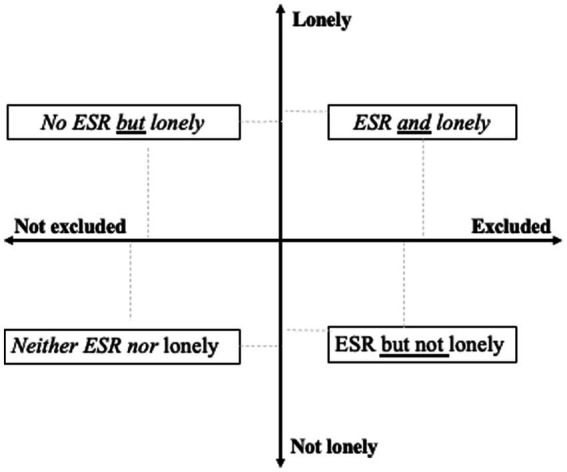
Background: States of exclusion from social relations (ESR) refers to severe social isolation in older age that is not always typified by increased loneliness. Relevant deficiencies in the social network of older persons may be gendered and associated with personality and socioeconomic barriers, with direct implications for older persons' welfare. Although the contribution of personality traits and socioeconomic barriers in shaping ESR states in older age are often debated, empirical evidence that addresses their unique contribution is limited. Therefore, the aim of this study was to examine the gender-stratified associations of situational (e.g., marital status, socioeconomic conditions) and dispositional factors (i.e., personality traits) with ESR states and loneliness in older age.
Methods: A cross-sectional and gender-stratified secondary analysis of a sample (N = 36,814) from the Survey on Health, Aging, and Retirement in Europe was conducted using logistic regression models.
Results: The probability of ESR was higher among older men. Certain situational factors (e.g., widowed, never married) significantly increased the probabilities of ESR for both genders, while other (e.g., divorce) had a gender-specific significance. Less extraversion among older women and less conscientiousness among older men was associated with an increased probability of ESR in later life. Within ESR states, older men living alone and older women who are less extraverted were more at-risk of loneliness.
Conclusion: Situational factors are more predictive of ESR states than personality traits, yet a gendered perspective is needed when assessing the risk factors of ESR and loneliness in later life.
期刊介绍:
Frontiers in Public Health is a multidisciplinary open-access journal which publishes rigorously peer-reviewed research and is at the forefront of disseminating and communicating scientific knowledge and impactful discoveries to researchers, academics, clinicians, policy makers and the public worldwide. The journal aims at overcoming current fragmentation in research and publication, promoting consistency in pursuing relevant scientific themes, and supporting finding dissemination and translation into practice.
Frontiers in Public Health is organized into Specialty Sections that cover different areas of research in the field. Please refer to the author guidelines for details on article types and the submission process.





 京公网安备 11010802042870号
京ICP备2023020795号-1
京公网安备 11010802042870号
京ICP备2023020795号-1

 分享
分享
 求助内容:
求助内容: 应助结果提醒方式:
 扫码关注我们
