Jorge Vergara-Morales, Milenko Del Valle, Nancy Lepe
{"title":"Indirect Effects of Executive Planning Functions and Affectivity on the Work Ethic of University Students.","authors":"Jorge Vergara-Morales, Milenko Del Valle, Nancy Lepe","doi":"10.3390/jintelligence13020020","DOIUrl":null,"url":null,"abstract":"<p><p>Work ethic represents a key factor for professional performance, as it guides behaviors relevant to the transparency and quality of work practices. Although a wide field of study has been developed, less research has analyzed the indirect influence of affective and cognitive factors involved in work ethic. Therefore, this study aims to assess the indirect effects of executive planning functions and affectivity on the work ethic of Chilean university students. The purpose is to test the following hypotheses: (1) executive planning functions have an indirect effect on work ethic through moral reasoning; (2) affectivity has an indirect effect on work ethic through moral intuition. The participants were a total of 582 Chilean university students from a university in the north (38.5%), one in the center (35.9%), and one in the southern area (25.6%). The data were analyzed using descriptive statistics, structural equation models (SEMs), and SEM mediation analysis. The results show the direct effect of moral reasoning (β = 0.47, <i>p</i> < .01) and moral intuition (β = 0.85, <i>p</i> < .01) on work ethic. Furthermore, they support the indirect effect of executive planning functions (β = 0.06, <i>p</i> < .01) and affectivity (β = 0.46, <i>p</i> < .01) on work ethic. The model explains 98% of the variance of work ethic, highlighting the critical roles of moral reasoning and moral intuition as psychological mechanisms that intervene and drive the effect of cognitive and affective factors. Theoretical and practical implications for teaching-learning processes in higher education are discussed.</p>","PeriodicalId":52279,"journal":{"name":"Journal of Intelligence","volume":"13 2","pages":""},"PeriodicalIF":3.4000,"publicationDate":"2025-02-11","publicationTypes":"Journal Article","fieldsOfStudy":null,"isOpenAccess":false,"openAccessPdf":"https://www.ncbi.nlm.nih.gov/pmc/articles/PMC11856469/pdf/","citationCount":"0","resultStr":null,"platform":"Semanticscholar","paperid":null,"PeriodicalName":"Journal of Intelligence","FirstCategoryId":"102","ListUrlMain":"https://doi.org/10.3390/jintelligence13020020","RegionNum":3,"RegionCategory":"心理学","ArticlePicture":[],"TitleCN":null,"AbstractTextCN":null,"PMCID":null,"EPubDate":"","PubModel":"","JCR":"Q1","JCRName":"PSYCHOLOGY, MULTIDISCIPLINARY","Score":null,"Total":0}
引用次数: 0
Abstract
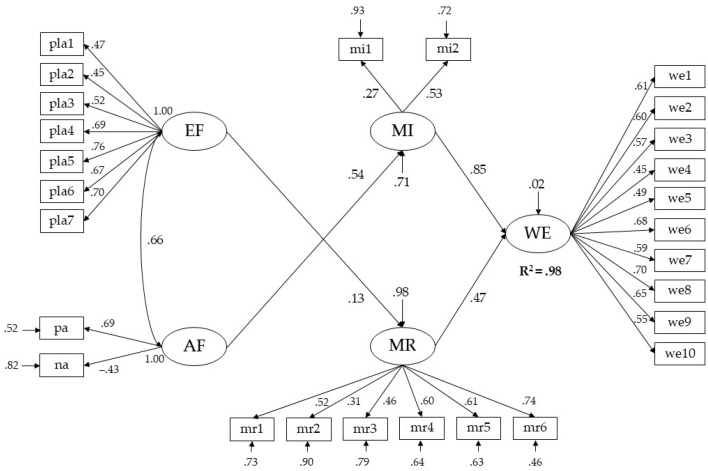
Work ethic represents a key factor for professional performance, as it guides behaviors relevant to the transparency and quality of work practices. Although a wide field of study has been developed, less research has analyzed the indirect influence of affective and cognitive factors involved in work ethic. Therefore, this study aims to assess the indirect effects of executive planning functions and affectivity on the work ethic of Chilean university students. The purpose is to test the following hypotheses: (1) executive planning functions have an indirect effect on work ethic through moral reasoning; (2) affectivity has an indirect effect on work ethic through moral intuition. The participants were a total of 582 Chilean university students from a university in the north (38.5%), one in the center (35.9%), and one in the southern area (25.6%). The data were analyzed using descriptive statistics, structural equation models (SEMs), and SEM mediation analysis. The results show the direct effect of moral reasoning (β = 0.47, p < .01) and moral intuition (β = 0.85, p < .01) on work ethic. Furthermore, they support the indirect effect of executive planning functions (β = 0.06, p < .01) and affectivity (β = 0.46, p < .01) on work ethic. The model explains 98% of the variance of work ethic, highlighting the critical roles of moral reasoning and moral intuition as psychological mechanisms that intervene and drive the effect of cognitive and affective factors. Theoretical and practical implications for teaching-learning processes in higher education are discussed.






 京公网安备 11010802042870号
京ICP备2023020795号-1
京公网安备 11010802042870号
京ICP备2023020795号-1

 分享
分享
 求助内容:
求助内容: 应助结果提醒方式:
 扫码关注我们
