{"title":"Using Cognitive Diagnostic Models to Evaluate the Two-Process Theory of Matrix Reasoning.","authors":"Julian Preuß, Franzis Preckel","doi":"10.3390/jintelligence13020022","DOIUrl":null,"url":null,"abstract":"<p><p>Figural matrices are widely used to measure reasoning ability. According to the two-process model of figural matrix reasoning, task performance relies on correspondence finding (linked to induction ability) and goal management (linked to working memory). Cognitive theory suggests that item characteristics (i.e., change rules and design principles of figural elements) are related to the two solution processes and impact item difficulties in a multiplicative, interactive manner. This study tested the multiplicative effect hypothesis by comparing two cognitive diagnostic models using additive and multiplicative effect estimations. A 26-item figural matrix test was administered to 633 high-ability individuals across paper-and-pencil and computer formats. The linear logistic test model (LLTM) and least square distance method (LSDM) were applied to Rasch and 2PL item parameters. Contrary to the multiplicative effect hypothesis, the additive LLTM model showed better item parameter reconstruction than the LSDM that includes multiplicative effects. These results suggest that change rules and design principles may independently contribute to the difficulty of figural matrices. Correspondence-finding demands may primarily arise from design principles, while change rules may primarily contribute to difficulty through goal management demands based on their number and complexity. The findings highlight the need to consider item components related to the phenomenological representation of figural elements when explaining solution processes of figural matrices. Implications for cognitive theory and item construction are discussed.</p>","PeriodicalId":52279,"journal":{"name":"Journal of Intelligence","volume":"13 2","pages":""},"PeriodicalIF":3.4000,"publicationDate":"2025-02-15","publicationTypes":"Journal Article","fieldsOfStudy":null,"isOpenAccess":false,"openAccessPdf":"https://www.ncbi.nlm.nih.gov/pmc/articles/PMC11856643/pdf/","citationCount":"0","resultStr":null,"platform":"Semanticscholar","paperid":null,"PeriodicalName":"Journal of Intelligence","FirstCategoryId":"102","ListUrlMain":"https://doi.org/10.3390/jintelligence13020022","RegionNum":3,"RegionCategory":"心理学","ArticlePicture":[],"TitleCN":null,"AbstractTextCN":null,"PMCID":null,"EPubDate":"","PubModel":"","JCR":"Q1","JCRName":"PSYCHOLOGY, MULTIDISCIPLINARY","Score":null,"Total":0}
引用次数: 0
Abstract
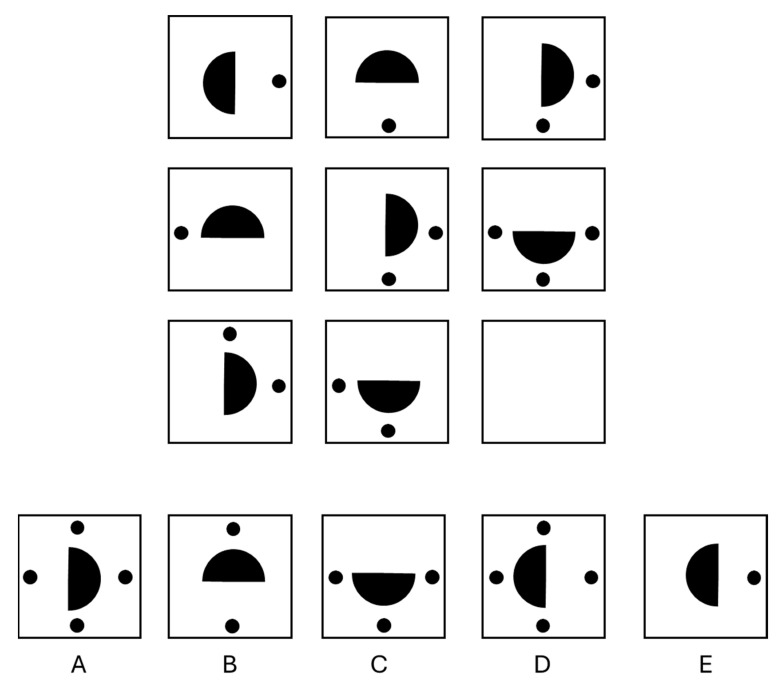
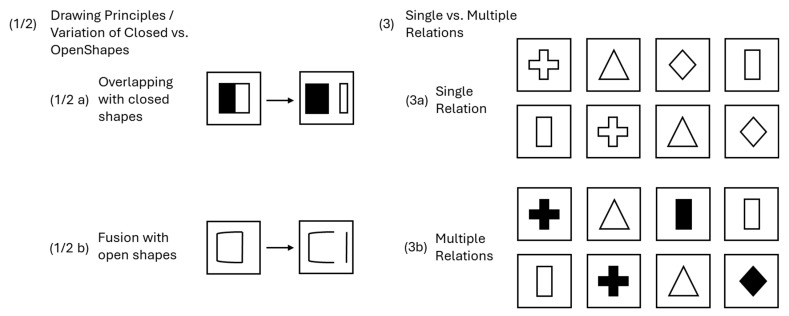
Figural matrices are widely used to measure reasoning ability. According to the two-process model of figural matrix reasoning, task performance relies on correspondence finding (linked to induction ability) and goal management (linked to working memory). Cognitive theory suggests that item characteristics (i.e., change rules and design principles of figural elements) are related to the two solution processes and impact item difficulties in a multiplicative, interactive manner. This study tested the multiplicative effect hypothesis by comparing two cognitive diagnostic models using additive and multiplicative effect estimations. A 26-item figural matrix test was administered to 633 high-ability individuals across paper-and-pencil and computer formats. The linear logistic test model (LLTM) and least square distance method (LSDM) were applied to Rasch and 2PL item parameters. Contrary to the multiplicative effect hypothesis, the additive LLTM model showed better item parameter reconstruction than the LSDM that includes multiplicative effects. These results suggest that change rules and design principles may independently contribute to the difficulty of figural matrices. Correspondence-finding demands may primarily arise from design principles, while change rules may primarily contribute to difficulty through goal management demands based on their number and complexity. The findings highlight the need to consider item components related to the phenomenological representation of figural elements when explaining solution processes of figural matrices. Implications for cognitive theory and item construction are discussed.





 京公网安备 11010802042870号
京ICP备2023020795号-1
京公网安备 11010802042870号
京ICP备2023020795号-1

 分享
分享
 求助内容:
求助内容: 应助结果提醒方式:
 扫码关注我们
