Minghao Fu, Kyung-Sik Yoon, Joohun Ha, Insug Kang, Wonchae Choe
{"title":"Crosstalk Between Antioxidants and Adipogenesis: Mechanistic Pathways and Their Roles in Metabolic Health.","authors":"Minghao Fu, Kyung-Sik Yoon, Joohun Ha, Insug Kang, Wonchae Choe","doi":"10.3390/antiox14020203","DOIUrl":null,"url":null,"abstract":"<p><p>The interplay between oxidative stress and adipogenesis is a critical factor in the development of obesity and its associated metabolic disorders. Excessive reactive oxygen species (ROS) disrupt key transcription factors such as peroxisome proliferator-activated receptor gamma (PPARγ) and CCAAT/enhancer-binding protein alpha (C/EBPα), impairing lipid metabolism, promoting adipocyte dysfunction, and exacerbating inflammation and insulin resistance. Antioxidants, classified as endogenous (e.g., glutathione, superoxide dismutase, and catalase) and exogenous (e.g., polyphenols, flavonoids, and vitamins C and E), are pivotal in mitigating these effects by restoring redox balance and preserving adipocyte functionality. Endogenous antioxidants neutralize ROS and safeguard cellular structures; however, under heightened oxidative stress, these defenses are often insufficient, necessitating dietary supplementation. Exogenous antioxidants derived from plant-based sources, such as polyphenols and vitamins, act through direct ROS scavenging, upregulation of endogenous antioxidant enzymes, and modulation of key signaling pathways like nuclear factor kappa B (NF-κB) and PPARγ, reducing lipid peroxidation, inflammation, and adipocyte dysfunction. Furthermore, they influence epigenetic regulation and transcriptional networks to restore adipocyte differentiation and limit lipid accumulation. Antioxidant-rich diets, including the Mediterranean diet, are strongly associated with improved metabolic health, reduced obesity rates, and enhanced insulin sensitivity. Advances in personalized antioxidant therapies, guided by biomarkers of oxidative stress and supported by novel delivery systems, present promising avenues for optimizing therapeutic interventions. This review, \"Crosstalk Between Antioxidants and Adipogenesis: Mechanistic Pathways and Their Role in Metabolic Health\", highlights the mechanistic pathways by which antioxidants regulate oxidative stress and adipogenesis to enhance metabolic health.</p>","PeriodicalId":7984,"journal":{"name":"Antioxidants","volume":"14 2","pages":""},"PeriodicalIF":6.6000,"publicationDate":"2025-02-10","publicationTypes":"Journal Article","fieldsOfStudy":null,"isOpenAccess":false,"openAccessPdf":"https://www.ncbi.nlm.nih.gov/pmc/articles/PMC11852089/pdf/","citationCount":"0","resultStr":null,"platform":"Semanticscholar","paperid":null,"PeriodicalName":"Antioxidants","FirstCategoryId":"3","ListUrlMain":"https://doi.org/10.3390/antiox14020203","RegionNum":2,"RegionCategory":"医学","ArticlePicture":[],"TitleCN":null,"AbstractTextCN":null,"PMCID":null,"EPubDate":"","PubModel":"","JCR":"Q1","JCRName":"BIOCHEMISTRY & MOLECULAR BIOLOGY","Score":null,"Total":0}
引用次数: 0
Abstract
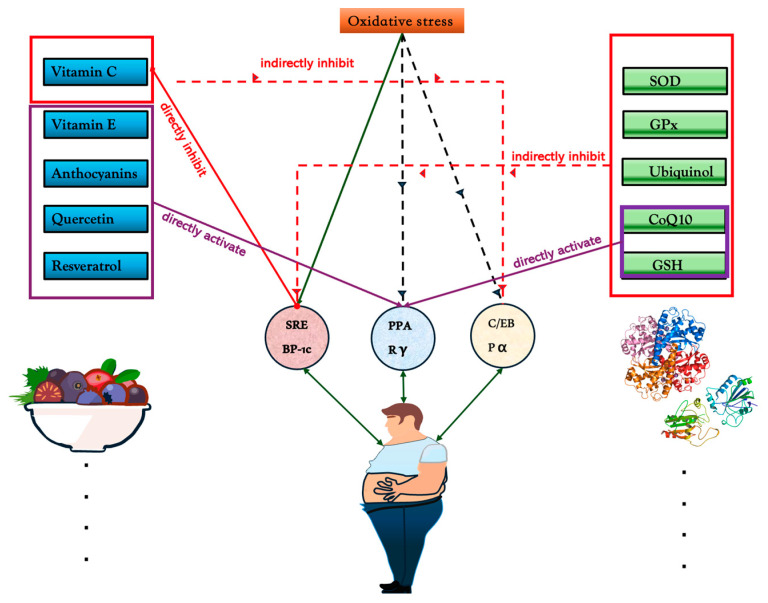
The interplay between oxidative stress and adipogenesis is a critical factor in the development of obesity and its associated metabolic disorders. Excessive reactive oxygen species (ROS) disrupt key transcription factors such as peroxisome proliferator-activated receptor gamma (PPARγ) and CCAAT/enhancer-binding protein alpha (C/EBPα), impairing lipid metabolism, promoting adipocyte dysfunction, and exacerbating inflammation and insulin resistance. Antioxidants, classified as endogenous (e.g., glutathione, superoxide dismutase, and catalase) and exogenous (e.g., polyphenols, flavonoids, and vitamins C and E), are pivotal in mitigating these effects by restoring redox balance and preserving adipocyte functionality. Endogenous antioxidants neutralize ROS and safeguard cellular structures; however, under heightened oxidative stress, these defenses are often insufficient, necessitating dietary supplementation. Exogenous antioxidants derived from plant-based sources, such as polyphenols and vitamins, act through direct ROS scavenging, upregulation of endogenous antioxidant enzymes, and modulation of key signaling pathways like nuclear factor kappa B (NF-κB) and PPARγ, reducing lipid peroxidation, inflammation, and adipocyte dysfunction. Furthermore, they influence epigenetic regulation and transcriptional networks to restore adipocyte differentiation and limit lipid accumulation. Antioxidant-rich diets, including the Mediterranean diet, are strongly associated with improved metabolic health, reduced obesity rates, and enhanced insulin sensitivity. Advances in personalized antioxidant therapies, guided by biomarkers of oxidative stress and supported by novel delivery systems, present promising avenues for optimizing therapeutic interventions. This review, "Crosstalk Between Antioxidants and Adipogenesis: Mechanistic Pathways and Their Role in Metabolic Health", highlights the mechanistic pathways by which antioxidants regulate oxidative stress and adipogenesis to enhance metabolic health.
AntioxidantsBiochemistry, Genetics and Molecular Biology-Physiology
CiteScore
10.60
自引率
11.40%
发文量
2123
审稿时长
16.3 days
期刊介绍:
Antioxidants (ISSN 2076-3921), provides an advanced forum for studies related to the science and technology of antioxidants. It publishes research papers, reviews and communications. Our aim is to encourage scientists to publish their experimental and theoretical results in as much detail as possible. There is no restriction on the length of the papers. The full experimental details must be provided so that the results can be reproduced. Electronic files and software regarding the full details of the calculation or experimental procedure, if unable to be published in a normal way, can be deposited as supplementary electronic material.




 京公网安备 11010802042870号
京ICP备2023020795号-1
京公网安备 11010802042870号
京ICP备2023020795号-1

 分享
分享
 求助内容:
求助内容: 应助结果提醒方式:
 扫码关注我们
