Robert K Batori, Zsuzsanna Bordan, Caleb A Padgett, Yuqing Huo, Feng Chen, Reem T Atawia, Rudolf Lucas, Masuko Ushio-Fukai, Tohru Fukai, Eric J Belin de Chantemele, David W Stepp, David J R Fulton
{"title":"PFKFB3 Connects Glycolytic Metabolism with Endothelial Dysfunction in Human and Rodent Obesity.","authors":"Robert K Batori, Zsuzsanna Bordan, Caleb A Padgett, Yuqing Huo, Feng Chen, Reem T Atawia, Rudolf Lucas, Masuko Ushio-Fukai, Tohru Fukai, Eric J Belin de Chantemele, David W Stepp, David J R Fulton","doi":"10.3390/antiox14020172","DOIUrl":null,"url":null,"abstract":"<p><p>Obesity and type 2 diabetes (T2D) increase cardiovascular risk, largely due to altered metabolic state. An early consequence of T2D/obesity is the loss of endothelial function and impaired nitric oxide (NO) signaling. In blood vessels, endothelial nitric oxide synthase (eNOS) synthesizes NO to maintain vessel homeostasis. The biological actions of NO are compromised by superoxide that is generated by NADPH oxidases (NOXs). Herein we investigated how altered metabolism affects superoxide/NO balance in obesity. We found that eNOS expression and NO bioavailability are significantly decreased in endothelial cells (ECs) from T2D patients and animal models of obesity. In parallel, PFKFB3, a key glycolytic regulatory enzyme, is significantly increased in ECs of obese animals. EC overexpression of wild-type and a cytosol-restricted mutant PFKFB3 decreased NO production due to increased eNOS-T495 phosphorylation. PFKFB3 also blunted Akt-S473 phosphorylation, reducing stimulus-dependent phosphorylation of S1177 and the activation of eNOS. Furthermore, PFKFB3 enhanced the activities of NOX1 and NOX5, which are major contributors to endothelial dysfunction. Prolonged exposure of ECs to high glucose or TNFα, which are hallmarks of T2D, leads to increased PFKFB3 expression. These results demonstrate a novel functional relationship between endothelial metabolism, ROS, and NO balance that may contribute to endothelial dysfunction in obesity.</p>","PeriodicalId":7984,"journal":{"name":"Antioxidants","volume":"14 2","pages":""},"PeriodicalIF":6.6000,"publicationDate":"2025-01-31","publicationTypes":"Journal Article","fieldsOfStudy":null,"isOpenAccess":false,"openAccessPdf":"https://www.ncbi.nlm.nih.gov/pmc/articles/PMC11851787/pdf/","citationCount":"0","resultStr":null,"platform":"Semanticscholar","paperid":null,"PeriodicalName":"Antioxidants","FirstCategoryId":"3","ListUrlMain":"https://doi.org/10.3390/antiox14020172","RegionNum":2,"RegionCategory":"医学","ArticlePicture":[],"TitleCN":null,"AbstractTextCN":null,"PMCID":null,"EPubDate":"","PubModel":"","JCR":"Q1","JCRName":"BIOCHEMISTRY & MOLECULAR BIOLOGY","Score":null,"Total":0}
引用次数: 0
Abstract
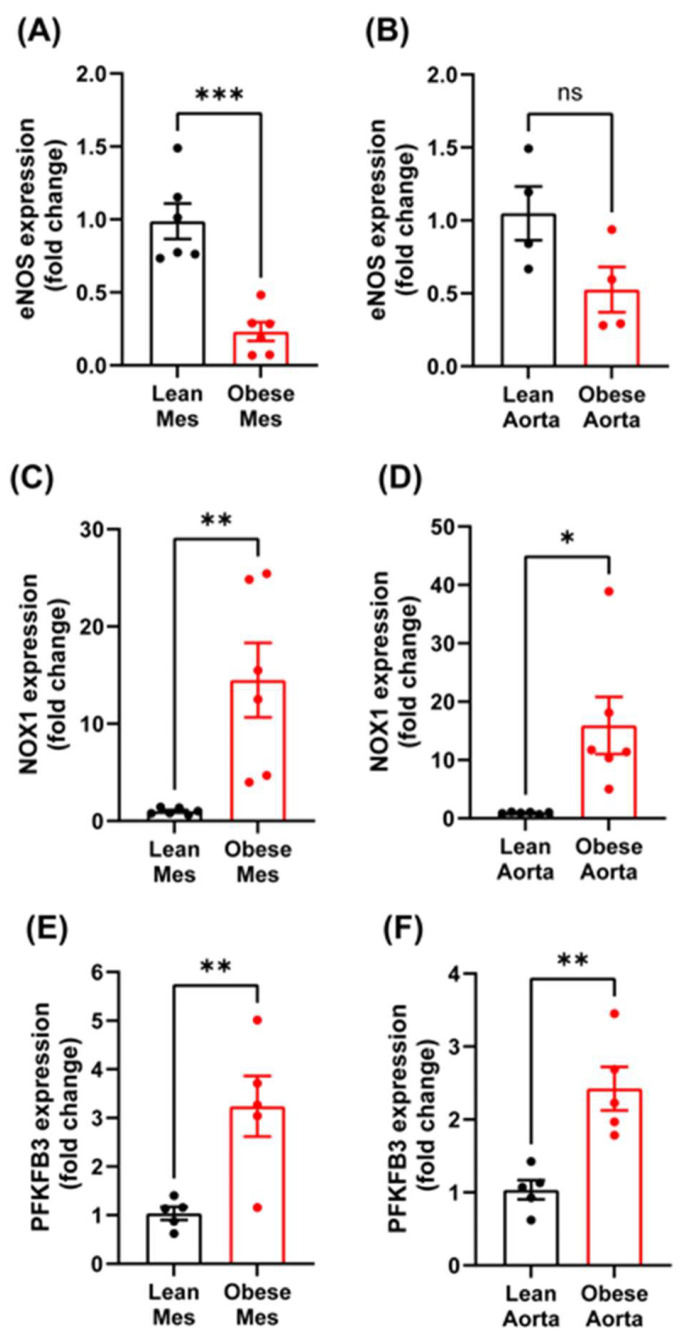
Obesity and type 2 diabetes (T2D) increase cardiovascular risk, largely due to altered metabolic state. An early consequence of T2D/obesity is the loss of endothelial function and impaired nitric oxide (NO) signaling. In blood vessels, endothelial nitric oxide synthase (eNOS) synthesizes NO to maintain vessel homeostasis. The biological actions of NO are compromised by superoxide that is generated by NADPH oxidases (NOXs). Herein we investigated how altered metabolism affects superoxide/NO balance in obesity. We found that eNOS expression and NO bioavailability are significantly decreased in endothelial cells (ECs) from T2D patients and animal models of obesity. In parallel, PFKFB3, a key glycolytic regulatory enzyme, is significantly increased in ECs of obese animals. EC overexpression of wild-type and a cytosol-restricted mutant PFKFB3 decreased NO production due to increased eNOS-T495 phosphorylation. PFKFB3 also blunted Akt-S473 phosphorylation, reducing stimulus-dependent phosphorylation of S1177 and the activation of eNOS. Furthermore, PFKFB3 enhanced the activities of NOX1 and NOX5, which are major contributors to endothelial dysfunction. Prolonged exposure of ECs to high glucose or TNFα, which are hallmarks of T2D, leads to increased PFKFB3 expression. These results demonstrate a novel functional relationship between endothelial metabolism, ROS, and NO balance that may contribute to endothelial dysfunction in obesity.
AntioxidantsBiochemistry, Genetics and Molecular Biology-Physiology
CiteScore
10.60
自引率
11.40%
发文量
2123
审稿时长
16.3 days
期刊介绍:
Antioxidants (ISSN 2076-3921), provides an advanced forum for studies related to the science and technology of antioxidants. It publishes research papers, reviews and communications. Our aim is to encourage scientists to publish their experimental and theoretical results in as much detail as possible. There is no restriction on the length of the papers. The full experimental details must be provided so that the results can be reproduced. Electronic files and software regarding the full details of the calculation or experimental procedure, if unable to be published in a normal way, can be deposited as supplementary electronic material.





 京公网安备 11010802042870号
京ICP备2023020795号-1
京公网安备 11010802042870号
京ICP备2023020795号-1

 分享
分享
 求助内容:
求助内容: 应助结果提醒方式:
 扫码关注我们
