Duo Zhang, Leilei Wang, Lu Tang, Yeting Zhang, Huaiyong Zhang, Lin Zou
{"title":"Protective Effect of Methyl Sulfonyl Methane on the Progression of Age-Induced Bone Loss by Regulating Oxidative Stress-Mediated Bone Resorption.","authors":"Duo Zhang, Leilei Wang, Lu Tang, Yeting Zhang, Huaiyong Zhang, Lin Zou","doi":"10.3390/antiox14020216","DOIUrl":null,"url":null,"abstract":"<p><p>Aging is associated with detrimental bone loss, often leading to fragility fractures, which may be driven by oxidative stress. In this study, the outcomes of comparing the differences among young, adult and aged C57BL/6J mice found that the trabecular bone volume was significantly lower in the aged mice compared to young mice, and the bone characteristics were significantly correlated with the oxidative status. To counteract the adverse effects of aging, methyl sulfonyl methane (MSM), a stable metabolite of dimethyl sulfoxide, was used to supplement the drinking water (400 mg/kg/day) of the aged mice (73 weeks old) for 8 weeks. The MSM supplementation improved the maximum load, bone microarchitecture, and mRNA levels of osteocyte-specific genes in the tibia. Furthermore, MSM reduced the serum level of the C-terminal telopeptide of type I collagen, a marker of bone resorption, and downregulated the mRNA levels of genes related to osteoclast proliferation and activity. MSM also decreased the levels of pro-inflammatory cytokines in both the serum and bone marrow. Importantly, the MSM-treated mice exhibited an enhanced antioxidant status, characterized by increased glutathione peroxidase (GPx) activity and glutathione concentration in plasma, erythrocytes and bone marrow. These improvements were linked to the activation of the nuclear factor E2 related factor 2 (Nrf2) pathway and its downstream antioxidant gene expression, including that of superoxide dismutase and GPx. These findings suggested that age-related bone loss is closely tied to oxidative stress, and MSM supplementation effectively reverses bone loss by mitigating oxidative stress-mediated bone resorption.</p>","PeriodicalId":7984,"journal":{"name":"Antioxidants","volume":"14 2","pages":""},"PeriodicalIF":6.6000,"publicationDate":"2025-02-13","publicationTypes":"Journal Article","fieldsOfStudy":null,"isOpenAccess":false,"openAccessPdf":"https://www.ncbi.nlm.nih.gov/pmc/articles/PMC11851857/pdf/","citationCount":"0","resultStr":null,"platform":"Semanticscholar","paperid":null,"PeriodicalName":"Antioxidants","FirstCategoryId":"3","ListUrlMain":"https://doi.org/10.3390/antiox14020216","RegionNum":2,"RegionCategory":"医学","ArticlePicture":[],"TitleCN":null,"AbstractTextCN":null,"PMCID":null,"EPubDate":"","PubModel":"","JCR":"Q1","JCRName":"BIOCHEMISTRY & MOLECULAR BIOLOGY","Score":null,"Total":0}
引用次数: 0
Abstract
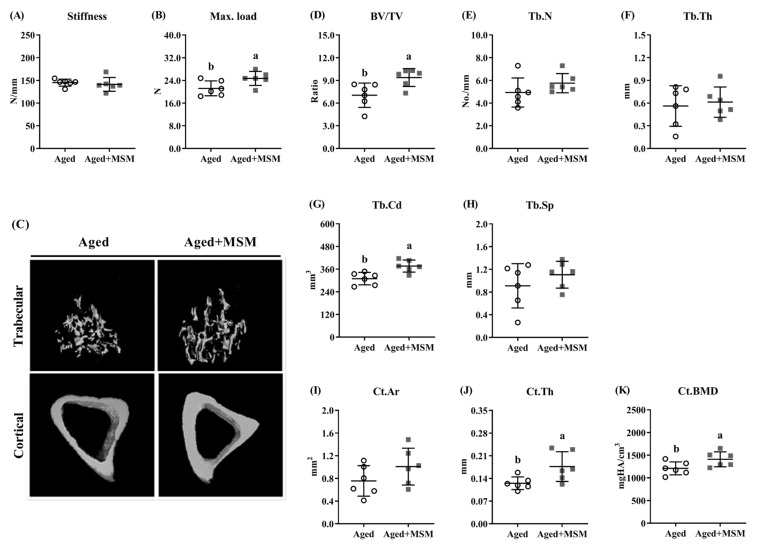
Aging is associated with detrimental bone loss, often leading to fragility fractures, which may be driven by oxidative stress. In this study, the outcomes of comparing the differences among young, adult and aged C57BL/6J mice found that the trabecular bone volume was significantly lower in the aged mice compared to young mice, and the bone characteristics were significantly correlated with the oxidative status. To counteract the adverse effects of aging, methyl sulfonyl methane (MSM), a stable metabolite of dimethyl sulfoxide, was used to supplement the drinking water (400 mg/kg/day) of the aged mice (73 weeks old) for 8 weeks. The MSM supplementation improved the maximum load, bone microarchitecture, and mRNA levels of osteocyte-specific genes in the tibia. Furthermore, MSM reduced the serum level of the C-terminal telopeptide of type I collagen, a marker of bone resorption, and downregulated the mRNA levels of genes related to osteoclast proliferation and activity. MSM also decreased the levels of pro-inflammatory cytokines in both the serum and bone marrow. Importantly, the MSM-treated mice exhibited an enhanced antioxidant status, characterized by increased glutathione peroxidase (GPx) activity and glutathione concentration in plasma, erythrocytes and bone marrow. These improvements were linked to the activation of the nuclear factor E2 related factor 2 (Nrf2) pathway and its downstream antioxidant gene expression, including that of superoxide dismutase and GPx. These findings suggested that age-related bone loss is closely tied to oxidative stress, and MSM supplementation effectively reverses bone loss by mitigating oxidative stress-mediated bone resorption.
AntioxidantsBiochemistry, Genetics and Molecular Biology-Physiology
CiteScore
10.60
自引率
11.40%
发文量
2123
审稿时长
16.3 days
期刊介绍:
Antioxidants (ISSN 2076-3921), provides an advanced forum for studies related to the science and technology of antioxidants. It publishes research papers, reviews and communications. Our aim is to encourage scientists to publish their experimental and theoretical results in as much detail as possible. There is no restriction on the length of the papers. The full experimental details must be provided so that the results can be reproduced. Electronic files and software regarding the full details of the calculation or experimental procedure, if unable to be published in a normal way, can be deposited as supplementary electronic material.





 京公网安备 11010802042870号
京ICP备2023020795号-1
京公网安备 11010802042870号
京ICP备2023020795号-1

 分享
分享
 求助内容:
求助内容: 应助结果提醒方式:
 扫码关注我们
