Lisa Smith Kilpela, Taylur Loera, Salomé Adelia Wilfred, Jessica Salinas, Sabrina E Cuauro, Carolyn Black Becker
{"title":"The Additive Psychosocial Effects of Binge Eating and Food Insecurity Among Midlife and Older Women.","authors":"Lisa Smith Kilpela, Taylur Loera, Salomé Adelia Wilfred, Jessica Salinas, Sabrina E Cuauro, Carolyn Black Becker","doi":"10.3390/nu17040730","DOIUrl":null,"url":null,"abstract":"<p><p><b>Background/Objectives</b>: Evidence suggests that food insecurity (FI) is a risk factor for eating disorder (ED) symptoms, especially binge eating (BE), yet research focusing on the psychosocial effects among midlife/older women is lacking. Midlife/older women living with FI experience intersectional disadvantage, thus highlighting the need for an independent investigation of the cultural and contextual factors of this population. The current study examined the difference in psychological health and quality of life (QOL) among women living with BE and FI (BE + FI) versus FI without BE. <b>Method</b>: Female clients of a food bank, aged 50+ (<i>N</i> = 295; <i>M</i> age = 62.1 years, SD = 8.2) living with FI completed measures of BE and psychosocial comorbidities. The measures were provided in English and Spanish. <b>Results</b>: A multivariate analysis of covariance compared women living with BE and FI (BE + FI) versus FI without BE on outcomes related to mental health and wellbeing. Covarying for age, FI severity, and ethnicity, the results indicated that women living with BE + FI reported worsened anxiety, depression, ED-related psychosocial impairment, internalized weight stigma, and QOL versus women living with FI without BE (all <i>p</i>s < 0.001). Effect sizes ranged from small to medium to large. <b>Conclusions</b>: Midlife/older women living with BE + FI report poorer psychological health and QOL than those living with FI without BE, demonstrating a critical need for mental healthcare in this population. Innovative solutions-and likely a portfolio of interventional approaches with various entry points and delivery modalities-are warranted, if we are to make significant strides in addressing ED symptoms in this population.</p>","PeriodicalId":19486,"journal":{"name":"Nutrients","volume":"17 4","pages":""},"PeriodicalIF":5.0000,"publicationDate":"2025-02-19","publicationTypes":"Journal Article","fieldsOfStudy":null,"isOpenAccess":false,"openAccessPdf":"https://www.ncbi.nlm.nih.gov/pmc/articles/PMC11858212/pdf/","citationCount":"0","resultStr":null,"platform":"Semanticscholar","paperid":null,"PeriodicalName":"Nutrients","FirstCategoryId":"3","ListUrlMain":"https://doi.org/10.3390/nu17040730","RegionNum":2,"RegionCategory":"医学","ArticlePicture":[],"TitleCN":null,"AbstractTextCN":null,"PMCID":null,"EPubDate":"","PubModel":"","JCR":"Q1","JCRName":"NUTRITION & DIETETICS","Score":null,"Total":0}
引用次数: 0
Abstract
Background/Objectives: Evidence suggests that food insecurity (FI) is a risk factor for eating disorder (ED) symptoms, especially binge eating (BE), yet research focusing on the psychosocial effects among midlife/older women is lacking. Midlife/older women living with FI experience intersectional disadvantage, thus highlighting the need for an independent investigation of the cultural and contextual factors of this population. The current study examined the difference in psychological health and quality of life (QOL) among women living with BE and FI (BE + FI) versus FI without BE. Method: Female clients of a food bank, aged 50+ (N = 295; M age = 62.1 years, SD = 8.2) living with FI completed measures of BE and psychosocial comorbidities. The measures were provided in English and Spanish. Results: A multivariate analysis of covariance compared women living with BE and FI (BE + FI) versus FI without BE on outcomes related to mental health and wellbeing. Covarying for age, FI severity, and ethnicity, the results indicated that women living with BE + FI reported worsened anxiety, depression, ED-related psychosocial impairment, internalized weight stigma, and QOL versus women living with FI without BE (all ps < 0.001). Effect sizes ranged from small to medium to large. Conclusions: Midlife/older women living with BE + FI report poorer psychological health and QOL than those living with FI without BE, demonstrating a critical need for mental healthcare in this population. Innovative solutions-and likely a portfolio of interventional approaches with various entry points and delivery modalities-are warranted, if we are to make significant strides in addressing ED symptoms in this population.
期刊介绍:
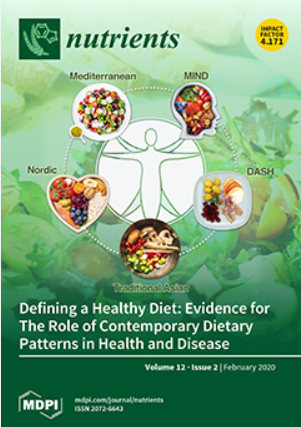
Nutrients (ISSN 2072-6643) is an international, peer-reviewed open access advanced forum for studies related to Human Nutrition. It publishes reviews, regular research papers and short communications. Our aim is to encourage scientists to publish their experimental and theoretical results in as much detail as possible. There is no restriction on the length of the papers. The full experimental details must be provided so that the results can be reproduced.



 京公网安备 11010802042870号
京ICP备2023020795号-1
京公网安备 11010802042870号
京ICP备2023020795号-1

 分享
分享
 求助内容:
求助内容: 应助结果提醒方式:
 扫码关注我们
