{"title":"Predicting Toxicity toward Nitrifiers by Attention-Enhanced Graph Neural Networks and Transfer Learning from Baseline Toxicity","authors":"Kunyang Zhang, Philippe Schwaller, Kathrin Fenner","doi":"10.1021/acs.est.4c12247","DOIUrl":null,"url":null,"abstract":"Assessing chemical environmental impacts is critical but challenging due to the time-consuming nature of experimental testing. Graph neural networks (GNNs) support superior prediction performance and mechanistic interpretation of (eco-)toxicity data, but face the risk of overfitting on the typically small experimental data sets. In contrast to purely data-driven approaches, we propose a mechanism-guided transfer learning strategy that is highly efficient and provides key insights into the underlying drivers of (eco-)toxicity. By leveraging the mechanistic link between baseline toxicity and toxicity toward nitrifiers, we pretrained a GNN on lipophilicity data (log P) and subsequently fine-tuned it on the limited data set of toxicity toward nitrifiers, achieving prediction performance comparable with pretraining on much larger but mechanistically less relevant data sets. Additionally, we enhanced GNN interpretability by adjusting multihead attentions after convolutional layers to identify key substructures, and quantified their contributions using a Shapley Value method adapted for graph-structured data with improved computational efficiency. The highlighted substructures aligned well with and effectively distinguished known structural alerts for baseline toxicity and specific modes of toxic action in nitrifiers. The proposed strategy will allow uncovering new structural alerts in other (eco)toxicity data, and thus foster new mechanistic insights to support chemical risk assessment and safe-by-design principles.","PeriodicalId":36,"journal":{"name":"环境科学与技术","volume":"26 1","pages":""},"PeriodicalIF":11.3000,"publicationDate":"2025-02-27","publicationTypes":"Journal Article","fieldsOfStudy":null,"isOpenAccess":false,"openAccessPdf":"","citationCount":"0","resultStr":null,"platform":"Semanticscholar","paperid":null,"PeriodicalName":"环境科学与技术","FirstCategoryId":"1","ListUrlMain":"https://doi.org/10.1021/acs.est.4c12247","RegionNum":1,"RegionCategory":"环境科学与生态学","ArticlePicture":[],"TitleCN":null,"AbstractTextCN":null,"PMCID":null,"EPubDate":"","PubModel":"","JCR":"Q1","JCRName":"ENGINEERING, ENVIRONMENTAL","Score":null,"Total":0}
引用次数: 0
Abstract
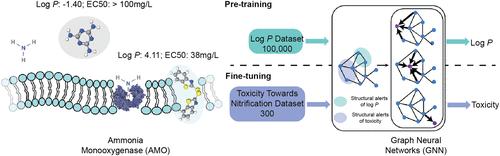
Assessing chemical environmental impacts is critical but challenging due to the time-consuming nature of experimental testing. Graph neural networks (GNNs) support superior prediction performance and mechanistic interpretation of (eco-)toxicity data, but face the risk of overfitting on the typically small experimental data sets. In contrast to purely data-driven approaches, we propose a mechanism-guided transfer learning strategy that is highly efficient and provides key insights into the underlying drivers of (eco-)toxicity. By leveraging the mechanistic link between baseline toxicity and toxicity toward nitrifiers, we pretrained a GNN on lipophilicity data (log P) and subsequently fine-tuned it on the limited data set of toxicity toward nitrifiers, achieving prediction performance comparable with pretraining on much larger but mechanistically less relevant data sets. Additionally, we enhanced GNN interpretability by adjusting multihead attentions after convolutional layers to identify key substructures, and quantified their contributions using a Shapley Value method adapted for graph-structured data with improved computational efficiency. The highlighted substructures aligned well with and effectively distinguished known structural alerts for baseline toxicity and specific modes of toxic action in nitrifiers. The proposed strategy will allow uncovering new structural alerts in other (eco)toxicity data, and thus foster new mechanistic insights to support chemical risk assessment and safe-by-design principles.
期刊介绍:
Environmental Science & Technology (ES&T) is a co-sponsored academic and technical magazine by the Hubei Provincial Environmental Protection Bureau and the Hubei Provincial Academy of Environmental Sciences.
Environmental Science & Technology (ES&T) holds the status of Chinese core journals, scientific papers source journals of China, Chinese Science Citation Database source journals, and Chinese Academic Journal Comprehensive Evaluation Database source journals. This publication focuses on the academic field of environmental protection, featuring articles related to environmental protection and technical advancements.




 京公网安备 11010802042870号
京ICP备2023020795号-1
京公网安备 11010802042870号
京ICP备2023020795号-1

 分享
分享
 求助内容:
求助内容: 应助结果提醒方式:
 扫码关注我们
