{"title":"Women's Educating and Coping Strategies for Cultivating Supportive Web-Based Spaces for Discussing Sexual and Reproductive Health: Co-Design Study.","authors":"Hyeyoung Ryu, Wanda Pratt","doi":"10.2196/62716","DOIUrl":null,"url":null,"abstract":"<p><strong>Background: </strong>Stigma surrounding women's sexual and reproductive health (SRH) often prevents them from seeking essential care. In South Korea, unmarried women face strong cultural taboos, increasing their risk for conditions such as pelvic inflammatory disease, infertility, and cervical cancer. While many unmarried women turn to web-based communities for support, these spaces frequently expose them to microaggressions, further discouraging their access to health care and worsening their health risks.</p><p><strong>Objective: </strong>We aimed to encourage a safe space for seeking support on the culturally taboo topic of SRH by counteracting and reducing web-based microaggressions. We sought to make these last-resort safe spaces supportive by reducing and preventing microaggressions, fostering coping strategies, and educating rather than solely punishing perpetrators.</p><p><strong>Methods: </strong>We conducted co-design sessions with 14 unmarried Korean women. In the first co-design session, we introduced the term microaggression and collaborated with participants to create base design components aimed at countering and preventing microaggressions. In the second co-design session, participants initially viewed examples of microaggression comments, then designed using the provided base design templates inspired by their suggestions from the first session and finally designed for a scenario where they would be seeking support. We analyzed co-design session transcripts using inductive and deductive methods.</p><p><strong>Results: </strong>Our analysis revealed 6 goals addressing coping strategies, educational approaches, and cultural characteristics shaping participants' designs. Reflective coping strategies were supported through designs that numerically indicate positive support and provide holistic views of diverse perspectives, helping participants reassess provocative situations with cognitive clarity. Suppressive coping strategies were fostered by encouraging less-emotional responses, empowering participants to address microaggressions logically without self-blame. Educational approaches emphasized fostering shared awareness of microaggressions and providing respectful education for perpetrators about the harm their words can cause. Participants suggested counterspeech mechanisms, including rephrasing suggestions and public educational resources, to balance education with freedom of expression. They also proposed that forum-approved experts guide discussions to ensure accurate, empathetic responses and support users in addressing nuanced situations effectively. Cultural characteristics heavily influenced these goals. Participants noted the nebulous nature of microaggressions, their reluctance to burden their social support network, and societal perceptions of women as overly emotional-all of which shaped their desire for designs that enhance logical justification. For example, participants preferred tools such as expert-led discussions and comprehensive perspectives to rationalize their experiences while reducing stigma.</p><p><strong>Conclusions: </strong>Our work advocates for prioritizing educational and explanatory approaches over punitive detection and deletion measures to create supportive web-based spaces for individuals discussing stigmatized SRH. By integrating culturally informed coping strategies, counter speech mechanisms, and educational designs, these tools empower microaggression targets and allies while fostering reflection and behavior change among perpetrators. Our work provides a first step toward counteracting microaggressions and ultimately encouraging women to seek the needed SRH care.</p>","PeriodicalId":16337,"journal":{"name":"Journal of Medical Internet Research","volume":"27 ","pages":"e62716"},"PeriodicalIF":6.0000,"publicationDate":"2025-02-26","publicationTypes":"Journal Article","fieldsOfStudy":null,"isOpenAccess":false,"openAccessPdf":"https://www.ncbi.nlm.nih.gov/pmc/articles/PMC11904372/pdf/","citationCount":"0","resultStr":null,"platform":"Semanticscholar","paperid":null,"PeriodicalName":"Journal of Medical Internet Research","FirstCategoryId":"3","ListUrlMain":"https://doi.org/10.2196/62716","RegionNum":2,"RegionCategory":"医学","ArticlePicture":[],"TitleCN":null,"AbstractTextCN":null,"PMCID":null,"EPubDate":"","PubModel":"","JCR":"Q1","JCRName":"HEALTH CARE SCIENCES & SERVICES","Score":null,"Total":0}
引用次数: 0
Abstract
Background: Stigma surrounding women's sexual and reproductive health (SRH) often prevents them from seeking essential care. In South Korea, unmarried women face strong cultural taboos, increasing their risk for conditions such as pelvic inflammatory disease, infertility, and cervical cancer. While many unmarried women turn to web-based communities for support, these spaces frequently expose them to microaggressions, further discouraging their access to health care and worsening their health risks.
Objective: We aimed to encourage a safe space for seeking support on the culturally taboo topic of SRH by counteracting and reducing web-based microaggressions. We sought to make these last-resort safe spaces supportive by reducing and preventing microaggressions, fostering coping strategies, and educating rather than solely punishing perpetrators.
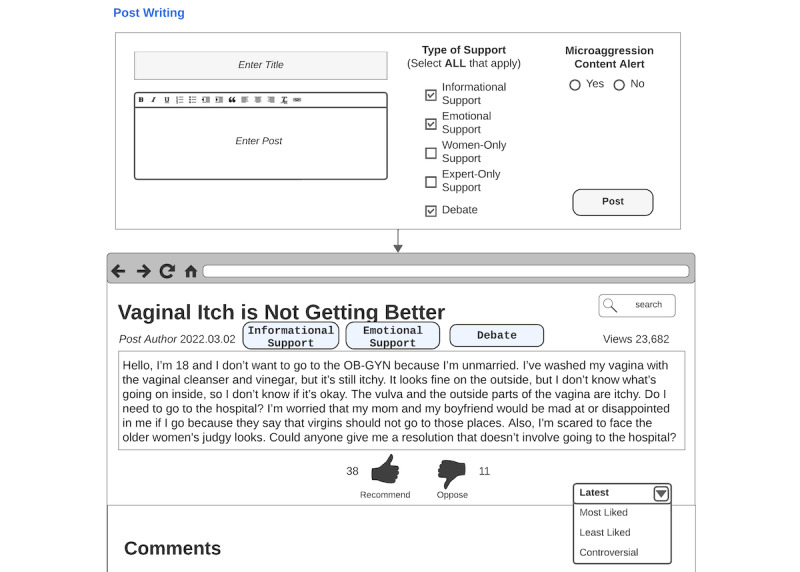
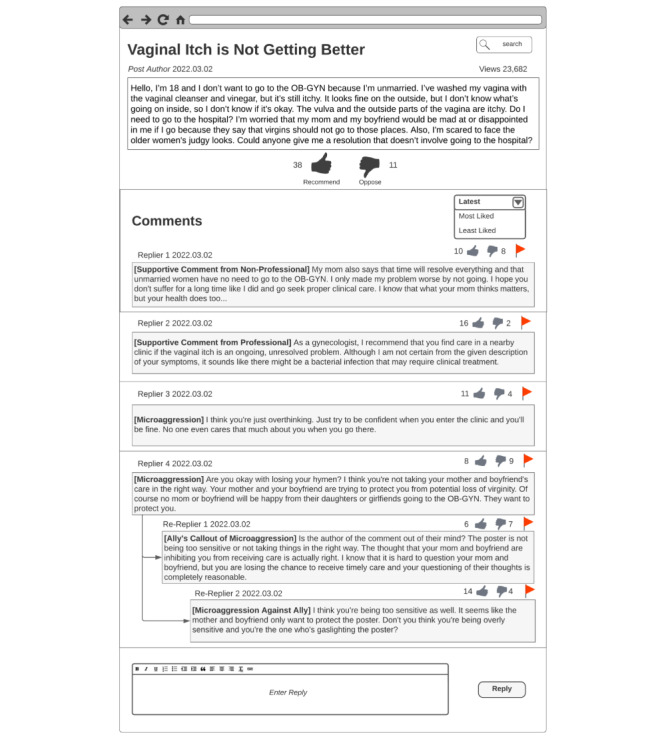
Methods: We conducted co-design sessions with 14 unmarried Korean women. In the first co-design session, we introduced the term microaggression and collaborated with participants to create base design components aimed at countering and preventing microaggressions. In the second co-design session, participants initially viewed examples of microaggression comments, then designed using the provided base design templates inspired by their suggestions from the first session and finally designed for a scenario where they would be seeking support. We analyzed co-design session transcripts using inductive and deductive methods.
Results: Our analysis revealed 6 goals addressing coping strategies, educational approaches, and cultural characteristics shaping participants' designs. Reflective coping strategies were supported through designs that numerically indicate positive support and provide holistic views of diverse perspectives, helping participants reassess provocative situations with cognitive clarity. Suppressive coping strategies were fostered by encouraging less-emotional responses, empowering participants to address microaggressions logically without self-blame. Educational approaches emphasized fostering shared awareness of microaggressions and providing respectful education for perpetrators about the harm their words can cause. Participants suggested counterspeech mechanisms, including rephrasing suggestions and public educational resources, to balance education with freedom of expression. They also proposed that forum-approved experts guide discussions to ensure accurate, empathetic responses and support users in addressing nuanced situations effectively. Cultural characteristics heavily influenced these goals. Participants noted the nebulous nature of microaggressions, their reluctance to burden their social support network, and societal perceptions of women as overly emotional-all of which shaped their desire for designs that enhance logical justification. For example, participants preferred tools such as expert-led discussions and comprehensive perspectives to rationalize their experiences while reducing stigma.
Conclusions: Our work advocates for prioritizing educational and explanatory approaches over punitive detection and deletion measures to create supportive web-based spaces for individuals discussing stigmatized SRH. By integrating culturally informed coping strategies, counter speech mechanisms, and educational designs, these tools empower microaggression targets and allies while fostering reflection and behavior change among perpetrators. Our work provides a first step toward counteracting microaggressions and ultimately encouraging women to seek the needed SRH care.
期刊介绍:
The Journal of Medical Internet Research (JMIR) is a highly respected publication in the field of health informatics and health services. With a founding date in 1999, JMIR has been a pioneer in the field for over two decades.
As a leader in the industry, the journal focuses on digital health, data science, health informatics, and emerging technologies for health, medicine, and biomedical research. It is recognized as a top publication in these disciplines, ranking in the first quartile (Q1) by Impact Factor.
Notably, JMIR holds the prestigious position of being ranked #1 on Google Scholar within the "Medical Informatics" discipline.




 京公网安备 11010802042870号
京ICP备2023020795号-1
京公网安备 11010802042870号
京ICP备2023020795号-1

 分享
分享
 求助内容:
求助内容: 应助结果提醒方式:
 扫码关注我们
