Abby Spangler, Geoffrey D. Shimberg, Grace E. Mantus, Rory Malek, Lauren Y. Cominsky, Yaroslav Tsybovsky, Ning Li, Rebecca A. Gillespie, Michelle Ravichandran, Adrian Creanga, Julie E. Raab, Suprabhath R. Gajjala, Floreliz Mendoza, Katherine V. Houser, Lesia Dropulic, Adrian B. McDermott, Masaru Kanekiyo, Sarah F. Andrews
{"title":"Early influenza virus exposure shapes the B cell response to influenza vaccination in individuals 50 years later","authors":"Abby Spangler, Geoffrey D. Shimberg, Grace E. Mantus, Rory Malek, Lauren Y. Cominsky, Yaroslav Tsybovsky, Ning Li, Rebecca A. Gillespie, Michelle Ravichandran, Adrian Creanga, Julie E. Raab, Suprabhath R. Gajjala, Floreliz Mendoza, Katherine V. Houser, Lesia Dropulic, Adrian B. McDermott, Masaru Kanekiyo, Sarah F. Andrews","doi":"10.1016/j.immuni.2025.02.004","DOIUrl":null,"url":null,"abstract":"Pre-existing immunity impacts vaccine responses to influenza, but directly connecting influenza infections early in life with immune responses decades later is difficult. However, H2N2 stopped circulating in the human population in 1968, creating the opportunity to directly evaluate the impact of early H2N2 exposure on vaccine responses 50 years later. Here, we vaccinated individuals born before (H2 exposed) or after (H2 naive) 1968 with an H2 hemagglutinin (HA) DNA plasmid and/or a ferritin nanoparticle vaccine. H2-exposed individuals generated a rapid B cell recall response that was more potent, targeted more conserved epitopes, and differed phenotypically from the <em>de novo</em> response in H2-naive individuals. Furthermore, vaccinating with a DNA versus a protein nanoparticle vaccine altered the response in H2-naive but not H2-exposed individuals. This study establishes and describes the lifelong impact of influenza HA-specific memory B cells formed early in life on vaccine responses decades later.","PeriodicalId":13269,"journal":{"name":"Immunity","volume":"85 1","pages":""},"PeriodicalIF":26.3000,"publicationDate":"2025-02-28","publicationTypes":"Journal Article","fieldsOfStudy":null,"isOpenAccess":false,"openAccessPdf":"","citationCount":"0","resultStr":null,"platform":"Semanticscholar","paperid":null,"PeriodicalName":"Immunity","FirstCategoryId":"3","ListUrlMain":"https://doi.org/10.1016/j.immuni.2025.02.004","RegionNum":1,"RegionCategory":"医学","ArticlePicture":[],"TitleCN":null,"AbstractTextCN":null,"PMCID":null,"EPubDate":"","PubModel":"","JCR":"Q1","JCRName":"IMMUNOLOGY","Score":null,"Total":0}
引用次数: 0
Abstract
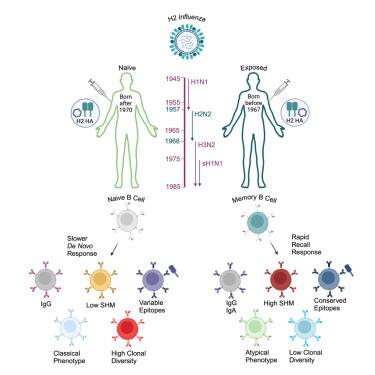
Pre-existing immunity impacts vaccine responses to influenza, but directly connecting influenza infections early in life with immune responses decades later is difficult. However, H2N2 stopped circulating in the human population in 1968, creating the opportunity to directly evaluate the impact of early H2N2 exposure on vaccine responses 50 years later. Here, we vaccinated individuals born before (H2 exposed) or after (H2 naive) 1968 with an H2 hemagglutinin (HA) DNA plasmid and/or a ferritin nanoparticle vaccine. H2-exposed individuals generated a rapid B cell recall response that was more potent, targeted more conserved epitopes, and differed phenotypically from the de novo response in H2-naive individuals. Furthermore, vaccinating with a DNA versus a protein nanoparticle vaccine altered the response in H2-naive but not H2-exposed individuals. This study establishes and describes the lifelong impact of influenza HA-specific memory B cells formed early in life on vaccine responses decades later.
期刊介绍:
Immunity is a publication that focuses on publishing significant advancements in research related to immunology. We encourage the submission of studies that offer groundbreaking immunological discoveries, whether at the molecular, cellular, or whole organism level. Topics of interest encompass a wide range, such as cancer, infectious diseases, neuroimmunology, autoimmune diseases, allergies, mucosal immunity, metabolic diseases, and homeostasis.



 京公网安备 11010802042870号
京ICP备2023020795号-1
京公网安备 11010802042870号
京ICP备2023020795号-1

 分享
分享
 求助内容:
求助内容: 应助结果提醒方式:
 扫码关注我们
