Ermira Krasniqi, Arben Boshnjaku, Karl-Heinz Wagner, Barbara Wessner
{"title":"Exploring the impact of vitamin D-related genetic variants on muscular fitness changes in middle-aged and older adults in Kosovo.","authors":"Ermira Krasniqi, Arben Boshnjaku, Karl-Heinz Wagner, Barbara Wessner","doi":"10.3389/fpubh.2025.1476492","DOIUrl":null,"url":null,"abstract":"<p><strong>Introduction: </strong>Age-related decline in muscle strength and performance significantly impact morbidity and mortality. Various factors including genetics have been investigated to better understand this decline. This study aimed to investigate longitudinal changes in physical performance and strength and their association with genetic variants in genes involved in the vitamin D pathway.</p><p><strong>Methods: </strong>This longitudinal study was conducted in the Prishtina region, Kosovo, with community-dwelling adults over 40 years of age. Genomic DNA was extracted from saliva samples to assess single nucleotide polymorphisms in the vitamin D receptor (VDR) gene (rs7975232, rs2228570, rs731236, also referred to as ApaI, FokI, and TaqI, respectively) and the vitamin D binding protein (GC) gene (rs4588, rs2282679). Physical performance was assessed by isometric handgrip strength, 30-s chair stand, timed up and go and 6-min walk test. Vitamin D levels were assessed from blood samples only at follow-up.</p><p><strong>Results: </strong>A total of 138 participants (65.1 ± 9.0 years, 52.2% female) were included. Over a 2.7-year period, significant declines in the 30-s chair stand test (<i>p</i> < 0.001) and timed up and go performance (<i>p</i> < 0.001) were observed, whereas BMI increased. Only female participants experienced a decrease in handgrip strength (<i>p</i> < 0.001). Genotyping showed significant associations of the ApaI variant with changes in BMI and handgrip strength. Participants with the minor CC genotype showed a greater increase in BMI and a greater decrease in absolute and relative handgrip strength. No significant interactions were observed for FokI and TaqI in the VDR gene, or rs4588 and rs2282679 in the GC gene. Vitamin D deficiency (<50 nmol/L) was prevalent in 47.5% of participants, with significant differences in 25(OH)D levels observed between genotypes of the GC gene (rs4588, <i>p</i> = 0.039; rs2282679, <i>p</i> = 0.036).</p><p><strong>Conclusion: </strong>Physical fitness declined significantly over time, with female participants experiencing a greater decline in handgrip strength. The ApaI variant in the VDR gene was associated with changes in muscle strength, while variants in the GC gene were associated with vitamin D levels. These findings suggest that genetic factors related to the vitamin D pathway may contribute to the age-related decline in muscle strength. Therefore, genetic predisposition should be considered when developing individual interventions for healthy aging.</p>","PeriodicalId":12548,"journal":{"name":"Frontiers in Public Health","volume":"13 ","pages":"1476492"},"PeriodicalIF":3.4000,"publicationDate":"2025-02-13","publicationTypes":"Journal Article","fieldsOfStudy":null,"isOpenAccess":false,"openAccessPdf":"https://www.ncbi.nlm.nih.gov/pmc/articles/PMC11864933/pdf/","citationCount":"0","resultStr":null,"platform":"Semanticscholar","paperid":null,"PeriodicalName":"Frontiers in Public Health","FirstCategoryId":"3","ListUrlMain":"https://doi.org/10.3389/fpubh.2025.1476492","RegionNum":3,"RegionCategory":"医学","ArticlePicture":[],"TitleCN":null,"AbstractTextCN":null,"PMCID":null,"EPubDate":"2025/1/1 0:00:00","PubModel":"eCollection","JCR":"Q2","JCRName":"PUBLIC, ENVIRONMENTAL & OCCUPATIONAL HEALTH","Score":null,"Total":0}
引用次数: 0
Abstract
Introduction: Age-related decline in muscle strength and performance significantly impact morbidity and mortality. Various factors including genetics have been investigated to better understand this decline. This study aimed to investigate longitudinal changes in physical performance and strength and their association with genetic variants in genes involved in the vitamin D pathway.
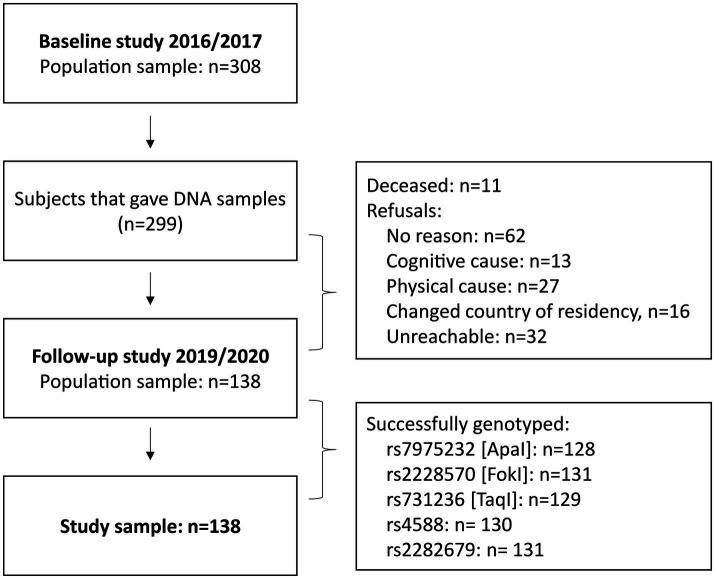
Methods: This longitudinal study was conducted in the Prishtina region, Kosovo, with community-dwelling adults over 40 years of age. Genomic DNA was extracted from saliva samples to assess single nucleotide polymorphisms in the vitamin D receptor (VDR) gene (rs7975232, rs2228570, rs731236, also referred to as ApaI, FokI, and TaqI, respectively) and the vitamin D binding protein (GC) gene (rs4588, rs2282679). Physical performance was assessed by isometric handgrip strength, 30-s chair stand, timed up and go and 6-min walk test. Vitamin D levels were assessed from blood samples only at follow-up.
Results: A total of 138 participants (65.1 ± 9.0 years, 52.2% female) were included. Over a 2.7-year period, significant declines in the 30-s chair stand test (p < 0.001) and timed up and go performance (p < 0.001) were observed, whereas BMI increased. Only female participants experienced a decrease in handgrip strength (p < 0.001). Genotyping showed significant associations of the ApaI variant with changes in BMI and handgrip strength. Participants with the minor CC genotype showed a greater increase in BMI and a greater decrease in absolute and relative handgrip strength. No significant interactions were observed for FokI and TaqI in the VDR gene, or rs4588 and rs2282679 in the GC gene. Vitamin D deficiency (<50 nmol/L) was prevalent in 47.5% of participants, with significant differences in 25(OH)D levels observed between genotypes of the GC gene (rs4588, p = 0.039; rs2282679, p = 0.036).
Conclusion: Physical fitness declined significantly over time, with female participants experiencing a greater decline in handgrip strength. The ApaI variant in the VDR gene was associated with changes in muscle strength, while variants in the GC gene were associated with vitamin D levels. These findings suggest that genetic factors related to the vitamin D pathway may contribute to the age-related decline in muscle strength. Therefore, genetic predisposition should be considered when developing individual interventions for healthy aging.
年龄相关的肌肉力量和性能下降显著影响发病率和死亡率。包括遗传学在内的各种因素已经被研究,以更好地理解这种下降。这项研究旨在调查身体表现和力量的纵向变化及其与维生素D途径相关基因的遗传变异的关系。方法:这项纵向研究是在科索沃普里什蒂纳地区进行的,社区居住的成年人年龄超过40 岁。从唾液样本中提取基因组DNA,评估维生素D受体(VDR)基因(rs7975232、rs2228570、rs731236,分别称为ApaI、FokI和TaqI)和维生素D结合蛋白(GC)基因(rs4588、rs2282679)的单核苷酸多态性。身体表现通过等长握力、30秒站立、起身和步行6分钟测试来评估。维生素D水平仅在随访时通过血液样本进行评估。结果:共纳入138例受试者(65.1 ± 9.0 岁,女性52.2%)。在2.7年的时间里,30-s的椅子站立测试显著下降(p p p p = 0.039;rs2282679 p = 0.036)。结论:随着时间的推移,身体素质明显下降,女性参与者的握力下降更大。VDR基因中的ApaI变异与肌肉力量的变化有关,而GC基因的变异与维生素D水平有关。这些发现表明,与维生素D途径相关的遗传因素可能导致与年龄相关的肌肉力量下降。因此,在制定健康老龄化的个人干预措施时,应考虑遗传易感性。
期刊介绍:
Frontiers in Public Health is a multidisciplinary open-access journal which publishes rigorously peer-reviewed research and is at the forefront of disseminating and communicating scientific knowledge and impactful discoveries to researchers, academics, clinicians, policy makers and the public worldwide. The journal aims at overcoming current fragmentation in research and publication, promoting consistency in pursuing relevant scientific themes, and supporting finding dissemination and translation into practice.
Frontiers in Public Health is organized into Specialty Sections that cover different areas of research in the field. Please refer to the author guidelines for details on article types and the submission process.





 京公网安备 11010802042870号
京ICP备2023020795号-1
京公网安备 11010802042870号
京ICP备2023020795号-1

 分享
分享
 求助内容:
求助内容: 应助结果提醒方式:
 扫码关注我们
