Two-Dimensional Siloxene Nanosheets: Understanding the Effect of Heat Treatment on the Surface Chemistry and Resulting Electrochemistry in Lithium-Based Batteries
Jessica Luo, Edelmy J. Marin Bernardez, David J. Arnot, Andrew Nicoll, Arun Kingan, Patrick J. Barry, Steven T. King, Cherno Jaye, Daniel A. Fischer, Xiao Tong, David C. Bock, Lei Wang, Esther S. Takeuchi, Amy C. Marschilok, Shan Yan, Kenneth J. Takeuchi
{"title":"Two-Dimensional Siloxene Nanosheets: Understanding the Effect of Heat Treatment on the Surface Chemistry and Resulting Electrochemistry in Lithium-Based Batteries","authors":"Jessica Luo, Edelmy J. Marin Bernardez, David J. Arnot, Andrew Nicoll, Arun Kingan, Patrick J. Barry, Steven T. King, Cherno Jaye, Daniel A. Fischer, Xiao Tong, David C. Bock, Lei Wang, Esther S. Takeuchi, Amy C. Marschilok, Shan Yan, Kenneth J. Takeuchi","doi":"10.1021/acsami.4c22619","DOIUrl":null,"url":null,"abstract":"Two-dimensional (2D) silicon materials are conceptually appealing as negative electrode materials in lithium-ion batteries due to their layered morphology, which can accommodate (de)lithiation-induced volume changes. Herein, heat treatment of 2D Siloxene materials was used to modify the surface functional groups to determine the impact on the electrochemical behavior. Spectroscopic characterization of the heat-treated nanosheets confirmed the loss of oxygenated and hydride surface functional groups with an increased annealing temperature. Formation and disproportionation of the amorphous suboxides with increasing heat treatment were affirmed with lab and synchrotron-based measurements. A reduced irreversible capacity was observed for Siloxene with a higher temperature heat treatment consistent with the formation of a more favorable surface electrolyte interphase (SEI). A Siloxene-400||NMC622 full cell (prepared with 400 °C-annealed Siloxene (Siloxene-400) and LiNi<sub>0.6</sub>Mn<sub>0.2</sub>Co<sub>0.2</sub>O<sub>2</sub> (NMC622)) showed significantly enhanced capacity and rate capability compared to a nano Si||NMC622 cell. These results illustrate the ability of thermal annealing to modify the surface functional groups of Siloxene and highlight the favorable impact of the appropriate surface functionality on the electrochemistry of Siloxene in lithium cells.","PeriodicalId":5,"journal":{"name":"ACS Applied Materials & Interfaces","volume":"38 1","pages":""},"PeriodicalIF":8.2000,"publicationDate":"2025-03-02","publicationTypes":"Journal Article","fieldsOfStudy":null,"isOpenAccess":false,"openAccessPdf":"","citationCount":"0","resultStr":null,"platform":"Semanticscholar","paperid":null,"PeriodicalName":"ACS Applied Materials & Interfaces","FirstCategoryId":"88","ListUrlMain":"https://doi.org/10.1021/acsami.4c22619","RegionNum":2,"RegionCategory":"材料科学","ArticlePicture":[],"TitleCN":null,"AbstractTextCN":null,"PMCID":null,"EPubDate":"","PubModel":"","JCR":"Q1","JCRName":"MATERIALS SCIENCE, MULTIDISCIPLINARY","Score":null,"Total":0}
引用次数: 0
Abstract
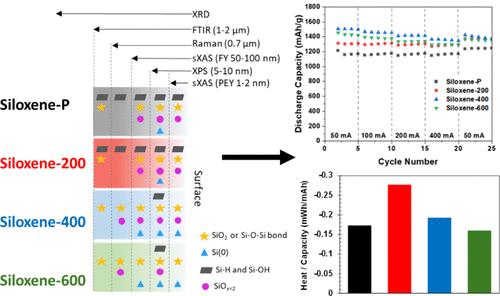
Two-dimensional (2D) silicon materials are conceptually appealing as negative electrode materials in lithium-ion batteries due to their layered morphology, which can accommodate (de)lithiation-induced volume changes. Herein, heat treatment of 2D Siloxene materials was used to modify the surface functional groups to determine the impact on the electrochemical behavior. Spectroscopic characterization of the heat-treated nanosheets confirmed the loss of oxygenated and hydride surface functional groups with an increased annealing temperature. Formation and disproportionation of the amorphous suboxides with increasing heat treatment were affirmed with lab and synchrotron-based measurements. A reduced irreversible capacity was observed for Siloxene with a higher temperature heat treatment consistent with the formation of a more favorable surface electrolyte interphase (SEI). A Siloxene-400||NMC622 full cell (prepared with 400 °C-annealed Siloxene (Siloxene-400) and LiNi0.6Mn0.2Co0.2O2 (NMC622)) showed significantly enhanced capacity and rate capability compared to a nano Si||NMC622 cell. These results illustrate the ability of thermal annealing to modify the surface functional groups of Siloxene and highlight the favorable impact of the appropriate surface functionality on the electrochemistry of Siloxene in lithium cells.
期刊介绍:
ACS Applied Materials & Interfaces is a leading interdisciplinary journal that brings together chemists, engineers, physicists, and biologists to explore the development and utilization of newly-discovered materials and interfacial processes for specific applications. Our journal has experienced remarkable growth since its establishment in 2009, both in terms of the number of articles published and the impact of the research showcased. We are proud to foster a truly global community, with the majority of published articles originating from outside the United States, reflecting the rapid growth of applied research worldwide.



 京公网安备 11010802042870号
京ICP备2023020795号-1
京公网安备 11010802042870号
京ICP备2023020795号-1

 分享
分享
 求助内容:
求助内容: 应助结果提醒方式:
 扫码关注我们
