Hamideh Darjazi, Alessandro Piovano, Giuseppina Meligrana, Giuseppe A. Elia, Claudio Gerbaldi
{"title":"Using Recycled Materials in a Novel Dual Binder System for Hard Carbon Anodes: Closing the Loop Toward Sustainable Li-/Na-ion Batteries","authors":"Hamideh Darjazi, Alessandro Piovano, Giuseppina Meligrana, Giuseppe A. Elia, Claudio Gerbaldi","doi":"10.1002/adfm.202426075","DOIUrl":null,"url":null,"abstract":"<p>Hard carbon (HC) has significant potential as anode material for both Li-ion and Na-ion batteries; however, its commercialization is hindered by challenges such as poor rate capability and low initial Coulombic efficiency (ICE). Although polymeric binders constitute a small fraction of the overall electrode composition, they play a crucial role in influencing the electrochemical performance. Here, this study introduces a novel dual composite binder, combining polyacrylic acid (PAA) and polyvinyl butyral (PVB). The interaction between the COOH groups in PAA and the OH groups in PVB via hydrogen bonding prompts a cohesive polymer network resulting in electrodes exhibiting superior rate capability and high ICE in both Li-ion and Na-ion laboratory-scale cells, surpassing the performance of those with other binders tested. After optimizing the formulations by using commercial PVB, we demonstrate for the first time the use of recycled PVB, sourced from laminated glass waste, to address the lack of end-of-life programs for this material, which often ends up in landfills. Repurposing PVB waste for battery applications tackles waste management issues and contributes to innovative development of advanced, green battery materials in a circular economy approach, thus paving the way for novel waste-to-energy solutions combining high-performance with socio-economical and environmental benefits.</p>","PeriodicalId":112,"journal":{"name":"Advanced Functional Materials","volume":"35 30","pages":""},"PeriodicalIF":19.0000,"publicationDate":"2025-03-03","publicationTypes":"Journal Article","fieldsOfStudy":null,"isOpenAccess":false,"openAccessPdf":"https://onlinelibrary.wiley.com/doi/epdf/10.1002/adfm.202426075","citationCount":"0","resultStr":null,"platform":"Semanticscholar","paperid":null,"PeriodicalName":"Advanced Functional Materials","FirstCategoryId":"88","ListUrlMain":"https://advanced.onlinelibrary.wiley.com/doi/10.1002/adfm.202426075","RegionNum":1,"RegionCategory":"材料科学","ArticlePicture":[],"TitleCN":null,"AbstractTextCN":null,"PMCID":null,"EPubDate":"","PubModel":"","JCR":"Q1","JCRName":"CHEMISTRY, MULTIDISCIPLINARY","Score":null,"Total":0}
引用次数: 0
Abstract
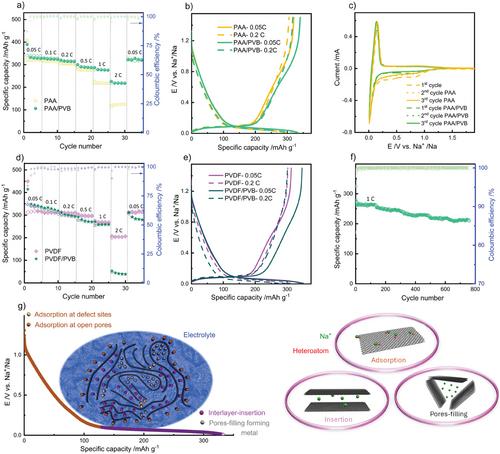
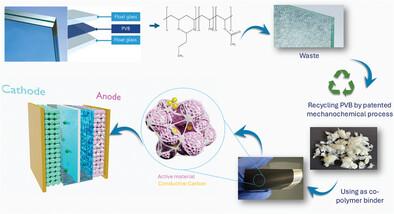
Hard carbon (HC) has significant potential as anode material for both Li-ion and Na-ion batteries; however, its commercialization is hindered by challenges such as poor rate capability and low initial Coulombic efficiency (ICE). Although polymeric binders constitute a small fraction of the overall electrode composition, they play a crucial role in influencing the electrochemical performance. Here, this study introduces a novel dual composite binder, combining polyacrylic acid (PAA) and polyvinyl butyral (PVB). The interaction between the COOH groups in PAA and the OH groups in PVB via hydrogen bonding prompts a cohesive polymer network resulting in electrodes exhibiting superior rate capability and high ICE in both Li-ion and Na-ion laboratory-scale cells, surpassing the performance of those with other binders tested. After optimizing the formulations by using commercial PVB, we demonstrate for the first time the use of recycled PVB, sourced from laminated glass waste, to address the lack of end-of-life programs for this material, which often ends up in landfills. Repurposing PVB waste for battery applications tackles waste management issues and contributes to innovative development of advanced, green battery materials in a circular economy approach, thus paving the way for novel waste-to-energy solutions combining high-performance with socio-economical and environmental benefits.
期刊介绍:
Firmly established as a top-tier materials science journal, Advanced Functional Materials reports breakthrough research in all aspects of materials science, including nanotechnology, chemistry, physics, and biology every week.
Advanced Functional Materials is known for its rapid and fair peer review, quality content, and high impact, making it the first choice of the international materials science community.





 京公网安备 11010802042870号
京ICP备2023020795号-1
京公网安备 11010802042870号
京ICP备2023020795号-1

 分享
分享
 求助内容:
求助内容: 应助结果提醒方式:
 扫码关注我们
