Mingyang Li, Limin Wu, Haibo Si, Yuangang Wu, Yuan Liu, Yi Zeng, Bin Shen
{"title":"Engineered mitochondria in diseases: mechanisms, strategies, and applications","authors":"Mingyang Li, Limin Wu, Haibo Si, Yuangang Wu, Yuan Liu, Yi Zeng, Bin Shen","doi":"10.1038/s41392-024-02081-y","DOIUrl":null,"url":null,"abstract":"<p>Mitochondrial diseases represent one of the most prevalent and debilitating categories of hereditary disorders, characterized by significant genetic, biological, and clinical heterogeneity, which has driven the development of the field of engineered mitochondria. With the growing recognition of the pathogenic role of damaged mitochondria in aging, oxidative disorders, inflammatory diseases, and cancer, the application of engineered mitochondria has expanded to those non-hereditary contexts (sometimes referred to as mitochondria-related diseases). Due to their unique non-eukaryotic origins and endosymbiotic relationship, mitochondria are considered highly suitable for gene editing and intercellular transplantation, and remarkable progress has been achieved in two promising therapeutic strategies—mitochondrial gene editing and artificial mitochondrial transfer (collectively referred to as engineered mitochondria in this review) over the past two decades. Here, we provide a comprehensive review of the mechanisms and recent advancements in the development of engineered mitochondria for therapeutic applications, alongside a concise summary of potential clinical implications and supporting evidence from preclinical and clinical studies. Additionally, an emerging and potentially feasible approach involves ex vivo mitochondrial editing, followed by selection and transplantation, which holds the potential to overcome limitations such as reduced in vivo operability and the introduction of allogeneic mitochondrial heterogeneity, thereby broadening the applicability of engineered mitochondria.</p>","PeriodicalId":21766,"journal":{"name":"Signal Transduction and Targeted Therapy","volume":"5 1","pages":""},"PeriodicalIF":52.7000,"publicationDate":"2025-03-03","publicationTypes":"Journal Article","fieldsOfStudy":null,"isOpenAccess":false,"openAccessPdf":"","citationCount":"0","resultStr":null,"platform":"Semanticscholar","paperid":null,"PeriodicalName":"Signal Transduction and Targeted Therapy","FirstCategoryId":"3","ListUrlMain":"https://doi.org/10.1038/s41392-024-02081-y","RegionNum":1,"RegionCategory":"医学","ArticlePicture":[],"TitleCN":null,"AbstractTextCN":null,"PMCID":null,"EPubDate":"","PubModel":"","JCR":"Q1","JCRName":"BIOCHEMISTRY & MOLECULAR BIOLOGY","Score":null,"Total":0}
引用次数: 0
Abstract
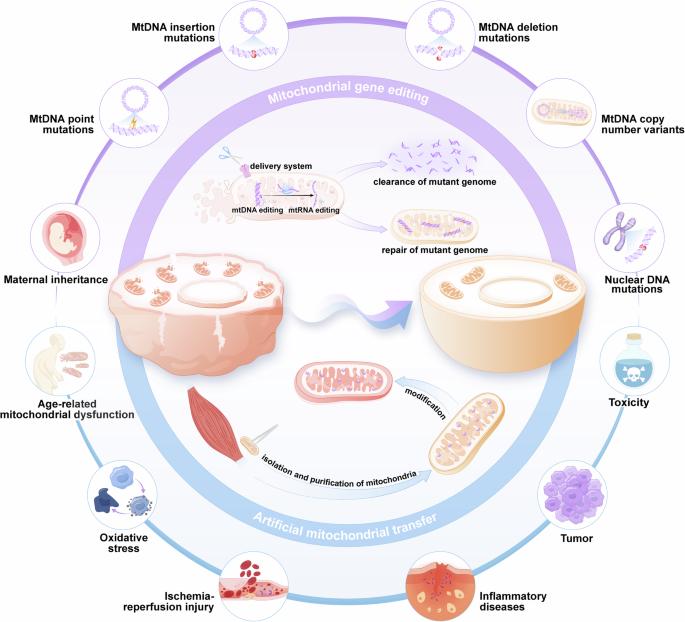
Mitochondrial diseases represent one of the most prevalent and debilitating categories of hereditary disorders, characterized by significant genetic, biological, and clinical heterogeneity, which has driven the development of the field of engineered mitochondria. With the growing recognition of the pathogenic role of damaged mitochondria in aging, oxidative disorders, inflammatory diseases, and cancer, the application of engineered mitochondria has expanded to those non-hereditary contexts (sometimes referred to as mitochondria-related diseases). Due to their unique non-eukaryotic origins and endosymbiotic relationship, mitochondria are considered highly suitable for gene editing and intercellular transplantation, and remarkable progress has been achieved in two promising therapeutic strategies—mitochondrial gene editing and artificial mitochondrial transfer (collectively referred to as engineered mitochondria in this review) over the past two decades. Here, we provide a comprehensive review of the mechanisms and recent advancements in the development of engineered mitochondria for therapeutic applications, alongside a concise summary of potential clinical implications and supporting evidence from preclinical and clinical studies. Additionally, an emerging and potentially feasible approach involves ex vivo mitochondrial editing, followed by selection and transplantation, which holds the potential to overcome limitations such as reduced in vivo operability and the introduction of allogeneic mitochondrial heterogeneity, thereby broadening the applicability of engineered mitochondria.
期刊介绍:
Signal Transduction and Targeted Therapy is an open access journal that focuses on timely publication of cutting-edge discoveries and advancements in basic science and clinical research related to signal transduction and targeted therapy.
Scope: The journal covers research on major human diseases, including, but not limited to:
Cancer,Cardiovascular diseases,Autoimmune diseases,Nervous system diseases.



 京公网安备 11010802042870号
京ICP备2023020795号-1
京公网安备 11010802042870号
京ICP备2023020795号-1

 分享
分享
 求助内容:
求助内容: 应助结果提醒方式:
 扫码关注我们
