{"title":"Diabetes Advances Cardiomyocyte Senescence Through Interfering Rnd3 Expression and Function","authors":"Linxu Wu, Xinglin Zhu, Shanshan Pan, Yan Chen, Cai Luo, Yangyang Zhao, Jingci Xing, Kaijia Shi, Shuya Zhang, Jiaqi Li, Jinxuan Chai, Xuebin Ling, Jianmin Qiu, Yan Wang, Zhihua Shen, Wei Jie, Junli Guo","doi":"10.1111/acel.70031","DOIUrl":null,"url":null,"abstract":"<p>Rnd3 is a small Rho-GTPase that has been implicated in various cardiovascular diseases. Yet, its role in diabetes-induced cardiomyocyte senescence remains unknown. Here we tested the role of Rnd3 in cardiomyocyte senescence and diabetic cardiomyopathy (DCM). The expression of <i>Rnd3</i> was found to be reduced in peripheral blood mononuclear cells from diabetic patients and correlated negatively with age but positively with cardiac function. In 96-week-old Sprague Dawley (SD) rats, cardiac function was impaired, accompanied by an increased number of SA-β-gal-positive cells and elevated levels of the senescence-associated secretory phenotype (SASP) related factors, compared to those of 12-week-old rats. Diabetes and high glucose (HG, 35 mmol/L D-glucose) suppressed <i>Rnd3</i> expression in cardiomyocytes and induced cardiomyocyte senescence. The deficiency of <i>Rnd3</i> exacerbated cardiomyocyte senescence in vitro and in vivo. MicroRNA sequencing in AC16 cells identified a conserved miR-103a-3p (present in humans and rats) as a key HG-upregulated microRNA that bound to the <i>Rnd3</i> 3′-UTR. In cultured cardiomyocytes, miR-103a-3p inhibitors antagonized HG-induced cardiomyocyte senescence dependent on <i>Rnd3</i> expression. Treatment with AAV9 vectors carrying miR-103a-3p sponges and <i>Rnd3</i>-overexpressing plasmids alleviated cardiomyocyte senescence and restored cardiac function in diabetic SD rats. HG stimulation increased STAT3 (Tyr705) phosphorylation and promoted its nuclear translocation in H9C2 cells, an effect exacerbated by <i>Rnd3</i> knockout. Mechanistically, Rnd3 interacted with p-STAT3 in the cytoplasm, facilitating proteasome-mediated ubiquitination and p-STAT3 degradation. The STAT3 inhibitor S3I-201 blocked HG-induced STAT3 activation and mitigated cardiomyocyte senescence. These findings suggest that diabetes induces cardiomyocyte senescence via the miR-103a-3p/Rnd3/STAT3 signaling pathway, highlighting a potential therapeutic target for DCM.</p>","PeriodicalId":55543,"journal":{"name":"Aging Cell","volume":"24 6","pages":""},"PeriodicalIF":7.1000,"publicationDate":"2025-03-02","publicationTypes":"Journal Article","fieldsOfStudy":null,"isOpenAccess":false,"openAccessPdf":"https://onlinelibrary.wiley.com/doi/epdf/10.1111/acel.70031","citationCount":"0","resultStr":null,"platform":"Semanticscholar","paperid":null,"PeriodicalName":"Aging Cell","FirstCategoryId":"99","ListUrlMain":"https://onlinelibrary.wiley.com/doi/10.1111/acel.70031","RegionNum":1,"RegionCategory":"医学","ArticlePicture":[],"TitleCN":null,"AbstractTextCN":null,"PMCID":null,"EPubDate":"","PubModel":"","JCR":"Q1","JCRName":"Biochemistry, Genetics and Molecular Biology","Score":null,"Total":0}
引用次数: 0
Abstract
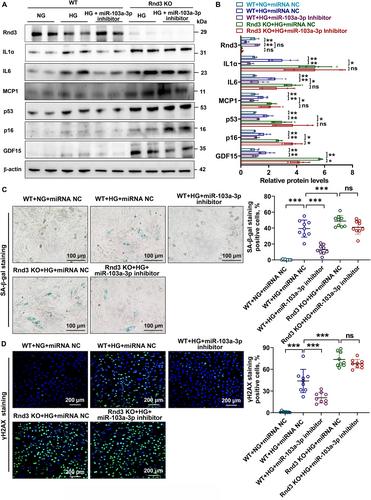
Rnd3 is a small Rho-GTPase that has been implicated in various cardiovascular diseases. Yet, its role in diabetes-induced cardiomyocyte senescence remains unknown. Here we tested the role of Rnd3 in cardiomyocyte senescence and diabetic cardiomyopathy (DCM). The expression of Rnd3 was found to be reduced in peripheral blood mononuclear cells from diabetic patients and correlated negatively with age but positively with cardiac function. In 96-week-old Sprague Dawley (SD) rats, cardiac function was impaired, accompanied by an increased number of SA-β-gal-positive cells and elevated levels of the senescence-associated secretory phenotype (SASP) related factors, compared to those of 12-week-old rats. Diabetes and high glucose (HG, 35 mmol/L D-glucose) suppressed Rnd3 expression in cardiomyocytes and induced cardiomyocyte senescence. The deficiency of Rnd3 exacerbated cardiomyocyte senescence in vitro and in vivo. MicroRNA sequencing in AC16 cells identified a conserved miR-103a-3p (present in humans and rats) as a key HG-upregulated microRNA that bound to the Rnd3 3′-UTR. In cultured cardiomyocytes, miR-103a-3p inhibitors antagonized HG-induced cardiomyocyte senescence dependent on Rnd3 expression. Treatment with AAV9 vectors carrying miR-103a-3p sponges and Rnd3-overexpressing plasmids alleviated cardiomyocyte senescence and restored cardiac function in diabetic SD rats. HG stimulation increased STAT3 (Tyr705) phosphorylation and promoted its nuclear translocation in H9C2 cells, an effect exacerbated by Rnd3 knockout. Mechanistically, Rnd3 interacted with p-STAT3 in the cytoplasm, facilitating proteasome-mediated ubiquitination and p-STAT3 degradation. The STAT3 inhibitor S3I-201 blocked HG-induced STAT3 activation and mitigated cardiomyocyte senescence. These findings suggest that diabetes induces cardiomyocyte senescence via the miR-103a-3p/Rnd3/STAT3 signaling pathway, highlighting a potential therapeutic target for DCM.
期刊介绍:
Aging Cell, an Open Access journal, delves into fundamental aspects of aging biology. It comprehensively explores geroscience, emphasizing research on the mechanisms underlying the aging process and the connections between aging and age-related diseases.



 京公网安备 11010802042870号
京ICP备2023020795号-1
京公网安备 11010802042870号
京ICP备2023020795号-1

 分享
分享
 求助内容:
求助内容: 应助结果提醒方式:
 扫码关注我们
