Effects of the VIVIFRAIL Exercise Protocol on Circulatory and Intracellular Peripheral Mediators Bridging Mitochondrial Dynamics and Inflammation in Robust and Frail Older People
Fiona Limanaqi, Evelyn Ferri, Pasquale Ogno, Franca Rosa Guerini, Gabriela Alexandra Mihali, Tiziano Lucchi, Mario Clerici, Chiara Fenoglio, Laura D'Andrea, Elena Marcello, Mara Biasin, Beatrice Arosio
{"title":"Effects of the VIVIFRAIL Exercise Protocol on Circulatory and Intracellular Peripheral Mediators Bridging Mitochondrial Dynamics and Inflammation in Robust and Frail Older People","authors":"Fiona Limanaqi, Evelyn Ferri, Pasquale Ogno, Franca Rosa Guerini, Gabriela Alexandra Mihali, Tiziano Lucchi, Mario Clerici, Chiara Fenoglio, Laura D'Andrea, Elena Marcello, Mara Biasin, Beatrice Arosio","doi":"10.1111/acel.70029","DOIUrl":null,"url":null,"abstract":"<p>Physical exercise has been associated with healthier aging trajectories, potentially preventing or mitigating age-related declines. This occurs through a complex, yet poorly characterized network of multi-organ interactions involving mitochondrial, inflammatory, and cell death/survival pathways. Here, we comprehensively evaluated the 12-week VIVIFRAIL multicomponent exercise protocol in physically frail (<i>n</i> = 16, mean age 81.4 ± 5.6) and robust (<i>n</i> = 50, mean-age 73.6 ± 4.7) old individuals. Before (T0) and after (T1) the protocol, functional outcomes were assessed alongside a detailed exploratory analysis of mitochondrial, inflammatory, apoptotic, and neuro-muscular mediators concerning their plasmatic/serum concentrations, and/or mRNA expression from peripheral blood mononuclear cells (PBMCs). Besides significant functional improvements across both groups, our findings highlighted unique and overlapping modulations of key biological pathways. Both groups showed refined mitochondrial integrity/turnover (upregulated <i>mt-ND1</i>, downregulated <i>TFAM</i>, and <i>ULK1</i>), anti-inflammatory responses (upregulated <i>IL10</i>, and <i>TGF-B</i>, and downregulated <i>IL6/IL10</i> mRNA ratio), as well as reduced cellular damage/apoptosis (reduced plasmatic ccf-nDNA, downregulated <i>BAX</i>, and upregulated <i>BCL-2/BAX</i> ratio). Plasmatic ccf-mtDNA was significantly reduced in robust subjects, while plasmatic IL6 and IL6/IL10 ratio were reduced in frail subjects uniquely. Spearman correlations between physical improvements and biological pathway variations also suggested different adaptation mechanisms influenced not only by chronological age but also by frailty status. In conclusion, this study confirms the benefits of physical activity in the older population and provides novel insights into specific biological mediators of the mitochondria-inflammation axis as key players in such effects. Moreover, our findings establish PBMCs as a valuable tool for monitoring the biological trajectories of aging and health-promoting lifestyle interventions.</p>","PeriodicalId":55543,"journal":{"name":"Aging Cell","volume":"24 6","pages":""},"PeriodicalIF":7.1000,"publicationDate":"2025-03-04","publicationTypes":"Journal Article","fieldsOfStudy":null,"isOpenAccess":false,"openAccessPdf":"https://onlinelibrary.wiley.com/doi/epdf/10.1111/acel.70029","citationCount":"0","resultStr":null,"platform":"Semanticscholar","paperid":null,"PeriodicalName":"Aging Cell","FirstCategoryId":"99","ListUrlMain":"https://onlinelibrary.wiley.com/doi/10.1111/acel.70029","RegionNum":1,"RegionCategory":"医学","ArticlePicture":[],"TitleCN":null,"AbstractTextCN":null,"PMCID":null,"EPubDate":"","PubModel":"","JCR":"Q1","JCRName":"Biochemistry, Genetics and Molecular Biology","Score":null,"Total":0}
引用次数: 0
Abstract
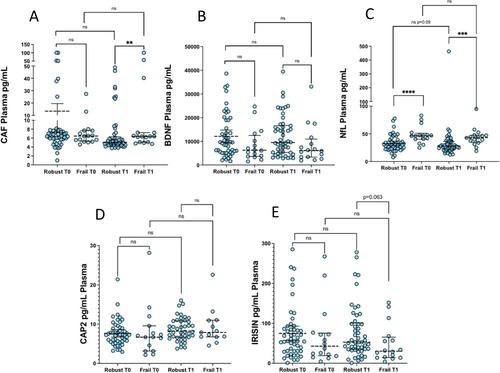
Physical exercise has been associated with healthier aging trajectories, potentially preventing or mitigating age-related declines. This occurs through a complex, yet poorly characterized network of multi-organ interactions involving mitochondrial, inflammatory, and cell death/survival pathways. Here, we comprehensively evaluated the 12-week VIVIFRAIL multicomponent exercise protocol in physically frail (n = 16, mean age 81.4 ± 5.6) and robust (n = 50, mean-age 73.6 ± 4.7) old individuals. Before (T0) and after (T1) the protocol, functional outcomes were assessed alongside a detailed exploratory analysis of mitochondrial, inflammatory, apoptotic, and neuro-muscular mediators concerning their plasmatic/serum concentrations, and/or mRNA expression from peripheral blood mononuclear cells (PBMCs). Besides significant functional improvements across both groups, our findings highlighted unique and overlapping modulations of key biological pathways. Both groups showed refined mitochondrial integrity/turnover (upregulated mt-ND1, downregulated TFAM, and ULK1), anti-inflammatory responses (upregulated IL10, and TGF-B, and downregulated IL6/IL10 mRNA ratio), as well as reduced cellular damage/apoptosis (reduced plasmatic ccf-nDNA, downregulated BAX, and upregulated BCL-2/BAX ratio). Plasmatic ccf-mtDNA was significantly reduced in robust subjects, while plasmatic IL6 and IL6/IL10 ratio were reduced in frail subjects uniquely. Spearman correlations between physical improvements and biological pathway variations also suggested different adaptation mechanisms influenced not only by chronological age but also by frailty status. In conclusion, this study confirms the benefits of physical activity in the older population and provides novel insights into specific biological mediators of the mitochondria-inflammation axis as key players in such effects. Moreover, our findings establish PBMCs as a valuable tool for monitoring the biological trajectories of aging and health-promoting lifestyle interventions.
期刊介绍:
Aging Cell, an Open Access journal, delves into fundamental aspects of aging biology. It comprehensively explores geroscience, emphasizing research on the mechanisms underlying the aging process and the connections between aging and age-related diseases.



 京公网安备 11010802042870号
京ICP备2023020795号-1
京公网安备 11010802042870号
京ICP备2023020795号-1

 分享
分享
 求助内容:
求助内容: 应助结果提醒方式:
 扫码关注我们
