Ying Yi, Yongfei Hu, Juanjuan Kang, Qifa Liu, Yan Huang, Dong Wang
{"title":"Biological Data Resources and Machine Learning Frameworks for Hematology Research.","authors":"Ying Yi, Yongfei Hu, Juanjuan Kang, Qifa Liu, Yan Huang, Dong Wang","doi":"10.1093/gpbjnl/qzaf021","DOIUrl":null,"url":null,"abstract":"<p><p>Hematology research has greatly benefited from the integration of diverse biological data resources and advanced machine learning (ML) frameworks. This integration has not only deepened our understanding of blood diseases such as leukemia and lymphoma, but also enhanced diagnostic accuracy and personalized treatment strategies. By applying ML algorithms to analyze large-scale biological data, researchers can more effectively identify disease patterns, predict treatment responses, and provide new perspectives for the diagnosis and treatment of hematologic disorders. Here, we provide an overview of the current landscape of biological data resources and the application of ML frameworks pertinent to hematology research.</p>","PeriodicalId":94020,"journal":{"name":"Genomics, proteomics & bioinformatics","volume":" ","pages":""},"PeriodicalIF":7.9000,"publicationDate":"2025-05-30","publicationTypes":"Journal Article","fieldsOfStudy":null,"isOpenAccess":false,"openAccessPdf":"https://www.ncbi.nlm.nih.gov/pmc/articles/PMC12321297/pdf/","citationCount":"0","resultStr":null,"platform":"Semanticscholar","paperid":null,"PeriodicalName":"Genomics, proteomics & bioinformatics","FirstCategoryId":"1085","ListUrlMain":"https://doi.org/10.1093/gpbjnl/qzaf021","RegionNum":0,"RegionCategory":null,"ArticlePicture":[],"TitleCN":null,"AbstractTextCN":null,"PMCID":null,"EPubDate":"","PubModel":"","JCR":"","JCRName":"","Score":null,"Total":0}
引用次数: 0
Abstract
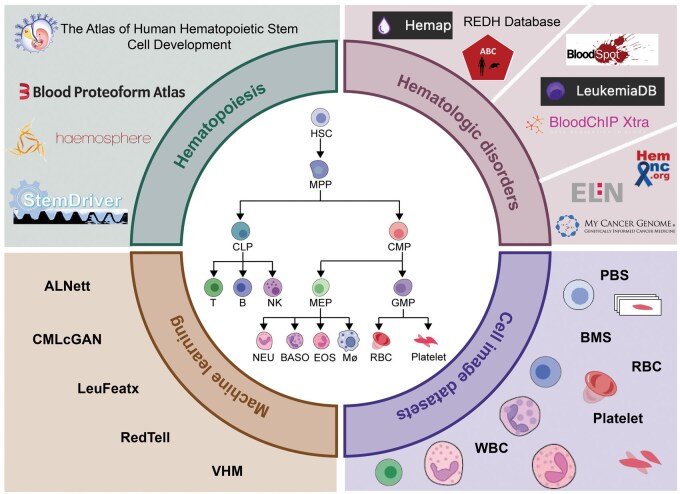
Hematology research has greatly benefited from the integration of diverse biological data resources and advanced machine learning (ML) frameworks. This integration has not only deepened our understanding of blood diseases such as leukemia and lymphoma, but also enhanced diagnostic accuracy and personalized treatment strategies. By applying ML algorithms to analyze large-scale biological data, researchers can more effectively identify disease patterns, predict treatment responses, and provide new perspectives for the diagnosis and treatment of hematologic disorders. Here, we provide an overview of the current landscape of biological data resources and the application of ML frameworks pertinent to hematology research.




 京公网安备 11010802042870号
京ICP备2023020795号-1
京公网安备 11010802042870号
京ICP备2023020795号-1

 分享
分享

 求助内容:
求助内容: 应助结果提醒方式:
 扫码关注我们
