{"title":"Trade-offs between resilience, sustainability and cost in the US agri-food transportation infrastructure","authors":"Deniz Berfin Karakoc, Megan Konar","doi":"10.1038/s43016-025-01128-9","DOIUrl":null,"url":null,"abstract":"Agricultural and food supply chains in the United States are essential for both global and local food security, yet the transportation of agri-food commodities has received little attention despite being an essential feature for connecting production to consumption. Here we map the US agri-food distribution onto real-world highways, railways and waterways and also quantify the trade-offs between cost, path redundancy and carbon emissions of agri-food transit across transportation modes. Highways show the greatest path redundancy; relative to waterways, highways also cost 3 orders of magnitude more and emit 60 times more carbon. On the contrary, waterways show the lowest cost and emission levels, but path redundancy against transportation disturbances is 80% lower than for highways. Railways offer a middle ground on path redundancy, carbon emission and cost concerns compared to highways and waterways. Our findings can inform efforts to balance affordability, resilience and sustainability in agri-food transportation. This study maps the transportation of agri-food commodities including highways, railways and waterways within the United States. It also quantifies the trade-offs between resilience, sustainability and cost for each transportation mode.","PeriodicalId":94151,"journal":{"name":"Nature food","volume":"6 4","pages":"401-409"},"PeriodicalIF":21.9000,"publicationDate":"2025-03-06","publicationTypes":"Journal Article","fieldsOfStudy":null,"isOpenAccess":false,"openAccessPdf":"","citationCount":"0","resultStr":null,"platform":"Semanticscholar","paperid":null,"PeriodicalName":"Nature food","FirstCategoryId":"1085","ListUrlMain":"https://www.nature.com/articles/s43016-025-01128-9","RegionNum":0,"RegionCategory":null,"ArticlePicture":[],"TitleCN":null,"AbstractTextCN":null,"PMCID":null,"EPubDate":"","PubModel":"","JCR":"Q1","JCRName":"FOOD SCIENCE & TECHNOLOGY","Score":null,"Total":0}
引用次数: 0
Abstract
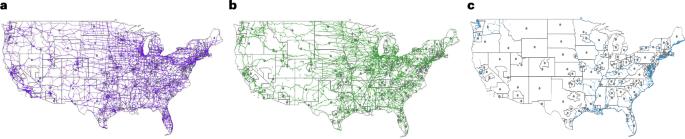
Agricultural and food supply chains in the United States are essential for both global and local food security, yet the transportation of agri-food commodities has received little attention despite being an essential feature for connecting production to consumption. Here we map the US agri-food distribution onto real-world highways, railways and waterways and also quantify the trade-offs between cost, path redundancy and carbon emissions of agri-food transit across transportation modes. Highways show the greatest path redundancy; relative to waterways, highways also cost 3 orders of magnitude more and emit 60 times more carbon. On the contrary, waterways show the lowest cost and emission levels, but path redundancy against transportation disturbances is 80% lower than for highways. Railways offer a middle ground on path redundancy, carbon emission and cost concerns compared to highways and waterways. Our findings can inform efforts to balance affordability, resilience and sustainability in agri-food transportation. This study maps the transportation of agri-food commodities including highways, railways and waterways within the United States. It also quantifies the trade-offs between resilience, sustainability and cost for each transportation mode.



 京公网安备 11010802042870号
京ICP备2023020795号-1
京公网安备 11010802042870号
京ICP备2023020795号-1

 分享
分享

 求助内容:
求助内容: 应助结果提醒方式:
 扫码关注我们
