Josephine Wagenaar, Ron van Beek, Henrike Pas, Martijn Suurveld, Anne Jacobs, Naomi Van der Linden, Julia Broos, Maaike Kleinsmann, Saba Hinrichs, Irwin Reiss, H Rob Taal
{"title":"Implementation and effectiveness of teleneonatology for neonatal intensive care units: a protocol for a hybrid type III implementation pilot.","authors":"Josephine Wagenaar, Ron van Beek, Henrike Pas, Martijn Suurveld, Anne Jacobs, Naomi Van der Linden, Julia Broos, Maaike Kleinsmann, Saba Hinrichs, Irwin Reiss, H Rob Taal","doi":"10.1136/bmjpo-2024-002711","DOIUrl":null,"url":null,"abstract":"<p><strong>Background: </strong>Telemedicine in neonatal care (TeleNeonatology) has the potential to improve neonatal outcomes, address capacity challenges and influence the emotional burden on parents. TeleNeonatology allows for real-time audiovisual communication between healthcare providers at different neonatal intensive care units (NICUs). Despite the high potential for multiple neonatal use-cases, TeleNeonatology is primarily being used for neonatal resuscitation and has yet to be widely implemented in Europe. Our study aims to evaluate both implementation strategies and effectiveness of TeleNeonatology in a pilot study in The Netherlands.</p><p><strong>Methods: </strong>A pre-post implementation study with hybrid type III design will be conducted from 1 January 2023 to 31 December 2024. The year 2023 will serve as a baseline period pre-implementation. From 1 January 2024, a TeleNeonatology device will be integrated within all communication between the NICU-level IV of the Erasmus MC hospital and the NICU-level II at Amphia Hospital. Outcomes of the implementation of the TeleNeo programme will be evaluated using a mixed-methods approach evaluating implementation outcomes, service outcomes and client outcomes. Feasibility, the primary implementation outcome, will be evaluated via a validated questionnaire for parents and personnel. Secondary implementation outcomes will be barriers and facilitators of implementation, based on semi-structured interviews and focus groups. A cost minimisation analysis, using decision trees, will be evaluated as service outcomes. Client outcomes will be assessed via parent-reported transfer experience questionnaires and interviews and the clinical outcomes NICU-level III transfer rate and length of stay.</p><p><strong>Ethics and dissemination: </strong>This study was reviewed by the Medical Ethical Committee of the Erasmus Medical Centre, who confirmed that the rules laid down in the Medical Research Involving Human Subjects Act do not apply (identification number: MEC-2023-0561). Results will be published in peer-reviewed journals in two separate scientific articles: the primary evaluation and the cost evaluation.</p>","PeriodicalId":9069,"journal":{"name":"BMJ Paediatrics Open","volume":"9 1","pages":""},"PeriodicalIF":2.3000,"publicationDate":"2025-03-05","publicationTypes":"Journal Article","fieldsOfStudy":null,"isOpenAccess":false,"openAccessPdf":"https://www.ncbi.nlm.nih.gov/pmc/articles/PMC11883619/pdf/","citationCount":"0","resultStr":null,"platform":"Semanticscholar","paperid":null,"PeriodicalName":"BMJ Paediatrics Open","FirstCategoryId":"3","ListUrlMain":"https://doi.org/10.1136/bmjpo-2024-002711","RegionNum":4,"RegionCategory":"医学","ArticlePicture":[],"TitleCN":null,"AbstractTextCN":null,"PMCID":null,"EPubDate":"","PubModel":"","JCR":"Q2","JCRName":"PEDIATRICS","Score":null,"Total":0}
引用次数: 0
Abstract
Background: Telemedicine in neonatal care (TeleNeonatology) has the potential to improve neonatal outcomes, address capacity challenges and influence the emotional burden on parents. TeleNeonatology allows for real-time audiovisual communication between healthcare providers at different neonatal intensive care units (NICUs). Despite the high potential for multiple neonatal use-cases, TeleNeonatology is primarily being used for neonatal resuscitation and has yet to be widely implemented in Europe. Our study aims to evaluate both implementation strategies and effectiveness of TeleNeonatology in a pilot study in The Netherlands.
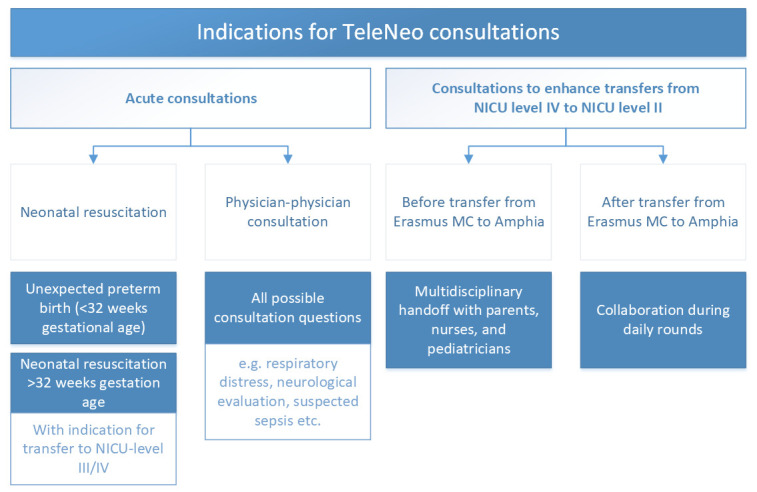
Methods: A pre-post implementation study with hybrid type III design will be conducted from 1 January 2023 to 31 December 2024. The year 2023 will serve as a baseline period pre-implementation. From 1 January 2024, a TeleNeonatology device will be integrated within all communication between the NICU-level IV of the Erasmus MC hospital and the NICU-level II at Amphia Hospital. Outcomes of the implementation of the TeleNeo programme will be evaluated using a mixed-methods approach evaluating implementation outcomes, service outcomes and client outcomes. Feasibility, the primary implementation outcome, will be evaluated via a validated questionnaire for parents and personnel. Secondary implementation outcomes will be barriers and facilitators of implementation, based on semi-structured interviews and focus groups. A cost minimisation analysis, using decision trees, will be evaluated as service outcomes. Client outcomes will be assessed via parent-reported transfer experience questionnaires and interviews and the clinical outcomes NICU-level III transfer rate and length of stay.
Ethics and dissemination: This study was reviewed by the Medical Ethical Committee of the Erasmus Medical Centre, who confirmed that the rules laid down in the Medical Research Involving Human Subjects Act do not apply (identification number: MEC-2023-0561). Results will be published in peer-reviewed journals in two separate scientific articles: the primary evaluation and the cost evaluation.






 京公网安备 11010802042870号
京ICP备2023020795号-1
京公网安备 11010802042870号
京ICP备2023020795号-1

 分享
分享
 求助内容:
求助内容: 应助结果提醒方式:
 扫码关注我们
