Gozdem Kayki, Nadir Yalcin, Hasan Tolga Celik, Sule Yigit
{"title":"Dexmedetomidine in neonates: utilisation trends and safety profile over time in a neonatal intensive care unit.","authors":"Gozdem Kayki, Nadir Yalcin, Hasan Tolga Celik, Sule Yigit","doi":"10.1136/bmjpo-2024-003004","DOIUrl":null,"url":null,"abstract":"<p><strong>Background: </strong>Dexmedetomidine is an alpha-2 adrenergic agonist with sedative, anxiolytic and analgesic effects. Its use in neonatal intensive care units (NICUs) has been increasing in the last decade. The aim of this study was to assess the safety profile of dexmedetomidine and to identify specific trends in its use over time.</p><p><strong>Methods: </strong>In this retrospective observational study, data were collected on all patients who received continuous infusion of dexmedetomidine in a level IV NICU in Turkey between 2018 and 2023. Demographic characteristics were compared between preterm and term infants using the Mann-Whitney U test. Differences in adverse effects between term and preterm infants, as well as between lower and higher doses, were analysed using the χ<sup>2</sup> test. Regression analysis was conducted to identify factors influencing adverse effects.</p><p><strong>Results: </strong>A total of 383 patients were included. The participants had a median (IQR) gestational age of 37 (35-38) weeks with a median (IQR) birth weight of 2700 (2140-3270) grams and the median (IQR) postmenstrual age at the time of dexmedetomidine initiation was 38 (36-40) weeks. The most common indication for use was pain control following surgery and/or interventional procedures (81.5%). There was a statistically significant increase in initial doses (p<0.001) and treatment duration (p=0.009). Adverse drug reactions (ADRs) were observed in 5% of cases, mostly bradycardia (50%) and ADRs did not correlate with the dose (0.80), treatment duration (0.96) or gestational age (p=0.93).</p><p><strong>Conclusion: </strong>Our data and experiences demonstrated a significant increase in the dose and duration of dexmedetomidine use in the NICU over the years. Additionally, the findings have suggested that higher doses and treatment duration do not result in an increase in ADRs during the acute period.</p>","PeriodicalId":9069,"journal":{"name":"BMJ Paediatrics Open","volume":"9 1","pages":""},"PeriodicalIF":2.3000,"publicationDate":"2025-03-18","publicationTypes":"Journal Article","fieldsOfStudy":null,"isOpenAccess":false,"openAccessPdf":"https://www.ncbi.nlm.nih.gov/pmc/articles/PMC11927418/pdf/","citationCount":"0","resultStr":null,"platform":"Semanticscholar","paperid":null,"PeriodicalName":"BMJ Paediatrics Open","FirstCategoryId":"3","ListUrlMain":"https://doi.org/10.1136/bmjpo-2024-003004","RegionNum":4,"RegionCategory":"医学","ArticlePicture":[],"TitleCN":null,"AbstractTextCN":null,"PMCID":null,"EPubDate":"","PubModel":"","JCR":"Q2","JCRName":"PEDIATRICS","Score":null,"Total":0}
引用次数: 0
Abstract
Background: Dexmedetomidine is an alpha-2 adrenergic agonist with sedative, anxiolytic and analgesic effects. Its use in neonatal intensive care units (NICUs) has been increasing in the last decade. The aim of this study was to assess the safety profile of dexmedetomidine and to identify specific trends in its use over time.
Methods: In this retrospective observational study, data were collected on all patients who received continuous infusion of dexmedetomidine in a level IV NICU in Turkey between 2018 and 2023. Demographic characteristics were compared between preterm and term infants using the Mann-Whitney U test. Differences in adverse effects between term and preterm infants, as well as between lower and higher doses, were analysed using the χ2 test. Regression analysis was conducted to identify factors influencing adverse effects.
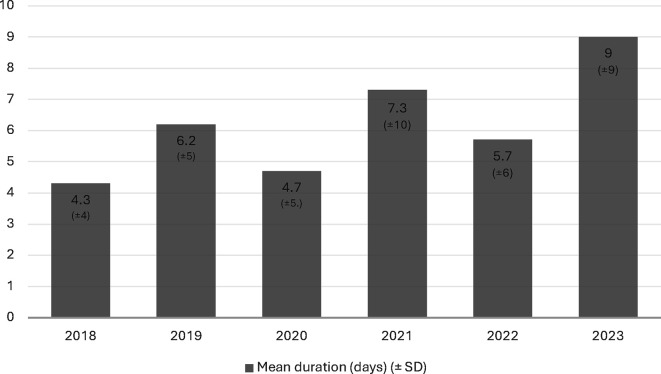
Results: A total of 383 patients were included. The participants had a median (IQR) gestational age of 37 (35-38) weeks with a median (IQR) birth weight of 2700 (2140-3270) grams and the median (IQR) postmenstrual age at the time of dexmedetomidine initiation was 38 (36-40) weeks. The most common indication for use was pain control following surgery and/or interventional procedures (81.5%). There was a statistically significant increase in initial doses (p<0.001) and treatment duration (p=0.009). Adverse drug reactions (ADRs) were observed in 5% of cases, mostly bradycardia (50%) and ADRs did not correlate with the dose (0.80), treatment duration (0.96) or gestational age (p=0.93).
Conclusion: Our data and experiences demonstrated a significant increase in the dose and duration of dexmedetomidine use in the NICU over the years. Additionally, the findings have suggested that higher doses and treatment duration do not result in an increase in ADRs during the acute period.





 京公网安备 11010802042870号
京ICP备2023020795号-1
京公网安备 11010802042870号
京ICP备2023020795号-1

 分享
分享
 求助内容:
求助内容: 应助结果提醒方式:
 扫码关注我们
