Ilige S. Hage , Charbel Y. Seif , Jose Enrico Q. Quinsaat , Daniel J. van de Pas , Richard Vendamme , Walter Eevers , Karolien Vanbroekhoven , Elias Feghali
{"title":"Neural network-optimized imaging for classifying lignin-based polyurethane foams: Linking molecular composition to cellular microstructure using advanced machine learning","authors":"Ilige S. Hage , Charbel Y. Seif , Jose Enrico Q. Quinsaat , Daniel J. van de Pas , Richard Vendamme , Walter Eevers , Karolien Vanbroekhoven , Elias Feghali","doi":"10.1016/j.polymer.2025.128235","DOIUrl":null,"url":null,"abstract":"<div><div>In recent years, there has been growth in machine learning (ML) applications in polymer science. However, applying ML strategies to solve problems faced by polymer chemists remains in its infancy. A critical challenge is designing polyurethane (PU) foams with tailored microstructures and properties, a process still largely reliant on time consuming trial-and-error. This study introduces Convolutional Neural Networks (CNNs), an optimized ML algorithm for image processing, to explore structure-property relationships in biobased PU foams derived from lignin hydrogenolysis oil. The dataset included specimens with varying compositions, characterized by compression testing and scanning electron microscopy images taken before and after compression. A 30:70 training-to-validation split was used for model development. The CNN optimized model for classification achieved excellent performance, to identify PU foam composition based on geometric features. For validation, the CNN optimized model was compared against the \"ResNet-50″ model. Across both compressed and uncompressed datasets, the presented CNN optimized model consistently outperformed \"ResNet-50″, achieving higher accuracy (up to 0.99) and high precision (0.97). The findings demonstrate the method's reliability, especially with data from compressed foams. This study underscores the transformative potential of ML in accelerating material design, offering a streamlined approach for developing PU foams with customized microstructures and enhanced performance.</div></div>","PeriodicalId":405,"journal":{"name":"Polymer","volume":"324 ","pages":"Article 128235"},"PeriodicalIF":4.5000,"publicationDate":"2025-04-17","publicationTypes":"Journal Article","fieldsOfStudy":null,"isOpenAccess":false,"openAccessPdf":"","citationCount":"0","resultStr":null,"platform":"Semanticscholar","paperid":null,"PeriodicalName":"Polymer","FirstCategoryId":"92","ListUrlMain":"https://www.sciencedirect.com/science/article/pii/S0032386125002216","RegionNum":2,"RegionCategory":"化学","ArticlePicture":[],"TitleCN":null,"AbstractTextCN":null,"PMCID":null,"EPubDate":"2025/3/6 0:00:00","PubModel":"Epub","JCR":"Q2","JCRName":"POLYMER SCIENCE","Score":null,"Total":0}
引用次数: 0
Abstract
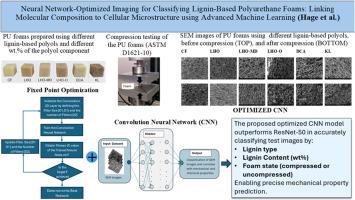
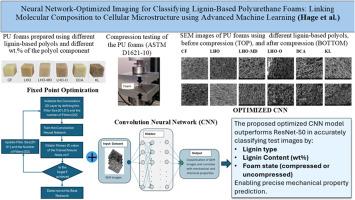
In recent years, there has been growth in machine learning (ML) applications in polymer science. However, applying ML strategies to solve problems faced by polymer chemists remains in its infancy. A critical challenge is designing polyurethane (PU) foams with tailored microstructures and properties, a process still largely reliant on time consuming trial-and-error. This study introduces Convolutional Neural Networks (CNNs), an optimized ML algorithm for image processing, to explore structure-property relationships in biobased PU foams derived from lignin hydrogenolysis oil. The dataset included specimens with varying compositions, characterized by compression testing and scanning electron microscopy images taken before and after compression. A 30:70 training-to-validation split was used for model development. The CNN optimized model for classification achieved excellent performance, to identify PU foam composition based on geometric features. For validation, the CNN optimized model was compared against the "ResNet-50″ model. Across both compressed and uncompressed datasets, the presented CNN optimized model consistently outperformed "ResNet-50″, achieving higher accuracy (up to 0.99) and high precision (0.97). The findings demonstrate the method's reliability, especially with data from compressed foams. This study underscores the transformative potential of ML in accelerating material design, offering a streamlined approach for developing PU foams with customized microstructures and enhanced performance.
期刊介绍:
Polymer is an interdisciplinary journal dedicated to publishing innovative and significant advances in Polymer Physics, Chemistry and Technology. We welcome submissions on polymer hybrids, nanocomposites, characterisation and self-assembly. Polymer also publishes work on the technological application of polymers in energy and optoelectronics.
The main scope is covered but not limited to the following core areas:
Polymer Materials
Nanocomposites and hybrid nanomaterials
Polymer blends, films, fibres, networks and porous materials
Physical Characterization
Characterisation, modelling and simulation* of molecular and materials properties in bulk, solution, and thin films
Polymer Engineering
Advanced multiscale processing methods
Polymer Synthesis, Modification and Self-assembly
Including designer polymer architectures, mechanisms and kinetics, and supramolecular polymerization
Technological Applications
Polymers for energy generation and storage
Polymer membranes for separation technology
Polymers for opto- and microelectronics.



 京公网安备 11010802042870号
京ICP备2023020795号-1
京公网安备 11010802042870号
京ICP备2023020795号-1

 分享
分享
 求助内容:
求助内容: 应助结果提醒方式:
 扫码关注我们
