{"title":"Hydrophobic deep eutectic solvents as plasticizers in low-density polyethylene films","authors":"Özgür Küçükçakır, Adnan Fatih Dağdelen","doi":"10.1016/j.polymer.2025.128238","DOIUrl":null,"url":null,"abstract":"<div><div>In this study, the performance of hydrophobic deep eutectic solvents (HbDESs) as plasticizers for low-density polyethylene (LDPE) films was investigated, and the results were compared with those of di(2-ethylhexyl) phthalate (DEHP) plasticizers. DESs were produced by mixing choline chloride (ChCl) (hydrogen bond acceptor, HBA) with hexanoic acid (HA) and pentanoic acid (PA) as hydrogen bond donors (HBDs) at 1:1 and 1:2 M ratios. The prepared DESs were added to LDPE at two different ratios based on polymer weight (10 % and 30 %), and twin-screw extruder was used for film production. The densities of the plasticizers were determined to be 1 g/cm<sup>3</sup> and below, viscosities ranging from 11 to 203 mPa s, the pH was above 1 and the volatility exceeded 0.9 %. FTIR and DSC analyses indicated that bonding interactions between HBA and HBD were established, confirming the successful production of DESs. After adding the plasticizers to the LDPE films at specific rates, the films were characterized based on mechanical, barrier, optical, thermal, molecular bond, microstructural, water behavior properties, and overall migration (OM) analyses. Among the films, the first three with the best properties (CH1:30, CP1:30, and DEHP:30) were identified using the multicriteria decision hierarchy technique (TOPSIS). When comparing the films with DESs to the control group and those with DEHP, significantly better results were achieved in terms of the elongation, barrier performance, light transmittance, and OM values. These findings demonstrate the potential of HbDESs as effective plasticizers in LDPE films.</div></div>","PeriodicalId":405,"journal":{"name":"Polymer","volume":"324 ","pages":"Article 128238"},"PeriodicalIF":4.5000,"publicationDate":"2025-03-06","publicationTypes":"Journal Article","fieldsOfStudy":null,"isOpenAccess":false,"openAccessPdf":"","citationCount":"0","resultStr":null,"platform":"Semanticscholar","paperid":null,"PeriodicalName":"Polymer","FirstCategoryId":"92","ListUrlMain":"https://www.sciencedirect.com/science/article/pii/S0032386125002241","RegionNum":2,"RegionCategory":"化学","ArticlePicture":[],"TitleCN":null,"AbstractTextCN":null,"PMCID":null,"EPubDate":"","PubModel":"","JCR":"Q2","JCRName":"POLYMER SCIENCE","Score":null,"Total":0}
引用次数: 0
Abstract
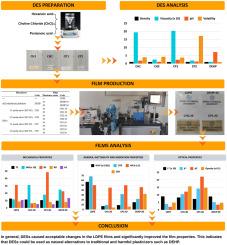
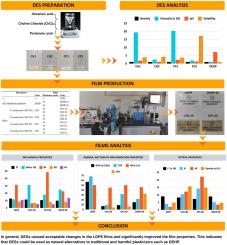
In this study, the performance of hydrophobic deep eutectic solvents (HbDESs) as plasticizers for low-density polyethylene (LDPE) films was investigated, and the results were compared with those of di(2-ethylhexyl) phthalate (DEHP) plasticizers. DESs were produced by mixing choline chloride (ChCl) (hydrogen bond acceptor, HBA) with hexanoic acid (HA) and pentanoic acid (PA) as hydrogen bond donors (HBDs) at 1:1 and 1:2 M ratios. The prepared DESs were added to LDPE at two different ratios based on polymer weight (10 % and 30 %), and twin-screw extruder was used for film production. The densities of the plasticizers were determined to be 1 g/cm3 and below, viscosities ranging from 11 to 203 mPa s, the pH was above 1 and the volatility exceeded 0.9 %. FTIR and DSC analyses indicated that bonding interactions between HBA and HBD were established, confirming the successful production of DESs. After adding the plasticizers to the LDPE films at specific rates, the films were characterized based on mechanical, barrier, optical, thermal, molecular bond, microstructural, water behavior properties, and overall migration (OM) analyses. Among the films, the first three with the best properties (CH1:30, CP1:30, and DEHP:30) were identified using the multicriteria decision hierarchy technique (TOPSIS). When comparing the films with DESs to the control group and those with DEHP, significantly better results were achieved in terms of the elongation, barrier performance, light transmittance, and OM values. These findings demonstrate the potential of HbDESs as effective plasticizers in LDPE films.
期刊介绍:
Polymer is an interdisciplinary journal dedicated to publishing innovative and significant advances in Polymer Physics, Chemistry and Technology. We welcome submissions on polymer hybrids, nanocomposites, characterisation and self-assembly. Polymer also publishes work on the technological application of polymers in energy and optoelectronics.
The main scope is covered but not limited to the following core areas:
Polymer Materials
Nanocomposites and hybrid nanomaterials
Polymer blends, films, fibres, networks and porous materials
Physical Characterization
Characterisation, modelling and simulation* of molecular and materials properties in bulk, solution, and thin films
Polymer Engineering
Advanced multiscale processing methods
Polymer Synthesis, Modification and Self-assembly
Including designer polymer architectures, mechanisms and kinetics, and supramolecular polymerization
Technological Applications
Polymers for energy generation and storage
Polymer membranes for separation technology
Polymers for opto- and microelectronics.



 京公网安备 11010802042870号
京ICP备2023020795号-1
京公网安备 11010802042870号
京ICP备2023020795号-1

 分享
分享
 求助内容:
求助内容: 应助结果提醒方式:
 扫码关注我们
