{"title":"Engineering design and computational particle fluid dynamics simulation of a 10 MWth CH4-fueled chemical looping combustion reactor","authors":"Yongqi Tong, Jie Cheng, Xi Chen, Haibo Zhao","doi":"10.1016/j.powtec.2025.120862","DOIUrl":null,"url":null,"abstract":"<div><div>The chemical looping combustion (CLC) technology, known for its capability to achieve in-situ CO<sub>2</sub> separation during fuel combustion, is recognized as one of the most promising carbon capture technologies currently available. CLC technology has recently transitioned from laboratory research to engineering demonstration. To explore the characteristics of the CLC process, an engineering design methodology is established, leading to the design of a 10 MW<sub>th</sub> CLC unit. A comprehensive computational particle fluid dynamics (CPFD) simulation of this 10 MW<sub>th</sub> CLC reactor is conducted at full scale, offering detailed hydrodynamic information on gas-solid two-phase reactive flow within the reactor. Pressure balance, flow patterns, and the distribution of various gas components are sequentially analyzed. Crucial multiphase-flow parameters, including gas phase distribution, solid phase distribution, and pressure distribution within the reactor, are acquired, supplementing important details that are usually challenging to obtain in experiments. The results reveal that an automatically-established pressure balance within the system, with the solid circulation rate at the air reactor outlet of 113 kg/s, is attained. The methane conversion fluctuates between 80 and 90 %, achieving a carbon capture efficiency of over 95 %. The lower loop-seal effectively isolates the atmospheres between the air reactor and fuel reactor. The simulation results align well with these of the engineering design, validating the reliability of the engineering design.</div></div>","PeriodicalId":407,"journal":{"name":"Powder Technology","volume":"457 ","pages":"Article 120862"},"PeriodicalIF":4.6000,"publicationDate":"2025-05-15","publicationTypes":"Journal Article","fieldsOfStudy":null,"isOpenAccess":false,"openAccessPdf":"","citationCount":"0","resultStr":null,"platform":"Semanticscholar","paperid":null,"PeriodicalName":"Powder Technology","FirstCategoryId":"5","ListUrlMain":"https://www.sciencedirect.com/science/article/pii/S0032591025002578","RegionNum":2,"RegionCategory":"工程技术","ArticlePicture":[],"TitleCN":null,"AbstractTextCN":null,"PMCID":null,"EPubDate":"2025/3/5 0:00:00","PubModel":"Epub","JCR":"Q2","JCRName":"ENGINEERING, CHEMICAL","Score":null,"Total":0}
引用次数: 0
Abstract
The chemical looping combustion (CLC) technology, known for its capability to achieve in-situ CO2 separation during fuel combustion, is recognized as one of the most promising carbon capture technologies currently available. CLC technology has recently transitioned from laboratory research to engineering demonstration. To explore the characteristics of the CLC process, an engineering design methodology is established, leading to the design of a 10 MWth CLC unit. A comprehensive computational particle fluid dynamics (CPFD) simulation of this 10 MWth CLC reactor is conducted at full scale, offering detailed hydrodynamic information on gas-solid two-phase reactive flow within the reactor. Pressure balance, flow patterns, and the distribution of various gas components are sequentially analyzed. Crucial multiphase-flow parameters, including gas phase distribution, solid phase distribution, and pressure distribution within the reactor, are acquired, supplementing important details that are usually challenging to obtain in experiments. The results reveal that an automatically-established pressure balance within the system, with the solid circulation rate at the air reactor outlet of 113 kg/s, is attained. The methane conversion fluctuates between 80 and 90 %, achieving a carbon capture efficiency of over 95 %. The lower loop-seal effectively isolates the atmospheres between the air reactor and fuel reactor. The simulation results align well with these of the engineering design, validating the reliability of the engineering design.
期刊介绍:
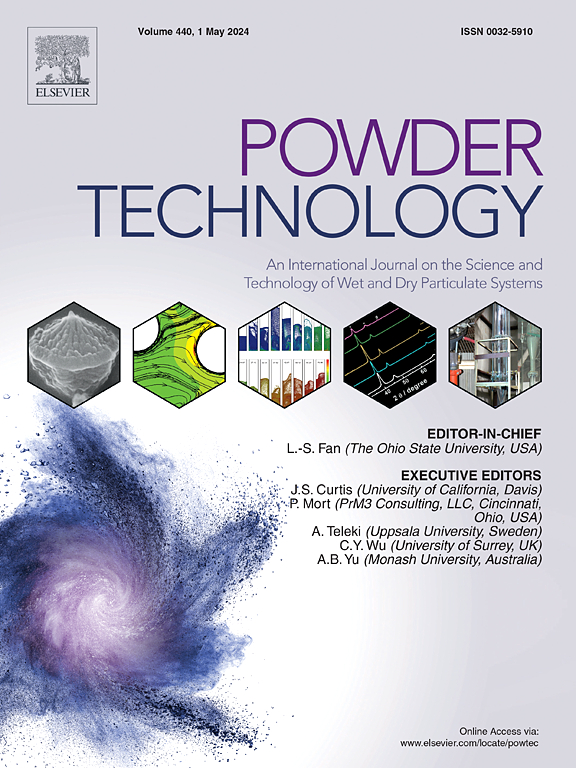
Powder Technology is an International Journal on the Science and Technology of Wet and Dry Particulate Systems. Powder Technology publishes papers on all aspects of the formation of particles and their characterisation and on the study of systems containing particulate solids. No limitation is imposed on the size of the particles, which may range from nanometre scale, as in pigments or aerosols, to that of mined or quarried materials. The following list of topics is not intended to be comprehensive, but rather to indicate typical subjects which fall within the scope of the journal's interests:
Formation and synthesis of particles by precipitation and other methods.
Modification of particles by agglomeration, coating, comminution and attrition.
Characterisation of the size, shape, surface area, pore structure and strength of particles and agglomerates (including the origins and effects of inter particle forces).
Packing, failure, flow and permeability of assemblies of particles.
Particle-particle interactions and suspension rheology.
Handling and processing operations such as slurry flow, fluidization, pneumatic conveying.
Interactions between particles and their environment, including delivery of particulate products to the body.
Applications of particle technology in production of pharmaceuticals, chemicals, foods, pigments, structural, and functional materials and in environmental and energy related matters.
For materials-oriented contributions we are looking for articles revealing the effect of particle/powder characteristics (size, morphology and composition, in that order) on material performance or functionality and, ideally, comparison to any industrial standard.





 京公网安备 11010802042870号
京ICP备2023020795号-1
京公网安备 11010802042870号
京ICP备2023020795号-1

 分享
分享
 求助内容:
求助内容: 应助结果提醒方式:
 扫码关注我们
